Stanford's campus is open to visitors and sits right next to downtown Palo Alto. This guide covers how to get there, where to park, how tours work and what to see first.
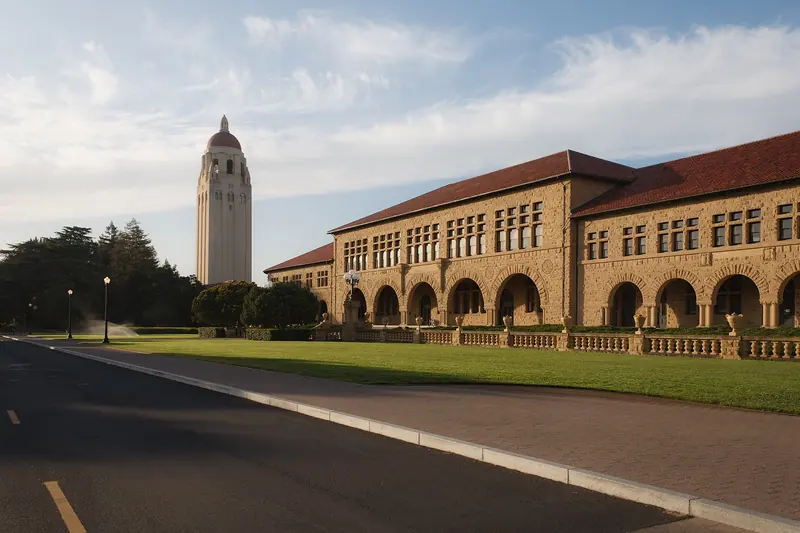
Stanford University is the biggest reason many people visit Palo Alto. The campus begins just across El Camino Real from downtown and its sandstone arcades, gold mosaics and long palm-lined drive feel nothing like a typical office park town. You do not need a tour, a ticket or a Stanford connection to see the highlights. You only need a plan for getting there and parking, since that is where most visitors run into trouble.
This hub covers the practical side of a campus visit: transit, parking, the Visitor Center and admission tours, the sights worth seeing first and what changes on football game days. It also clears up a common question about where Stanford ends and Palo Alto begins.
Leland Stanford, the railroad tycoon and former governor, began buying land along San Francisquito Creek in 1876 for a horse farm. He named it the Palo Alto Stock Farm after the old redwood on the creek. In 1878 the photographer Eadweard Muybridge used the farm's track to prove that a galloping horse lifts all four hooves off the ground.
After the Stanfords' only son died in 1884, they turned the farm into a university in his memory. It opened to students on October 1, 1891. The horses are long gone, but students and alumni still call the campus the Farm. You will see the nickname on sweatshirts, in alumni magazines and in the names of campus programs. For the full story, read our history of Palo Alto.
Stanford vs Palo Alto: where the line falls
Stanford is not part of the city of Palo Alto, even though most people treat them as one place. According to Stanford Facts, the university's land covers 8,353 acres spread across six local jurisdictions.
Jurisdiction
Stanford acres
Unincorporated Santa Clara County
3,994
Unincorporated San Mateo County
2,603
City of Palo Alto
1,292
Woodside
226
Menlo Park
142
Portola Valley
95
Los Altos Hills
1
The academic core, including the Main Quad, sits on unincorporated county land with its own mailing address: Stanford, CA 94305. Stanford's own Department of Public Safety patrols it. The Stanford land inside Palo Alto includes two places visitors often assume are on campus. One is Stanford Shopping Center, about 70 acres with more than 140 stores. The other is Stanford Research Park, about 700 acres that hold around 150 companies. In practice the line is invisible. You can walk from University Avenue to the Main Quad without noticing when you leave the city.
Advertisement
Getting there
By Caltrain and the Marguerite shuttle
The easiest way in is by train. Take Caltrain to the Palo Alto station at the foot of University Avenue. Next to it, the Palo Alto Transit Center is a stop for the Marguerite, Stanford's free shuttle. According to Stanford Transportation, Marguerite buses are open to the public with no ID required. They run Monday through Friday year-round, except university holidays. All buses are wheelchair accessible and carry bike racks. Routes and timetables are on the shuttle lines page.
On weekends, when the shuttle does not run, walking is the simple answer. From the station it is about a mile up Palm Drive to the Oval and the Main Quad. The walk under the palms is part of the experience. Our getting to Palo Alto page covers Caltrain from San Francisco and San Jose.
By car
Palm Drive meets El Camino Real at the edge of downtown and leads straight to the Oval. Campus roads are shared with thousands of cyclists. Stanford counts about 10,400 bikes on campus on a typical weekday, so take roundabouts and crosswalks slowly.
By bike
Cycling is how most people get around campus. Bring your own or look for rentals in town. Lock your bike at a rack, not to a railing or tree.
Visitor parking
Parking is the part of a Stanford visit that trips people up. Visitor and hourly spaces are in designated areas and all payment is contactless through ParkMobile. Every space has a zone number on a green sign. You can pay in three ways:
Use ParkMobile's zone parking page in a browser. No app or account is needed.
Call ParkMobile's automated pay-by-phone line, posted on the signs.
Download the ParkMobile app and set it up before you arrive.
Rates are set by the hour with a daily maximum and each payment adds a small transaction fee. Payments are not refundable, so buy only the time you need. The Visitor Parking layer on Stanford's searchable campus map shows zone numbers, paid hours and time limits for each lot. Full details are on the visitor parking page. International visitors can pay online by choosing Other for country and entering 00000 as the billing ZIP code. The free Stanford Visitor Wi-Fi works for this.
The Visitor Center and tours
The Stanford Visitor Center is at 295 Galvez Street, near the stadium. Visitor Information Services lists it as generally open Monday through Friday from 9 a.m. to 5 p.m., except most federal holidays and some breaks between academic quarters. Check visit.stanford.edu for closures.
Guided campus tours are run by the Office of Undergraduate Admission and are aimed at prospective students and their families. They run several times on most weekdays and on selected Saturdays during the spring and fall quarters. You register online. Registered self-guided visitors get priority for any spare spots. Admission also runs information sessions and live virtual tours for people who cannot come in person.
Good to know about tours
Tours pause between quarters. In 2026 none ran from August 29 to September 17, though the public could still walk the campus.
Group requests through commercial tour operators are not granted. Guided groups are limited to qualifying high schools, community colleges and college access nonprofits.
Middle school and elementary groups use self-guided materials.
For self-guided visits, Stanford points visitors to its mobile app and its virtual tours.
If you are not a prospective student, a self-guided walk is often the better choice anyway. Private operators also run Stanford and Silicon Valley tours that start in San Francisco.
Advertisement
Top things to see
The core of campus is compact. These sights are all within about a 15 minute walk of the Oval.
The Main Quad: Sandstone arcades from the founding years, class plaques in the walkway and Rodin's Burghers of Calais in Memorial Court.
Memorial Church: Jane Stanford's 1903 church with its gold facade mosaic and five organs.
Hoover Tower: A 285-foot landmark with an observation deck, closed from August 14, 2026 to January 25, 2027 according to the Hoover Institution.
Cantor Arts Center: A free museum with world art and close to 200 works by Rodin, plus the outdoor Rodin Sculpture Garden.
Anderson Collection: A free museum of postwar American art next to the Cantor.
The Dish: A 3.5 mile paved trail in the foothills above campus, open during daylight hours.
Our attractions guide covers sights in town too, such as the HP Garage and El Palo Alto.
Game days
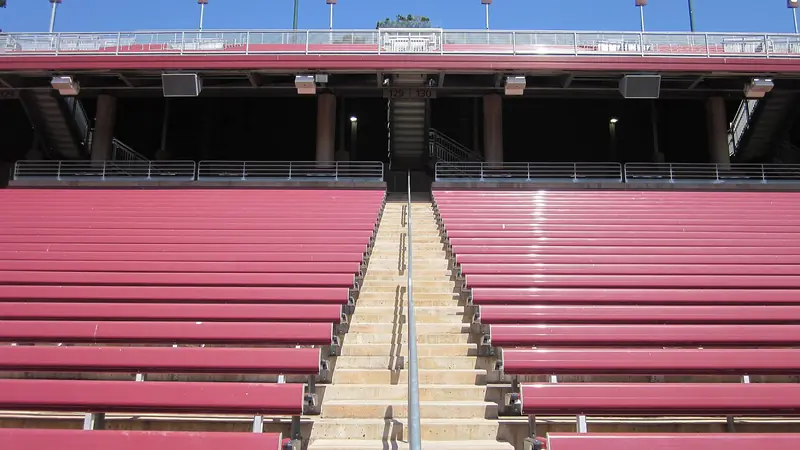
Stanford Stadium seats 50,424. The original stadium opened in 1921 and was rebuilt in 2005 and 2006. It hosted Super Bowl XIX in January 1985 and matches during the 1994 FIFA World Cup. Home football games bring tens of thousands of fans, heavy traffic on the roads around campus and special event parking near the stadium.
If you are not going to the game, avoid driving to campus on those days. Hoover Tower closes on home football game days. If you are going, check the schedule and parking information on gostanford.com and arrive by Caltrain if you can.
Stanford Stadium seats just over 50,000 fans on game days. Photo: BrokenSphere, Wikimedia Commons, CC BY 3.0
A half-day plan
Arrive by Caltrain and ride the Marguerite or walk up Palm Drive to the Oval.
Walk through Memorial Court into the Main Quad and visit Memorial Church if it is open.
Head east to Hoover Tower for the free ground-floor exhibits, or the deck when it reopens.
Walk north to the Cantor Arts Center, the Anderson Collection and the Rodin garden.
Have lunch at the Cantor's cafe or return to University Avenue for more choice.
With an extra day you can hike the Dish at sunrise and explore downtown Palo Alto at a slower pace. Visiting families and conference guests often stay close to campus, so compare hotels near Stanford early during graduation and big game weekends.
Yes. Stanford's outdoor spaces are open to the public and visitors can walk the Main Quad, Palm Drive and the Rodin garden on their own. Some buildings, labs and residences are restricted to the Stanford community.
Is Stanford in Palo Alto?
Not exactly. Most of the campus is unincorporated land in Santa Clara and San Mateo counties with the mailing address Stanford, CA 94305. About 1,292 acres of Stanford land, including Stanford Shopping Center and Stanford Research Park, lie inside Palo Alto city limits.
How do I get to Stanford from the Palo Alto Caltrain station?
Take the free Marguerite shuttle from the Palo Alto Transit Center beside the station. It runs on weekdays and is open to the public with no ID needed. You can also walk about a mile up Palm Drive to the Oval.
How much does parking cost at Stanford?
Visitor parking is paid by the hour through ParkMobile, with rates set by Stanford Transportation. Look for the zone number on the green sign in your space. Check transportation.stanford.edu for current rates and restrictions.
Why is Stanford called the Farm?
The university was built on Leland Stanford's Palo Alto Stock Farm, where he bred and trained horses. Students and alumni have called the campus the Farm ever since.