On this page
Palo Alto punches above its weight in the arts because it has two engines. The city itself has supported culture for decades through its art center, theaters, libraries and public art program. Next door, Stanford University runs world-class museums and concert halls that are open to everyone and often free. Put them together and a town of fewer than 70,000 people has more to see on a given weekend than many cities several times its size.
This hub covers the big institutions, the smaller venues and the festivals. Hours and programs change often, so we link to each official site. For a day-by-day view, see our events and festivals calendar.
Stanford's free museums
Cantor Arts Center
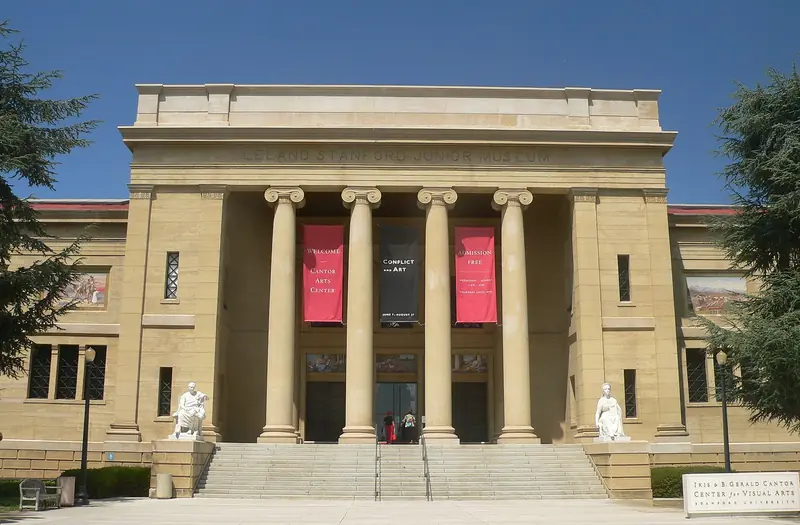
The Cantor Arts Center at 328 Lomita Drive is the oldest and largest museum on campus. It grew out of the Leland Stanford Junior Museum, which opened in the 1890s. Its collection spans thousands of years and every continent, from ancient objects to contemporary photography. Outside, the Rodin Sculpture Garden displays bronzes including The Gates of Hell. Admission is always free.
The museum is open five days a week. It closes on Tuesdays and Wednesdays and stays open late on Thursdays. Our full guide to the Cantor Arts Center and Rodin Garden covers highlights and tips.

Anderson Collection at Stanford
A short walk away at 314 Lomita Drive, the Anderson Collection holds a major collection of postwar American art. It opened in September 2014 with 121 works by 86 artists given by Harry "Hunk" Anderson, Mary Margaret "Moo" Anderson and their daughter Mary Patricia "Putter" Anderson Pence. Expect Jackson Pollock, Mark Rothko, Willem de Kooning, Joan Mitchell, Clyfford Still and Wayne Thiebaud. Admission is free.
The building was designed by Richard Olcott of Ennead Architects, who also designed Bing Concert Hall. Together with the Cantor and the McMurtry Building for art and art history, it forms an arts district near the main entrance to campus off Palm Drive. Plan on half a day if you want to see both museums properly. Learn more about the campus in our visiting Stanford guide.
Palo Alto Art Center and public art
The city's own arts hub is the Palo Alto Art Center at 1313 Newell Road, next to Rinconada Park. It was created in 1971 and is owned and operated by the City of Palo Alto, with support from the nonprofit Palo Alto Art Center Foundation. It reaches about 150,000 people a year. The center runs changing exhibitions in its gallery, adult and youth classes in painting and ceramics, summer camps and family days.
A few annual events draw big crowds. The Clay and Glass Festival in July brings ceramic and glass artists to the grounds. The Great Glass Pumpkin Patch in the fall fills the lawn with hand-blown glass pumpkins. A studio holiday sale follows in winter. Gallery hours run most of the week, with shorter hours on weekends. Check the visit page before you go.
The Public Art Program
Palo Alto's Public Art Program manages a collection of about 100 permanently sited works and more than 200 portable works. The program commissions art for city projects and oversees a city rule that requires public art in private development. The Public Art Commission advises on what gets chosen and where it goes.
The collection includes work by Nathan Oliveira, Fletcher Benton, Betty Gold, Gene Flores and Bruce Beasley. Recent additions include Peter Wegner's Space, Time & Palo Alto and Cameron Moberg's Generations, both from 2024. Nigel Sussman's Palo Alto Discoveries followed in 2026. There is also land art out at the Baylands. The city publishes an online map, which makes a self-guided public art walk easy. Murals, small grants and an artist residency round out the program.
Theater: the Lucie Stern and its companies
The center of live theater in Palo Alto is the Lucie Stern Community Center at 1305 Middlefield Road. The Spanish Revival complex was designed by local architect Birge Clark in the 1930s. Its roughly 400-seat theater hosts three established companies.
- TheatreWorks Silicon Valley was founded in Palo Alto in 1970. It won the Regional Theatre Tony Award in 2019 and is known for new musicals and new plays as well as classics. It splits each season between the Lucie Stern Theatre and the Mountain View Center for the Performing Arts on Castro Street. Its New Works Festival is a chance to see shows in development.
- Palo Alto Players was founded in 1931 and is one of the oldest community theater companies on the Peninsula. Its 2026 to 2027 season includes The Addams Family from October 30 to November 15, 2026, Clue in January 2027, Mary Poppins in spring and On Golden Pond in June.
- West Bay Opera is a long-running opera company now in its 71st season. The 2026 to 2027 lineup is Mozart's The Abduction from the Seraglio, Verdi's Don Carlos and Puccini's Turandot.
The city's Palo Alto Children's Theatre also uses the Lucie Stern complex. It stages full productions with young actors and is a rite of passage for many local kids. Families should also see our guide to Palo Alto with kids.
Film: the Stanford Theatre
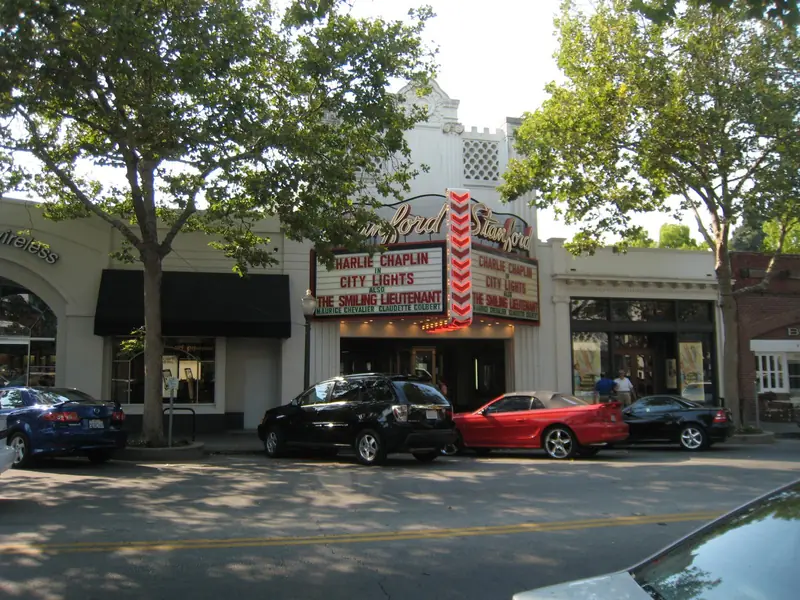
The Stanford Theatre at 221 University Avenue is one of the best places in the country to see old movies the way they were meant to be seen. It opened on June 9, 1925, in a neoclassical design with Persian and Moorish touches by the architects Weeks and Day. For decades it was Palo Alto's main movie house.
In 1987 the David and Lucile Packard Foundation bought the theater and restored it. It reopened in 1989 with The Wizard of Oz. Another refresh in 2017 brought new paint, carpet and restored seats. The nonprofit Stanford Theatre Foundation runs it today.
The programming sticks to classic films, roughly from the silent era through about 1970. Series are built around stars, directors and genres, often as double features. A Mighty Wurlitzer organ is played live during intermissions and accompanies silent films. In late October and early November 2026 the theater is showing Mary Poppins paired with The Wizard of Oz. Check the website for the current schedule and ticket details.

Music: Stanford Live, Bing and Frost
Stanford Live is the university's presenting organization and it books touring orchestras, chamber groups, jazz, dance and world music. Its main home is Bing Concert Hall, which opened in January 2013. The 842 seats are arranged in vineyard-style terraces around the stage, so no one sits far from the performers. Acoustician Yasuhisa Toyota tuned the hall and Richard Olcott of Ennead Architects designed it. A smaller underground space called The Studio hosts cabaret and club-style shows.
Frost Amphitheater is the big outdoor venue. It opened in 1937 and holds about 8,000 people on a grassy bowl surrounded by trees. The Grateful Dead played there more than a dozen times in the 1980s and it has hosted commencement ceremonies, symphony concerts and festivals. Buy tickets only through the official channels linked from Stanford Live.
Libraries
The Palo Alto City Library has five branches: Mitchell Park, Rinconada, Downtown, College Terrace and the Children's Library. Mitchell Park is the largest and shares a building with a community center. Rinconada, the former main library, sits beside the Art Center and Rinconada Park. The library runs author talks, story times and classes for all ages, many supported by the Friends of the Palo Alto Library.
Stanford's libraries are primarily for students and faculty, though some exhibitions in Green Library are open to visitors. Check access rules on the Stanford Libraries site before you go.
History and heritage
Palo Alto does not yet have a large history museum. The city bought the Roth Building at 300 Homer Avenue in 2000 with the plan of making it the home of a Palo Alto History Museum and the city archives. Restoration took years because of funding. The opening was postponed in January 2026 after water leaks were found. No new date had been set by late October 2026. Our Palo Alto History Museum page tracks its status.
In the meantime, history is easy to see on foot. Professorville, the Ramona Street Architectural District and the HP Garage are all within walking distance of downtown. Our history of Palo Alto pulls the story together and the HP Garage guide covers the most famous address in town.
Bookstores
Independent bookstores are part of the local culture.
- Bell's Books, 536 Emerson St., has served Palo Alto since 1935. It sells new, used and rare books, including signed first editions and fine bindings, from a stock of about 350,000 titles.
- Books Inc. has a Palo Alto store at 74 Town & Country Village that sells new books for adults and kids.
- Kepler's is just over the border in Menlo Park. It runs a busy calendar of author talks through its nonprofit, often with well-known writers.
Festivals and annual events
Palo Alto's arts calendar has a few anchors. The Palo Alto Festival of the Arts takes over University Avenue each year in late summer with artists' booths, food and street painting. The May Fete children's parade down University Avenue is a spring tradition that dates back about a century. The Art Center's Clay and Glass Festival comes in July and the Great Glass Pumpkin Patch in the fall. The city has also run a Code:ART festival that mixes digital art and technology.
Exact dates change from year to year. Our events page lists confirmed dates as they are announced.
Planning a culture day
- Start at the Cantor Arts Center when it opens, then walk to the Anderson Collection.
- Have lunch downtown on University Avenue or back on campus.
- Browse Bell's Books on Emerson Street in the afternoon.
- Catch an evening double feature at the Stanford Theatre or a show at the Lucie Stern Theatre.
Everything except the Lucie Stern is within a short walk or a free Stanford Marguerite shuttle ride of the Palo Alto Caltrain station. For dinner ideas, see food and drink.
In this section
Frequently asked questions
Are the Stanford museums free?
Yes. The Cantor Arts Center and the Anderson Collection at Stanford are both free and do not require reservations for individual visitors. Each is closed some days of the week, so check their sites before you go. Parking on campus is paid.
What does the Stanford Theatre show?
The Stanford Theatre on University Avenue specializes in classic Hollywood films made between about 1910 and 1970. It runs themed series devoted to stars, directors and genres. A Wurlitzer organ is played live during intermissions and for silent films.
Where does TheatreWorks Silicon Valley perform?
TheatreWorks splits its season between the Lucie Stern Theatre at 1305 Middlefield Road in Palo Alto and the Mountain View Center for the Performing Arts at 500 Castro Street. The company was founded in 1970 and won the Regional Theatre Tony Award in 2019.
What is there to do in Palo Alto at night?
Catch a classic film at the Stanford Theatre, a play at the Lucie Stern Theatre or a concert at Bing Concert Hall or Frost Amphitheater on the Stanford campus. Downtown restaurants and bars along University Avenue fill the gaps before and after a show.
Is there a history museum in Palo Alto?
The city bought the Roth Building at 300 Homer Avenue in 2000 to house a Palo Alto History Museum and the city archives. In January 2026 the opening was postponed after water leaks, with no new date set, so check the museum's website for current exhibits and programs before planning a visit.