Most of the world's best known startups raised money from a short list of firms based within a few miles of downtown Palo Alto. Apple, Google, Facebook and thousands of smaller companies all took checks from investors who work along Sand Hill Road or on University Avenue. This guide explains how that money works in plain English, who the main players are and how founders actually get in the door.
A quick note on sources. Fund sizes and returns change fast and are often reported loosely. We have left them out. Every firm named below was checked against its own website or recent reporting in 2026.
How venture capital works
A venture capital firm is a small team that manages pools of money called funds. The money comes from limited partners, usually pension funds, university endowments, foundations and wealthy families. The firm's partners pick startups, invest in exchange for shares and help the companies grow. A typical fund runs for about ten years.
The math is lopsided. Most startups fail or return little. A few succeed wildly. A venture fund only works if one or two investments return more than the whole fund, which is why VCs look for companies that could become very large. That explains questions that can feel strange to first time founders, such as how big a market could get or what happens if everything goes right.
The stages of funding
Pre-seed and seed. The first outside money, often from angels, seed funds or accelerators. It pays for a prototype and the first hires.
Series A. The first big institutional round, usually led by a venture firm once the product has real users or revenue.
Series B and later. Growth rounds that fund hiring, sales and expansion. Growth funds and crossover investors join here.
Exit. Investors get their money back when the company is acquired or goes public.
Each round sells part of the company. Founders give up a share of ownership in return for cash and help. Terms such as valuation, board seats and liquidation preferences matter as much as the headline number. Founders should always have a startup lawyer read a term sheet before signing.
Sand Hill Road, just next door
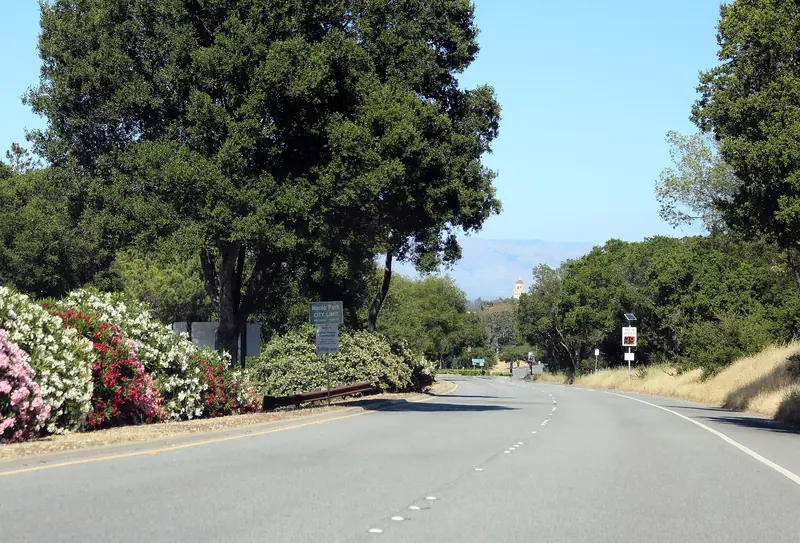
Sand Hill Road is a 5.6 mile road that begins at El Camino Real by Stanford Shopping Center and climbs west through Stanford land and Menlo Park toward Woodside. The stretch near Interstate 280 holds low office buildings set among oaks and parking lots. It does not look like a financial district. That is part of the appeal.
Firms began opening offices there in the early 1970s. Kleiner Perkins and Sequoia Capital were both founded in 1972 and the road soon became shorthand for the whole industry. The Rosewood Sand Hill hotel, a 121 room property on 16 acres about a mile west of Stanford, is a common spot for breakfast meetings and visiting investors.
Sand Hill Road is technically outside Palo Alto, but it is a five to ten minute drive from downtown. Most founders who pitch there are based in Palo Alto, Menlo Park or San Francisco. Public transit along the road is limited, so most people drive, take a rideshare or bike.
Sand Hill Road in Menlo Park, home to many of the best known venture firms. Photo: Coolcaesar, Wikimedia Commons, CC BY-SA 4.0
Advertisement
Firms on Sand Hill Road and in Palo Alto
This is not a ranking. It is a short list of firms whose offices we could confirm, with a line or two of history. Many more firms operate in the area.
Firm
Local office
Background
Accel
500 University Avenue, Palo Alto
Downtown Palo Alto headquarters. Also has a San Francisco office.
Sequoia Capital
Menlo Park
Founded in 1972 by Don Valentine. Early backer of Atari, Apple, Cisco and Google.
Kleiner Perkins
Menlo Park
Founded in 1972. Co-founder Eugene Kleiner was one of the eight who left Shockley to start Fairchild Semiconductor.
Andreessen Horowitz
Sand Hill Road, Menlo Park
Long based at 2865 Sand Hill Road. Leased new space at 2400 to 2450 Sand Hill Road with occupancy starting in 2026.
Greylock
2550 Sand Hill Road, Menlo Park
Also has a San Francisco office.
Lightspeed Venture Partners
2200 Sand Hill Road, Menlo Park
Also has offices in San Francisco and New York.
Mayfield
Sand Hill Road, Menlo Park
Founded in 1969. Sponsors the Mayfield Fellows Program at Stanford.
Pear VC
Menlo Park
Pre-seed and seed firm founded in 2013. Runs the PearX program.
Sequoia
Sequoia is the firm most closely tied to the region's history. Don Valentine founded it in 1972. It backed Atari in the mid 1970s and was one of Apple's first investors in 1978. In 2023 Sequoia announced it would split its global business into three separate firms. The China business became HongShan, the India and Southeast Asia business became Peak XV Partners and the United States and Europe business kept the Sequoia name.
Kleiner Perkins
Kleiner Perkins was founded in 1972 by Eugene Kleiner and Tom Perkins. Frank Caufield and Brook Byers joined soon after. Its early bets included Genentech and Tandem Computers. Later it backed Netscape, Amazon and Sun Microsystems. The link to Fairchild matters. Eugene Kleiner was one of the engineers who walked out of Shockley Semiconductor in 1957, so the firm connects the chip era directly to the venture era.
Founders Fund and the PayPal story
Founders Fund is based in San Francisco, not Sand Hill Road, but its roots run through Palo Alto. Peter Thiel, Ken Howery and Luke Nosek started it in 2005 after their time at PayPal, which grew up in downtown Palo Alto. The firm made the first institutional investments in SpaceX and Palantir. It is a good example of how one successful Palo Alto company can seed a whole new generation of investors.
General Catalyst
General Catalyst was founded in Cambridge, Massachusetts, in 2000 and is still headquartered there. Its Bay Area office is in San Francisco. We mention it because founders often assume every major firm sits on Sand Hill Road. Many now split time between Menlo Park and San Francisco or work mostly from the city.
Angels and seed funds
Before a startup is ready for a venture firm, it usually raises from angels. These are individuals, often former founders or executives, who invest their own money. Checks range from a few thousand dollars to a few hundred thousand. Angels often move faster than firms and care more about the founder than the spreadsheet.
The Band of Angels, founded in 1994, calls itself the first organized high-tech angel group in the United States. It has more than 150 members, mostly current and former tech executives. The group screens dozens of startups each month and invites three to present at its monthly Silicon Valley meeting. Founders apply through its website.
Seed funds fill the gap between angels and larger firms. Pear VC, based in Menlo Park, focuses on pre-seed and seed rounds and runs PearX, a 12 week program for early founders. Many large firms also now run their own seed programs, so the line between seed fund and venture firm has blurred.
How founders approach investors
Cold email works less often than people hope. Here is the approach most local founders use:
Research the partner, not just the firm. Each partner has a focus. Read their recent investments and posts.
Get a warm introduction. The strongest intros come from founders the investor has backed. Lawyers, angels and accelerator staff also make good connectors.
Send a short email. Three or four sentences on what you build, who it is for and what traction you have, plus a short deck.
Run a tight process. Schedule first meetings within a couple of weeks so interest builds at the same time.
Follow up with data. Investors remember founders who send clear monthly updates, even before they invest.
Good to know
Venture offices are private. Never show up without an appointment.
Many first meetings now happen on video. In-person pitches usually come at the partner meeting stage.
Allow extra driving time at rush hour, when traffic builds near Interstate 280 and El Camino Real.
Coffee meetings downtown are common. See our coffee guide for spots near University Avenue.
Advertisement
Stanford's role
Stanford is the reason so many investors cluster here. The university turns out founders every year and many firms recruit partners from its alumni. Its technology licensing office licenses research to startups. The best known case is Google, whose search ranking method came out of a Stanford project and was licensed by the university.
StartX, Stanford's nonprofit accelerator, takes no equity and charges no fees. It has held investor showcases for a vetted audience of active angels and firm decision makers. The Stanford Technology Ventures Program runs the Mayfield Fellows Program, which pairs a dozen students each year with a venture capitalist mentor and a paid startup internship. Mayfield, the firm, sponsors it. Read more on our Stanford visitor guide and our startups hub.
Visiting for a week of pitches
Founders who fly in for meetings usually base themselves in downtown Palo Alto or Menlo Park. From there Sand Hill Road, Stanford Research Park and University Avenue are all within a 15 minute drive. Compare hotels near Sand Hill Road well in advance because rooms fill up around Stanford events. If you land at SFO or San Jose, a prebooked airport transfer saves time on the first day. Our getting here and where to stay guides cover the details. Leave an afternoon free to walk past the HP Garage and the other famous tech addresses downtown. It is a good reminder that most of these firms exist because of companies that started in a garage or a rented office a few blocks away.
Mostly no. Sand Hill Road begins at El Camino Real next to Stanford Shopping Center in Palo Alto and runs west through Stanford land and Menlo Park toward Woodside. The famous cluster of venture firm offices is in the Menlo Park stretch near Interstate 280.
Which venture capital firms have offices in Palo Alto?
Accel lists its Silicon Valley headquarters at 500 University Avenue in downtown Palo Alto. Many other well known firms such as Sequoia, Kleiner Perkins, Greylock and Lightspeed are a few minutes away on Sand Hill Road in Menlo Park.
Can I just walk into a VC office on Sand Hill Road?
No. Venture firm offices are private and meetings are by appointment. The best way to get a meeting is a warm introduction from a founder, lawyer or angel the firm already trusts.
What is the difference between an angel investor and a venture capitalist?
An angel invests personal money, usually in very early companies and in smaller checks. A venture capitalist invests money raised from outside limited partners such as pension funds and endowments. VCs usually write larger checks and often take a board seat.
How does Stanford help founders raise money?
Programs like StartX connect founders with investors. The Stanford Technology Ventures Program pairs Mayfield Fellows with venture capital mentors. Stanford also licenses research to startups through its technology licensing office.