On this page
Palo Alto is a small city with an outsized list of sights. Most of them fall into two clusters. The first is the Stanford campus, which sits just west of downtown and holds the big-ticket landmarks: Hoover Tower, Memorial Church, the Main Quad and two free art museums. The second is the city itself, where you find the HP Garage, a thousand-year-old redwood, a classic movie palace and one of the best small children's museums in the Bay Area.
This page gives you a short, honest take on each major attraction, with links to deeper guides where we have them. Hours and closures change often at university sites, so we point you to the official page for anything time sensitive. If you have one day, the plan near the end shows how to string the highlights together without a car.

Stanford campus sights
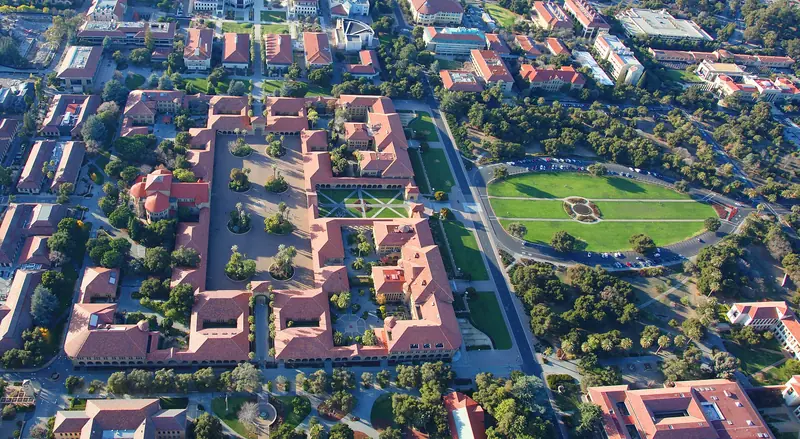
Stanford is the reason most visitors come. The university opened in 1891 on Leland Stanford's horse farm, which is why students still call it the Farm. The campus is open to walk around and the core is compact. From the Oval at the top of Palm Drive you can reach the Main Quad, Memorial Church, Hoover Tower and the Cantor Arts Center in a few minutes on foot.
The Main Quad is the centerpiece. Its sandstone arcades and red tile roofs date to the founding years and the plan came from Frederick Law Olmsted and the Boston firm Shepley, Rutan and Coolidge. Walk through Memorial Court to see Rodin's Burghers of Calais at ground level, then look down at the class plaques set into the arcade walkway. Our Main Quad guide includes a short walking route. For parking, shuttles and visitor center details, read visiting Stanford first.
Hoover Tower
At 285 feet, Hoover Tower is the tallest landmark for miles. It was finished in 1941 for Stanford's 50th anniversary and houses the Hoover Institution Library and Archives, which Herbert Hoover founded in 1919 with a $50,000 gift to collect records of the First World War. The observation deck sits 250 feet up and on clear days you can see across the campus to the bay and the foothills.
Plan ahead this season. The Hoover Institution lists the observation deck as closed from August 14, 2026 to January 25, 2027 and the tower as closed on weekends until that date. Exhibition galleries on the ground floor are free when the building is open. Our Hoover Tower guide covers tickets, the carillon and the best times to go once the deck reopens.
Cantor Arts Center, the Rodin garden and the Anderson Collection
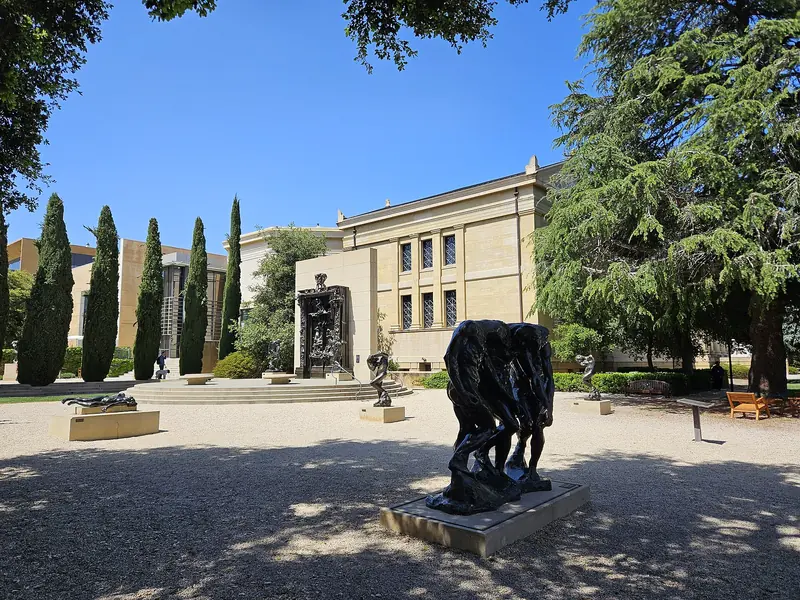
Stanford's museum began as the Leland Stanford Jr. Museum, which opened in 1894 in memory of the founders' son. It survived two major earthquakes and reopened in 1999 as the Iris and B. Gerald Cantor Center for Visual Arts. Today the Cantor Arts Center is free and covers art from many cultures and periods. Its collection includes one of the largest groups of Rodin bronzes outside Paris.
Out front, the B. Gerald Cantor Rodin Sculpture Garden holds about 20 monumental bronzes on roughly an acre, with The Gates of Hell at its eastern end. The museum lists the garden as open around the clock. Next door, the Anderson Collection shows postwar American painting and sculpture, including work by Rothko, Diebenkorn and Thiebaud. Its best-known painting, Jackson Pollock's Lucifer, is on loan to the Metropolitan Museum of Art until January 31, 2027. Both museums are free. Read our Cantor Arts Center guide and Anderson Collection guide for hours and planning tips.

Memorial Church
Jane Stanford built Memorial Church in memory of her husband Leland. It was dedicated in 1903. The facade mosaic glows gold at the head of the Main Quad and the interior is covered in Venetian mosaics, carved inscriptions and stained glass. The 1906 earthquake brought down its spire and the 1989 Loma Prieta earthquake closed it again for years. Five organs fill the church with sound during services and concerts.
The church is a working place of worship that welcomes visitors. Stanford's Office for Religious and Spiritual Life lists it as closed to visitors for maintenance from June 15 to October 31, 2026, with services continuing. See our Memorial Church guide for etiquette and tour details.
The HP Garage
A short walk from downtown, a modest wooden garage behind 367 Addison Avenue is where Bill Hewlett and Dave Packard started their company. They formalized their partnership on January 1, 1939. A coin toss settled the company name. Their first product was an audio oscillator. Walt Disney Studios bought eight of a modified model for work on Fantasia. The garage is California Historical Landmark No. 976 and carries the title Birthplace of Silicon Valley.
The property belongs to HP and is not open for tours. You view it from the sidewalk. It is on a quiet residential block, so keep your voice down and stay off the lawn. Our HP Garage guide explains the story and pairs it with a walk through Professorville.
El Palo Alto, the city's namesake tree
The city takes its name from El Palo Alto, a coast redwood on the bank of San Francisquito Creek. Members of the Portolá expedition camped nearby in 1769 and called it the tall stick. Arborists estimate the tree at roughly 1,080 years old. It stands in tiny El Palo Alto Park at Alma Street and Palo Alto Avenue, right beside the Caltrain tracks and a short walk from the Palo Alto station. There is no fee and you only need ten minutes. Read the full story in our Palo Alto history.
Baylands and the Dish
Two outdoor sights balance the museums. On the bay side of town, the Baylands Nature Preserve protects a large stretch of tidal marsh with flat levee trails and excellent birding, especially in fall and winter. Bring layers, since the wind off the water can be cool even on sunny days.
In the hills above campus, the Dish is a paved 3.5 mile trail that loops past a 150-foot radio antenna built in 1961. It is open during daylight hours only and dogs and bicycles are not allowed. Go early on summer mornings before the grassy slopes heat up.
Junior Museum and Zoo
Families should know about the Palo Alto Junior Museum and Zoo at 1451 Middlefield Road. It started in 1934 in the basement of an elementary school and reopened in 2021 after a full rebuild. The museum says it houses more than 60 animal species, along with hands-on science exhibits such as a solar system model, a rainbow tunnel and a dinosaur garden. It is open Tuesday through Sunday from 10 a.m. to 5 p.m. according to its official site, where you can also buy tickets. More ideas for children are in our guide to Palo Alto with kids.
Gamble Garden, the Stanford Theatre and University Avenue
Elizabeth F. Gamble Garden
Gamble Garden is a historic 2.5-acre garden at 1431 Waverley Street in Old Palo Alto. A nonprofit runs it and the grounds are free and open during daylight hours. Spring brings the best show of blossoms, but the formal beds and old house make a calm stop any time of year. Check gamblegarden.org for seasonal events.
Stanford Theatre
The Stanford Theatre at 221 University Avenue opened in 1925. The Packard Foundation bought it in 1987 and restored it and it reopened in 1989. It shows classic Hollywood films, mostly from 1910 to 1970. A Wurlitzer organ plays during intermissions. Programs run in themed series. The schedule is on stanfordtheatre.org.
University Avenue
University Avenue runs from the Caltrain station through downtown and becomes Palm Drive as it enters Stanford. The blocks between Alma Street and Middlefield Road are lined with cafes, restaurants and shops. Side streets such as Ramona and Bryant have Spanish Revival storefronts from the 1920s and 1930s. Startup fans can look for 165 University Avenue, the office building that housed early Google and PayPal. Our downtown guide has specific picks for eating and shopping.
A one-day plan without a car
- Morning: Take Caltrain to Palo Alto. Visit El Palo Alto beside the tracks, then ride the free Marguerite shuttle or walk up Palm Drive to campus.
- Late morning: Walk the Main Quad, step into Memorial Church if it is open and see the Burghers of Calais in Memorial Court.
- Lunch: Eat at Tootsie's inside the Cantor or head back to University Avenue.
- Afternoon: Spend an hour or two at the Cantor and the Anderson Collection. Walk through the Rodin garden on the way out.
- Late afternoon: Walk downtown, then south into Professorville to see the HP Garage.
- Evening: Catch a classic film at the Stanford Theatre or have dinner downtown.
Good to know
- Stanford visitor parking is paid through ParkMobile. Spaces are marked with zone numbers on green signs.
- The Cantor and the Anderson Collection are closed on Tuesdays and Wednesdays.
- Hoover Tower closes on Stanford home football game days and over the campus winter closure.
- If you would rather have a guide, browse Silicon Valley tours that include Stanford and the HP Garage.
Staying overnight lets you see the Dish at sunrise and the museums without rushing. Hotels cluster along El Camino Real and around downtown, so you can compare hotels near Stanford and stay within a short ride of campus.
In this section
Frequently asked questions
What is Palo Alto best known for?
Palo Alto is best known as the home of Stanford University and as the birthplace of Silicon Valley. Visitors come to see the Stanford campus, the HP Garage on Addison Avenue and the downtown streets where many famous startups began.
What can you see in Palo Alto for free?
The Cantor Arts Center, the Anderson Collection, the Rodin Sculpture Garden and the Main Quad at Stanford are all free. In town, Gamble Garden, the El Palo Alto redwood, the HP Garage from the sidewalk and the Baylands trails cost nothing to visit.
Is Hoover Tower open?
The Hoover Institution says the observation deck is closed from August 14, 2026 to January 25, 2027 and the tower is closed on weekends until that date. Check hoover.org before you go for the latest schedule.
How much time do you need to see Palo Alto?
One full day covers the highlights if you split it between the Stanford campus and downtown. Add a second day for the Baylands, the Dish hike or a slower visit to the museums.
Can you visit Stanford without a tour?
Yes. The outdoor spaces of the campus are open to the public and you can walk the Main Quad, Palm Drive and the Rodin garden on your own. The free museums welcome walk-in visitors during opening hours.