On this page
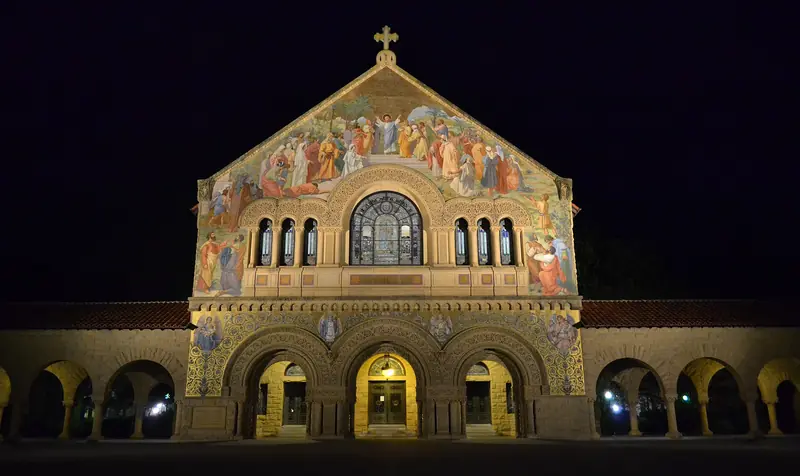
Walk up Palm Drive toward Stanford and one building fills the view at the far end of the Main Quad. Its facade is covered in a huge mosaic of gold and color that catches the late afternoon sun. That is Memorial Church, known on campus as MemChu. It is the heart of the founders' vision for the university and the most personal building Jane Stanford ever commissioned.
This guide covers why the church was built, how its mosaics were made, what two earthquakes did to it and what you need to know to visit. Note the 2026 maintenance closure in the visiting section before you plan your trip.

Jane Stanford's church
Leland and Jane Stanford founded the university in memory of their only child, Leland Stanford Jr., who died of typhoid fever in 1884. When Senator Stanford died in 1893, Jane took on the job of finishing what they had started. The church was her tribute to her husband and the project closest to her own heart. "While my whole heart is in the university, my soul is in that church," she said.
Construction began in 1899. Charles A. Coolidge of the firm Shepley, Rutan and Coolidge designed the church as well as much of the original campus. Chief builder John McGilvray and resident architect Charles Hodges oversaw the work. The church was dedicated on January 25, 1903, after a delay of almost a year.
The building is cruciform, about 190 feet long and 150 feet wide. The Stanfords did not want it tied to any one denomination. They meant it as a sanctuary for people of every faith. Jane died on February 28, 1905, only two years after the dedication.
The mosaics
The church's mosaics are its signature. Jane Stanford and her husband had admired the Byzantine churches of Constantinople and St. Mark's Basilica in Venice on a European trip in 1883. In Venice they met Maurizio Camerino, who managed the mosaic firm Antonio Salviati and Company. Jane visited him again in 1890 to plan the work.
The Salviati studios had more than 20,000 shades of glass tesserae to draw on. The project took five years. The great mosaic on the north facade measures 84 feet across and 30 feet high. According to Stanford's official church history, it took 12 men two years to complete.
Inside, look for these highlights:
- The Last Supper: A mosaic in the chancel that reproduces Cosimo Rosselli's fresco in the Sistine Chapel. Camerino obtained permission from Pope Leo XIII to copy it.
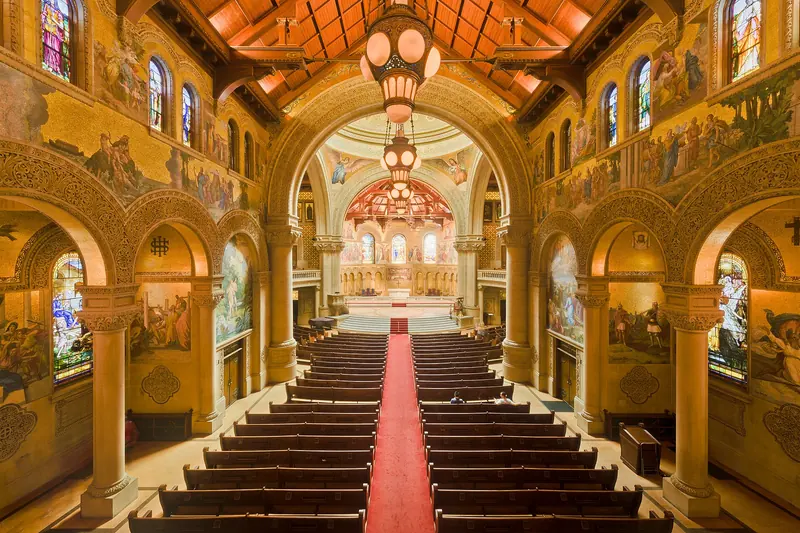
- Old Testament scenes: A long series of mosaic panels runs along both sides of the nave.
- Archangels: Four archangel mosaics decorate the pilasters.
- Stained glass: Frederick Lamb designed the windows.
- Carved inscriptions: Quotations chosen by Jane Stanford are cut into the walls. One in the east transept begins, "Religion is intended as a comfort, a solace, a necessity to the soul's welfare."

The 1906 earthquake
At 5:12 a.m. on April 18, 1906, the great San Francisco earthquake struck. Stanford was badly hit and Memorial Church suffered some of the worst damage on campus. The clock tower and its 80-foot spire fell through the roof onto the chancel. The front facade collapsed into the Inner Quad, taking the original mosaic with it. Marble statues of the twelve apostles at the altar were destroyed.
Repair was slow and careful. Work began in 1908 and the church was dismantled stone by stone, labeled and rebuilt in its original positions. Camerino's studio restored the interior mosaics and the facade mosaic was recreated. The spire was never rebuilt. A domed skylight now sits where the tower once stood. The rose window was replaced with a simpler arched window. The restoration was declared complete in 1917.
The 1989 earthquake
On October 17, 1989, the Loma Prieta earthquake shook the Bay Area. Memorial Church survived, but the archangel mosaics on the pilasters were damaged, one of them severely. The church closed for repairs. Engineers braced the crossing and added more than 470 tonnes of concrete inside the hollow arch walls to strengthen the building. Private donations paid for the work, which moved faster than repairs elsewhere on the Main Quad. The church was rededicated on November 1, 1992, as widely reported. Our history of the Loma Prieta earthquake covers the wider damage in Palo Alto and on campus.
Five organs
Music is a large part of life at Memorial Church. It has five organs. Stanford's organ page lists them as follows.
| Organ | Builder | Year | Notes |
|---|---|---|---|
| Murray Harris | Murray M. Harris Co. | 1901 | Rear gallery, 57 stops and 3,702 pipes, restored in 1996 |
| Fisk-Nanney | Charles Fisk | 1984 | Rear gallery, four manuals and 4,422 pipes |
| Potter-Brinegar | Paul Fritts and Company | 1995 | Single manual and movable within the church |
| Continuo | Martin Pasi | 2001 | Small three-stop organ for ensemble music |
| Tudor-style | Hupalo and Repasky | On loan since 2010 | About 200 pipes |
You can hear them at concerts throughout the year, most often played by the University Organist, Robert Huw Morgan. Services also use them every week.
Visiting the church
2026 maintenance closure
- Stanford listed Memorial Church as closed to visitors from June 15 to October 31, 2026 for maintenance.
- Religious services, weddings and programs continued during the closure.
- Docent tours were paused while the work was underway.
- Check the official visit page before you go.
The church stands at 450 Jane Stanford Way on the south side of the Main Quad. Enter the Quad through Memorial Court from the Oval end of Palm Drive and walk straight ahead. Outside of closures, the church is generally open to visitors during the day; check the church's site for current hours. Weddings, memorial services and other events can close it to the public at short notice.
Stanford has offered docent-led tours on Fridays at 11 a.m. Groups of fewer than 10 do not need a reservation. Larger groups should contact the Office for Religious and Spiritual Life ahead of time.
Etiquette
- Remember that this is a working place of worship. Speak quietly and silence your phone.
- Do not walk around or take photos during a service, wedding or funeral. Wait outside or sit quietly at the back.
- Read Stanford's photography policy before taking pictures, especially if you plan anything beyond a quick phone shot.
- Food and drink stay outside.
- Dress as you would for any house of worship. Shorts are fine on a hot day, but beachwear is not.
Services and events
Memorial Church remains active as a place of worship. A Sunday worship service is open to everyone and the church hosts a range of other religious services during the week. Concerts, lectures, memorial services and weddings fill the calendar too. Weddings are held here too, which is another reason to check the schedule. Check the schedule on the Office for Religious and Spiritual Life website for times.
Advent, Christmas, Lent and Easter bring special services. If you want a quiet look at the mosaics, a weekday morning outside the holidays is your best chance.
Nearby on campus
Memorial Church is the focal point of the Main Quad. Before or after your visit, walk the arcades, look for the class plaques in the walkway and see The Burghers of Calais in Memorial Court. Hoover Tower rises just to the east. The free Cantor Arts Center holds objects from the Stanford family and is a ten minute walk north.
For the full picture of the campus, including parking and the free shuttle, see our guide to visiting Stanford. The rest of the city's top sights are in our attractions overview. If you would like someone to tell the stories as you walk, a self-guided audio tour is a good low-key option.
Frequently asked questions
Is Stanford Memorial Church open to the public?
Yes. Memorial Church normally welcomes visitors of every faith or none. Stanford's Office for Religious and Spiritual Life listed it as closed to visitors for maintenance from June 15 to October 31, 2026, while services continued. Check the church's site at orsl.stanford.edu for current visiting hours before you go.
Who built Memorial Church?
Jane Stanford built the church in memory of her husband, Leland Stanford, who died in 1893. Construction began in 1899 and the church was dedicated on January 25, 1903. Charles A. Coolidge of Shepley, Rutan and Coolidge designed it.
What religion is Stanford Memorial Church?
Memorial Church is nondenominational. The Stanfords intended it as a sanctuary for people of every faith. Today it hosts a range of religious services along with concerts, weddings and memorial services.
Are there tours of Memorial Church?
Stanford offers docent-led tours on Fridays at 11 a.m. and groups of fewer than 10 do not need a reservation. Tours were paused during the 2026 maintenance closure, so confirm on the official site that they have resumed.
Why does Memorial Church have no steeple?
The original clock tower and spire collapsed through the roof in the 1906 earthquake. They were never rebuilt. A domed skylight now sits where the tower once stood.