On this page
The Duck Pond is the easiest win in the Palo Alto Baylands. You park a few steps away, the path is flat and the birds come close. Toddlers point at mallards. Birders scan the mudflats next door for godwits and curlews. On a clear winter morning the water reflects the hills on the far side of the bay.
It is also one of the oldest pieces of the Baylands as people use them today. The pond began as a saltwater swimming pool in the 1930s and became a bird sanctuary after World War II. This page covers that history, the city's ban on feeding wildlife, the loop trail, what birds to expect each season and how to plan a short visit. For the whole preserve, start with our Baylands Nature Preserve guide.
From swimming pool to bird sanctuary
The pond's story starts with John Fletcher Byxbee Jr., Palo Alto's city engineer from 1906 to 1941. Around 1930 he drew up a plan to turn the city's marsh into a recreation area with an airport, a golf course, a yacht harbor and a saltwater swimming pool. The pool was built in the 1930s beside Embarcadero Road and filled with bay water.
Swimming did not last. A historical marker about San Francisquito Creek, erected in 2001 at El Palo Alto Park, says that in 1948 the Palo Alto Bird Sanctuary, "popularly called 'the duck pond,'" was dedicated. The marker frames it as a turning point, when recreation along the creek and bay shifted from rafting and duck hunting toward watching birds instead.
The pond came through the fights of the 1960s and 1970s, when residents beat back plans to develop the Baylands. It now sits inside a 1,940 acre preserve with about 15 miles of trails. Our history of the Baylands covers the harbor, the dump and the people who saved the marsh.
The feeding rule
Many adults remember tossing bread here as children. That is no longer allowed. The Palo Alto Municipal Code says no person shall feed wildlife, "including any bird," or scatter or leave food, seed or anything else edible to wildlife in any park or open space without the written consent of the director. The current wording dates from a 2014 ordinance that built on a 1996 rule. Palo Alto Online reported the Parks and Recreation Commission backing the ban in August 2013 and the ban advancing in April 2014.
Why the rule matters at a pond like this one:
- Bread is junk food for birds. It fills them up without the nutrients they get from plants and invertebrates.
- Handouts crowd birds together. Dense flocks around a food source spread disease more easily.
- Leftovers foul the water. Uneaten food rots, feeds algae and draws rats.
- Gulls win. Big, bold gulls tend to grab most of the food and push out smaller birds.
The best way to bring birds close is to stay still on the bank for a few minutes. Ducks and gulls here are used to people and will often swim past within a few yards.

The Duck Pond loop
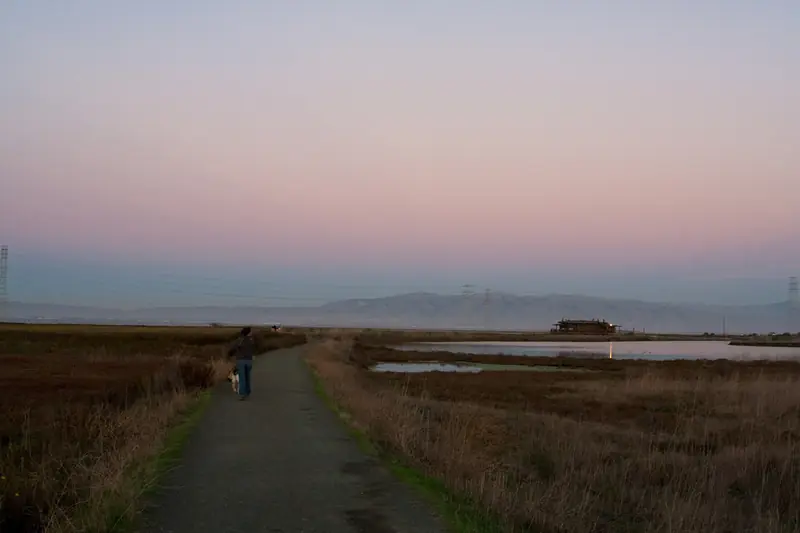
The Santa Clara Valley Bird Alliance describes a Duck Pond Loop Trail of about 0.7 mile. It is flat, has no obstacles and runs in full sun on a surface of crushed oyster shell and decomposed granite. The loop circles the pond and looks out over the mudflats of the lagoon beside it.
Plan on 15 to 25 minutes at a stroll and longer with binoculars. The surface works for most strollers and many wheelchairs, though loose patches can be soft after rain. The Bird Alliance guide also notes bikes are allowed on the trails except the boardwalk and dogs are allowed on a six foot leash. Our stroller-friendly walks page lists other flat routes around town.
Birds by season
The pond and its lagoon have birds every month of the year, but the mix changes with the seasons. Based on the Bird Alliance's trip guide:
| Season | What to look for |
|---|---|
| Year-round | Mallards, ring-billed and California gulls, pied-billed grebes, double-crested cormorants, American avocets and black-necked stilts |
| Late summer and fall | Arriving shorebirds in worn, plain plumage, with juveniles a little later |
| Fall through winter | Long-billed curlews, marbled godwits, whimbrels, willets, dowitchers, dunlin and western and least sandpipers |
| Spring | Shorebirds molting into breeding colors before they head north |
The mudflats are best at mid to low tide, when shorebirds spread out to feed. Check a tide table before you go. Our birdwatching guide covers the endangered Ridgway's rail and other species along the nearby boardwalk.
The Duck Pond with small children
For families with toddlers the pond is close to ideal. The parking is right there, the birds are big and easy to see and the walk can be as short as you like. A few ideas make it go smoothly:
- Bring a picture card. A simple bird chart turns "duck" into mallard, grebe and cormorant.
- Pack snacks for people only. Eat in the car or away from the water so birds do not learn to beg.
- Check for the EcoCenter on Wheels. Environmental Volunteers lists a mobile science station at the pond. Its schedule is on the group's calendar.
- Bring a layer. Wind off the bay builds most afternoons, even on warm days inland.
Our things to do with toddlers page has more short outings.
Hours, parking and facilities
The Baylands preserve is open daily from 8 a.m. to sunset. Gates near the Duck Pond close at times posted at the entrance, so watch the clock in late fall when sunset comes early. Entry and parking are free.
The Bird Alliance guide describes two small lots at the pond, one on each side. More parking is across the road at the Sea Scout Building and at the Lucy Evans nature center a short walk east. The same guide, last updated in 2022, mentioned one portable toilet at the pond and an accessible one near the sailing dock. Facilities change, so do not count on them. Environmental Volunteers has also posted a notice that access to parts of the Baylands may be restricted during extreme winter weather and high tides from October 26, 2026 to February 25, 2027.
Good to know
- Feeding birds or leaving seed is banned in all city parks and open space.
- There is little shade. Bring sun protection in summer and a jacket in winter.
- Drones are not allowed in city parks and open space.
- No public transit runs to the pond. Drive or ride a bike down Embarcadero Road.
Getting there and nearby
From Highway 101 take Embarcadero Road east toward the bay. Pass the airport and turn left at the T. The pond sits beside the road after a short drive, across from the ship-shaped Sea Scout Building. Keep going and you reach the Lucy Evans nature center and its boardwalk.
South of the airport, Byxbee Park adds grassy hills and wide views. The picnic area by the pond makes a good lunch stop. Our picnic spots guide lists others. For a meal after a cold walk, see where to eat near the Baylands.
Frequently asked questions
Can you feed the ducks at the Palo Alto Duck Pond?
No. Palo Alto's municipal code bars anyone from feeding wildlife, including birds, or leaving food or seed in any park or open space without the director's written consent. The rule covers the Duck Pond and the whole Baylands preserve.
Was the Palo Alto Duck Pond a swimming pool?
Yes. It was built in the 1930s as a saltwater swimming pool, part of city engineer John Fletcher Byxbee's plan for a bayside recreation area. A 2001 historical marker says the Palo Alto Bird Sanctuary, popularly called the duck pond, was dedicated in 1948.
How long is the Duck Pond loop?
The Duck Pond Loop Trail is about 0.7 mile, flat and in full sun, with a crushed oyster shell and decomposed granite surface, according to the Santa Clara Valley Bird Alliance. It takes 15 to 25 minutes at a stroll.
Where do you park for the Duck Pond?
The Santa Clara Valley Bird Alliance describes two small lots, one on each side of the pond. More parking is at the EcoCenter across the road and at the Lucy Evans nature center a short walk east. Parking is free.
What birds can you see at the Duck Pond?
Mallards, gulls, pied-billed grebes and double-crested cormorants are regulars. From late summer through spring the lagoon mudflats beside the loop fill with shorebirds such as marbled godwits, long-billed curlews, willets and dowitchers.