On this page
Amplify Partners is a Menlo Park venture firm built on one idea: engineers and researchers make the best founders for technical products. It tries to be the first institutional investor in a company and leads rounds from the very first check through Series A. Its early bets on Datadog and Fastly helped make its name. Its newer portfolio leans hard into AI and computational biology.
This page is a neutral profile for founders and readers following the local venture scene. It draws on Amplify's website and on reporting from TechCrunch, Fortune and Cooley, with dates given where figures appear. For background on venture funds, see our venture capital guide.
Founding and partners
Sunil Dhaliwal started Amplify. TechCrunch reported on January 31, 2013, that Dhaliwal, a former general partner at Battery Ventures, was launching a $40 million fund to invest only in what he called infrastructure 2.0 startups. At Battery he had invested in infrastructure companies such as Splunk, Netezza and Opscode. Amplify itself says it has been investing in technical founders since 2012.
The first fund grew from that $40 million target to a $49.1 million close, as VentureBeat reported in 2014. In August 2014 Fortune reported that Mike Dauber, another Battery investor, was joining. Today the team page lists four general partners: Sunil Dhaliwal, Mike Dauber, Lenny Pruss and Sarah Catanzaro. It also lists partners Barr Yaron, David Beyer, Elliot Hershberg and Grace Ge, plus venture partners and a separate team for operations and company building. Our Battery Ventures profile covers the firm both founders came from.
The Menlo Park office
Amplify lists its Menlo Park office at 800 Menlo Ave, Suite 220, Menlo Park, CA 94025. Menlo Avenue runs a block from Santa Cruz Avenue, the small downtown of cafes, shops and restaurants described in our Santa Cruz Avenue guide. The firm also lists a San Francisco office at 457 Bryant St and says its team is based in the Bay Area.
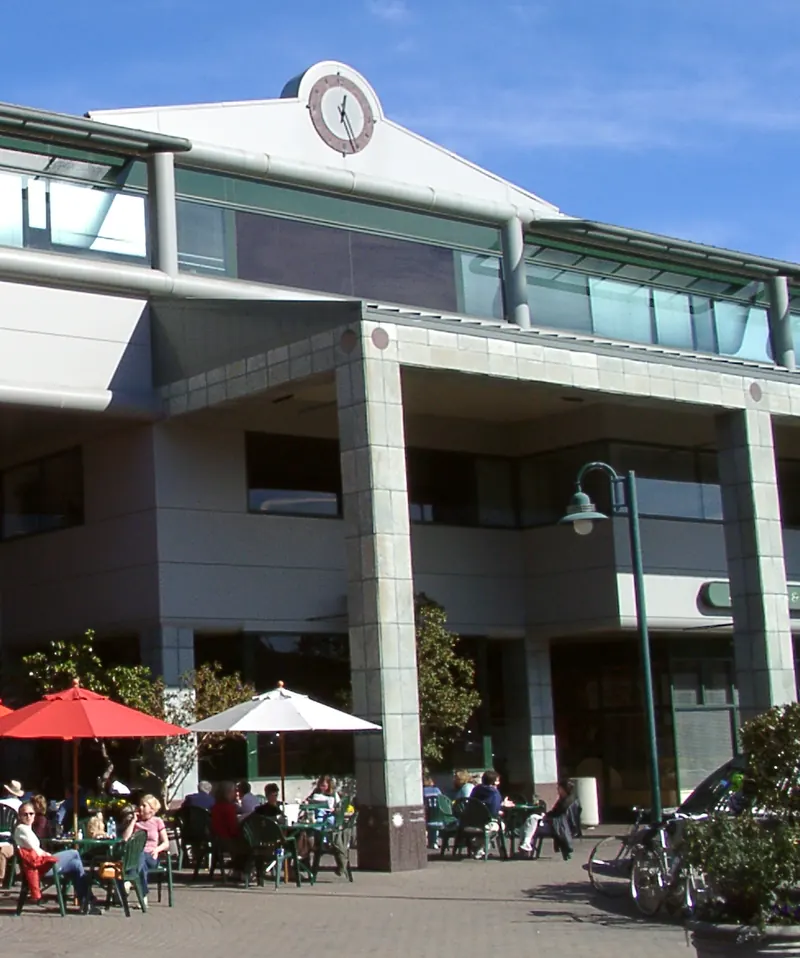

The location is not on Sand Hill Road, though it is only a short drive away. For visitors, downtown Menlo Park is easy to reach. The Menlo Park Caltrain station sits at the edge of downtown. Palo Alto is one stop south. Like any venture office, Amplify's is private and meetings are by appointment. Our Menlo Park guide has more on the town.
Focus and stage
Amplify's about page sums up its thesis in a phrase: "The first investor for technical founders." The firm says it leads investments from a company's first round through Series A and supports founders until an IPO. Its portfolio is sorted into a few broad sectors:
- Developer tools and computing infrastructure, such as databases, testing tools and cloud platforms.
- Data and analytics, including data pipelines and blockchain data.
- Machine learning and AI, from model infrastructure to AI applications.
- Cybersecurity, including software supply chain security.
- Digital biology, a newer area with its own fund and team.
The about page tells the firm's origin as a bet on a cultural shift. A decade ago, it says, engineers built the product but business people were trusted to build the company. Amplify bet that the script would flip. Now that technical founders are common, it argues that AI is making every field more technical, including biology.
Notable investments
Amplify's portfolio page lists the year it partnered with each company. The table below uses those dates.
| Partnered | Company | Status listed by Amplify |
|---|---|---|
| 2012 | Datadog | IPO in 2019 |
| 2012 | Fastly | IPO in 2019 |
| 2017 | Covariant | Active |
| 2018 | Runway | Active |
| 2019 | dbt Labs | Merged with Fivetran in 2026 |
| 2019 | Anyscale | Active |
| 2020 | Temporal | Active |
| 2020 | Hex | Active |
| 2020 | Hightouch | Active |
| 2021 | Chainguard | Active |
| 2022 | Modal | Active |
Amplify says it was the first institutional investor in Datadog and Fastly, more than ten years ago. It also names itself the first investor in Chainguard, Temporal, dbt and Runway. Newer entries include Antithesis, a software testing company it backed in 2025. Another is Boltz, which builds open AI models for biology. Every portfolio list shows success stories first. Most early-stage investments do not end in an IPO, a point our venture capital glossary explains.
Funds and size
Amplify's funds have grown steadily. Reported figures, in order:
- Fund I. Announced at $40 million in January 2013; closed at $49.1 million (VentureBeat, 2014).
- Fund II. $125 million, reported by Fortune in September 2015.
- Fund III. $200 million, reported by TechCrunch in September 2018.
- 2022 funds. Two funds totaling $700 million, per Cooley, which advised on them in June 2022.
- June 2025. $900 million across three funds, per Cooley: Fund 6 at $400 million, Fund 6 Select at $300 million for existing companies and Amplify Bio at $200 million, the firm's first dedicated digital biology fund.
Amplify's website says it is currently investing out of its sixth fund. These are reported sizes, not performance figures. This page makes no claims about returns.
How founders reach Amplify
Amplify does not publish a pitch form on the pages we read. Its website offers a newsletter and lists its offices. Its portfolio pages show the founders it has backed. At a firm of this kind, most new founders arrive through introductions from engineers, researchers and founders the partners already know.
- Read the firm's writing. Amplify publishes technical essays and an annual AI engineering report, which show what its partners care about.
- Find a founder in the portfolio who works in a nearby field and ask for an introduction with context.
- Lead with the technical insight. Amplify says it backs founders solving problems they have lived through.
- Avoid cold messages to partners' personal accounts. Use introductions and the firm's public channels.
Our guide to pitching investors covers meeting etiquette and follow-up.
Programs and community
Amplify runs several projects beyond investing. It sponsors a writing fellowship for technical writers, publishes a Startup Legal Hub with guides for founders and hosts a podcast called Barrchives. Its 2026 AI Engineering Report surveyed more than 1,000 engineers working on AI. The firm also runs Amplify Bio, a dedicated team and fund for companies applying computation to biology.
Amplify in the local ecosystem
Amplify is one of several early-stage firms that chose downtown Menlo Park over the office parks up the hill. The firm's focus on engineers also fits the area's talent pool. Stanford's computer science and engineering programs are a few minutes away. Many of the region's infrastructure companies started as research projects or side projects by engineers at large tech firms. Founders who want to compare Amplify with other firms chasing AI can read our page on AI investors near Palo Alto.
Good to know
- The Menlo Avenue office is private. Visit only for a confirmed meeting.
- Amplify Partners is unrelated to other companies named Amplify.
- Nothing on this page is investment advice. Portfolio claims come from the firm's own site.
Frequently asked questions
Where is Amplify Partners located?
Amplify lists two offices on its website: 800 Menlo Ave, Suite 220, Menlo Park, CA 94025 and 457 Bryant St in San Francisco. The Menlo Park office is in the town's downtown, about two miles from downtown Palo Alto. Meetings are by appointment.
Who founded Amplify Partners?
Sunil Dhaliwal founded Amplify. TechCrunch reported in January 2013 that Dhaliwal, a former general partner at Battery Ventures, was launching a $40 million fund for infrastructure startups. Amplify itself says it has invested in technical founders since 2012. Mike Dauber, also from Battery, later joined as a general partner.
What does Amplify invest in?
Amplify calls itself the first investor for technical founders. It backs engineers and researchers building developer tools, computing infrastructure, data platforms, AI and machine learning, cybersecurity and digital biology. It leads from a company's first round through Series A.
What are Amplify's best known investments?
Amplify says it was the first institutional investor in Datadog and Fastly, both of which went public in 2019. Its portfolio also lists dbt Labs, Temporal, Chainguard, Runway, Modal, Hex, Hightouch and Anyscale, with the year Amplify partnered with each.
How large are Amplify's funds?
In June 2025 Amplify announced $900 million across three funds: a $400 million Fund 6, a $300 million Fund 6 Select for existing companies and a $200 million Amplify Bio fund, according to its law firm Cooley. Its website says it is investing out of its sixth fund.