On this page
Greenmeadow is where to see Joseph Eichler's ideas at their most complete. Built in 1954 and 1955, it has 243 single-story houses with post-and-beam frames and glass walls, arranged around a shared park, pool and community center. Residents bought that center from Eichler within a year and still run it. In 2005 the tract joined the National Register of Historic Places, one of only two Eichler districts in Palo Alto with that status.
This loop starts at Mitchell Park, passes through the circular streets of Fairmeadow and then winds through Greenmeadow's cul-de-sacs. Every house is private, so the tour is about streetscape, site planning and the public places around them. Our Greenmeadow guide covers the neighborhood in depth.
Before you go
The loop runs about 2.3 miles and takes 1 to 1.5 hours. Park at Mitchell Park or the library lot. The closest Caltrain stop is San Antonio station in Mountain View, about a mile south. See our San Antonio station guide. Restrooms and water are at the library and Mitchell Park.
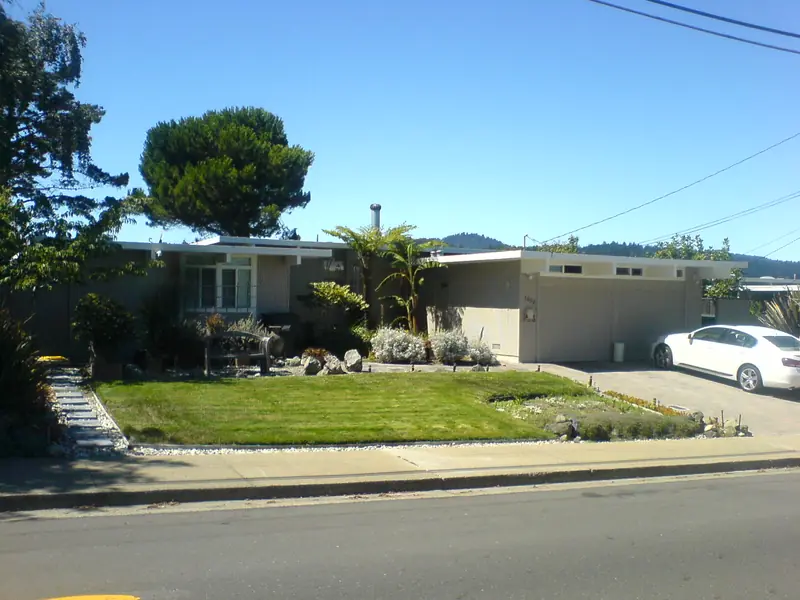
Eichlers face the street with mostly blank walls and open to private yards behind. Do not expect to see interiors. What you can see is the rhythm of low roofs, carports, vertical siding and the way the street plan turns inward.
The route, stop by stop
- Mitchell Park Library and Community Center, 3700 Middlefield Road. The building opened in December 2014 around a courtyard with a coast live oak. It is a fitting start: modern civic architecture in a neighborhood of modern houses. Our libraries guide covers its hours.
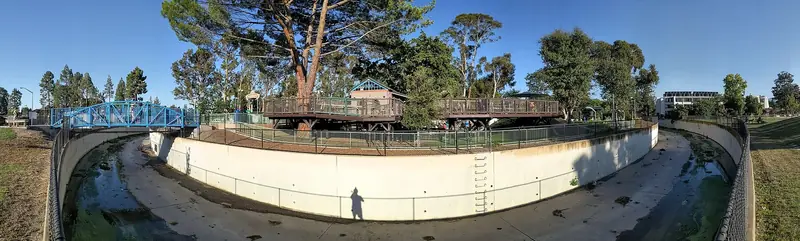
- Mitchell Park. Walk into the 21.4-acre park, opened in 1957. Look for Bruce Johnson's sculpture After the Fire and the Magical Bridge Playground, which opened in April 2015. See our Mitchell Park guide.
- East Meadow Drive and the school campuses. Head west along East Meadow Drive past Jane Lathrop Stanford Middle School and Fairmeadow Elementary. Fairmeadow's houses begin on the other side.
- The Fairmeadow circles. Turn into the tract and follow its concentric circular streets, which locals call the Circles. Fairmeadow was built from 1951 to 1954. The Greenmeadow nomination credits the circular plan to Anshen and Allen. The Eichler Network reports that Fortune put the circles on its February 1955 cover.
- East Charleston Road. Leave the circles and cross East Charleston at a signal. Hoover Elementary is on this road. Greenmeadow begins on the south side.
- Greenmeadow Community Center, 303 Parkside Drive. The heart of the tract. Eichler built a park, a pool and a multipurpose building here. Residents incorporated the Greenmeadow Community Association on July 16, 1955. That November they agreed to buy the center from Eichler for $10,000. A rebuilt pool and a new clubhouse by Dennis Kobza opened in 2018. The center, pool services building and pool are part of the historic district. It is for members and guests, so view it from Parkside Drive.
- The park and Thomas Church's redwoods. Landscape architect Thomas Church is credited with the original planting of redwoods around a central lawn. Notice how houses back onto shared green space instead of a through street.
- Nelson Drive. One of the four streets the National Register names. Buyers in 1954 chose among six models, some with four bedrooms, a family room and a double garage. Look at rooflines to spot the different plans.
- El Capitan Place and Adobe Place. These short courts show the cul-de-sac design that keeps through traffic out. Jones and Emmons built on the concentric ring idea from Fairmeadow but turned it into loops and courts.
- Creekside Drive and Middlefield Road. Walk the last of the district streets, then return north along Middlefield Road to Mitchell Park. Cubberley Community Center is across Middlefield if you want to add a stop.

What to look for
An Eichler is easiest to recognize from the street by what it hides. The National Register nomination and the Almanac list the features that define Greenmeadow's houses. Watch for:
- Flat or gently sloped roofs with wide overhangs.
- Exposed posts and beams, often visible at the carport.
- Vertical redwood siding and few street-facing windows.
- Clerestory windows set high under the roof.
- Concrete fireplaces and chimneys.
- Glass walls facing the back garden, glimpsed through gaps between houses.
Many houses have been updated inside while keeping their outside look, which is what the historic district aims for. Our architecture guide places Eichlers alongside Palo Alto's other styles.
Why the community center matters
Most tracts of the 1950s had no shared space. Greenmeadow was planned around one. In early 1955 residents worried that the Eichler company might rent part of the pool to a swim school. They hired a young lawyer, Pete McCloskey, who later served in Congress. Then they incorporated their association. According to the association, Eichler offered to sell the center for $20,000 the day before Thanksgiving in 1955. Resident John Berwald countered with $10,000 and Eichler accepted. Bank of America lent the money, backed by $50 pledges from at least 200 households. Berwald later served as mayor of Palo Alto.
The association still owns and runs the center at 303 Parkside Drive. Its heated pool is open year-round for members. The Fourth of July parade has run every year since 1955. Check the Greenmeadow Community Association website for membership.

The tract and its listing
Greenmeadow was built in two units. Greenmeadow I had 180 homes and Greenmeadow II had 63. A later phase of 27 homes by Claude Oakland from 1961 and 1962 adjoins the district but was not included in the listing. The nomination, titled Greenmeadow (Units I and II), was prepared by Marty Arbunich for a resident group called the Eichler Historic Quest committee. It covers about 73 acres. Green Gables in north Palo Alto was listed the same day.
Eichler Homes sold to buyers regardless of race or religion at a time when many builders refused. That policy and Eichler's 1958 resignation from the National Association of Home Builders are part of why historians value these tracts. Our Eichler homes history tells that story. For the wider postwar boom, see postwar growth, 1945 to 1970.
Sidewalk etiquette
Good to know
- Greenmeadow homes are private. Stay on the sidewalk or street edge.
- Never walk into carports, entry courts or atriums, even if a gate is open.
- Glass walls make residents visible from outside. Do not photograph into homes.
- The pool and clubhouse are for members and their guests.
- Keep groups small. Cul-de-sacs carry sound.
Extending the loop
Add a short ride east on Charleston Road to Susan Zoccola's 2022 sculpture Passage, one of five works at Charleston Road and Sutherland Drive. Our public art page lists it. By bike, cross Alma Street to the Eichlers of Charleston Meadows. To understand what historic district status means for owners, read our historic homes guide. For more modern architecture tours around the Bay Area, browse guided tours.
District facts on this page come from the National Register nomination as summarized by the Greenmeadow Community Association and the Eichler Network, plus the city's 2018 Eichler design guidelines.
Frequently asked questions
Can you walk through Greenmeadow in Palo Alto?
Yes. Its streets are public and the cul-de-sacs make it pleasant on foot. The houses are private, so stay on the sidewalk or street edge and do not walk into driveways, carports or atriums.
Can visitors go inside the Greenmeadow community center?
Not casually. The center at 303 Parkside Drive, with its pool and clubhouse, belongs to the Greenmeadow Community Association. Use is for members and their guests. The association's website says membership is open to people outside the neighborhood too.
Who designed Greenmeadow?
A. Quincy Jones and Frederick Emmons of Los Angeles designed the houses and site plan for Joseph Eichler in 1954 and 1955. Landscape architect Thomas Church is credited with the original landscaping of the community center and park.
Where can I see Eichler homes in Palo Alto on foot?
Greenmeadow and Green Gables are National Register historic districts and the easiest to walk. Fairmeadow's circular streets are next to Greenmeadow, so this loop covers both. A bike helps if you want to add Charleston Meadows across Alma Street.
When is the best time to walk Greenmeadow?
Weekend mornings are quiet and the low winter sun lights up the glass and wood. The neighborhood's Fourth of July parade, held every year since 1955, is a lively time to see it but is a residents' event.