On this page
Palo Alto has two public sculpture collections that almost never get seen together. The city owns about 100 permanently sited works, scattered from the Baylands to Barron Park. Stanford owns more than 85 outdoor works of its own, by its count, including one of the largest Rodin collections outside Paris. A mile of Palm Drive connects them.
This walk links the two. The first half covers the city pieces clustered near City Hall and the downtown library. The second half climbs to the Oval and loops through the campus arts district. Stop details come from the City of Palo Alto's public art collection map and Stanford's arts office, current as of October 2026. For background on each program, see our guides to public art in Palo Alto and public art at Stanford.
Before you go
- Start: the Palo Alto Caltrain station on University Avenue. Both legs begin within a few minutes of the platform.
- Shortcut: the free Marguerite shuttle runs from the transit center up Palm Drive. Its main lines run Monday to Friday only.
- Timing: the outdoor art is open every day. The Cantor Arts Center, which has restrooms and indoor galleries, closes on Tuesday and Wednesday.
- Apps: Stanford's Public Art App maps the campus collection. The city publishes an interactive map on its public art page.
- Shoes: the campus leg is mostly paved, with gravel paths in the Arboretum.
Leg 1: downtown, about 1 mile
The city's downtown sculptures are smaller and quieter than Stanford's. Several sit at civic buildings, so you will walk past them on the way to something else. The city map lists these within a few blocks of each other:
- Lytton Plaza, University Avenue at Emerson Street. The plaza hosts rotating temporary art. For years it held Digital DNA, an egg covered in circuit boards by Adriana Varella and Nilton Maltz. The city removed it in 2018. A collector bought and restored it. By 2019 it stood outside the Harvard i-Lab in Boston, according to Wikipedia. See our Lytton Plaza page.
- King Plaza and City Hall, 250 Hamilton Avenue. The plaza in front of City Hall is the city's main spot for rotating temporary installations. Inside the lobby, the map lists Susan Narduli's Conversation (2016). Seyed Alavi's Forgotten Languages (1995) is also listed at City Hall. Our King Plaza guide covers the building.
- Downtown Library, 271 Forest Avenue. Two older works are listed here: Joseph Mannino's Rock 'n Roll (1981) and Carrie Abramovitz's Separation (1978).
- 450 Bryant Street. Martin Webb's 148 Possibilities (2019) stands at Birge Clark's 1927 police and fire station, now the Avenidas senior center.
The city map also marks the traffic circle at the west end of University Avenue as a gateway public art site and the pedestrian tunnels under the tracks as a spot for temporary art. Walk through the tunnel by the station and you are at the foot of Palm Drive.
Leg 2: up Palm Drive to the Oval
Palm Drive runs about a mile from El Camino Real to the Oval. The walk is flat and shaded at the edges. If you have time for a detour, the city collection map lists two 2016 works by Brad Howe, Semillas (a series of five sculptures) and Qualia, at 180 El Camino Real, the Stanford Shopping Center address, just north of the Palm Drive entrance.
At the top, the Oval opens onto the Main Quad. Our Oval and Palm Drive guide covers the layout.
Memorial Court: the Burghers of Calais
Walk straight through the arches into Memorial Court, the front courtyard of the Main Quad. Here stands Rodin's full group of The Burghers of Calais, the six citizens who offered their lives to save their city in 1347. At Stanford the figures stand at ground level, so you can walk among them. It is one of the few places to see the group this close. Memorial Church at the far end of the Inner Quad was closed for maintenance from June 15 to October 31, 2026, so check its status if you want to go inside.
The arts district loop, about 1.5 miles
From the Quad, head north along Lomita Drive to the cluster of museums. This is the densest stretch of outdoor art on campus.
| Stop | Artist and year | Where |
|---|---|---|
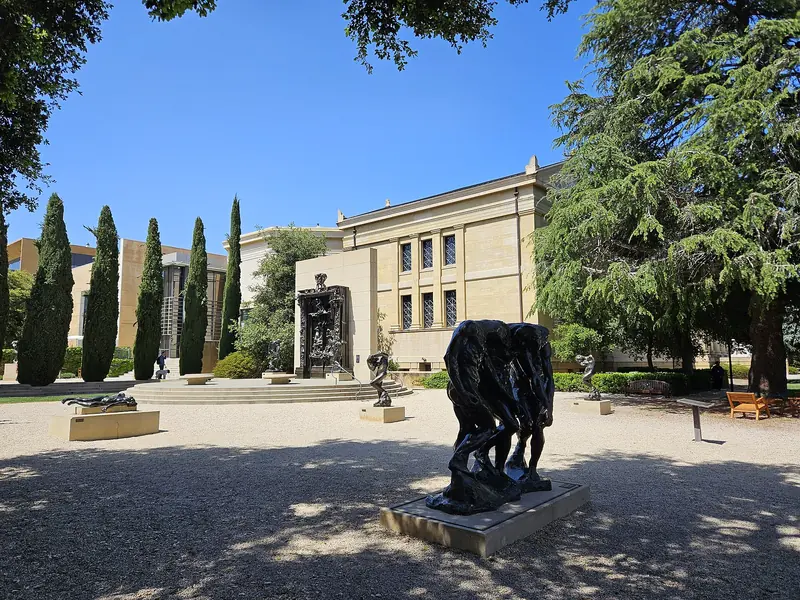
| Rodin Sculpture Garden, including The Gates of Hell | Auguste Rodin; Stanford's Gates cast in 1981 | Beside the Cantor Arts Center; Gates at the eastern end |
| Tree of 40 Fruit | Sam Van Aken (sources give 2019 or 2022) | Next to the Rodin garden |
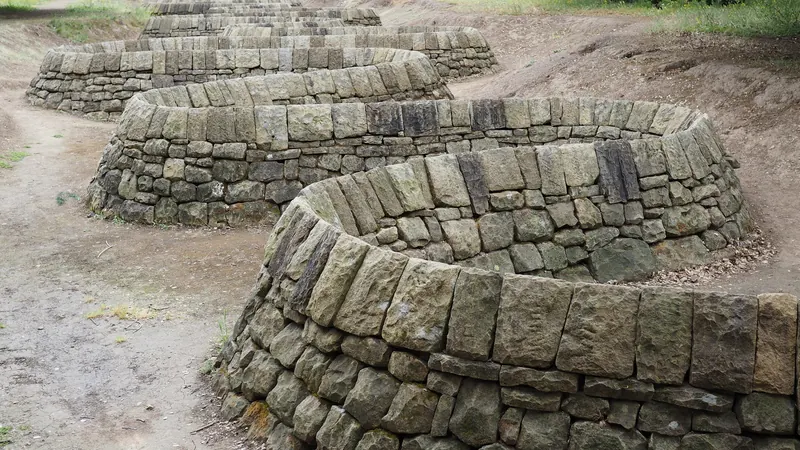
| Stone River | Andy Goldsworthy, 2001 | Northeast of the Cantor |
| Rocket bike rack | David Byrne | By the Cantor Arts Center |
| The Stanford Columns | Beverly Pepper, 2022 | Arboretum edge, across Lomita Drive from the Anderson Collection |
| Angel of Grief | Carved 1901, replaced 1908 | Arboretum, among the oaks |
| MOCNA | Ursula von Rydingsvard, 2018 | Denning House |
| Papua New Guinea Sculpture Garden | Sepik River artists, 1994 | Santa Teresa Street at Lomita Drive |
Spend the most time in the Rodin Sculpture Garden. It never closes, holds about 20 bronzes and puts The Three Shades, The Walking Man, Adam and Eve within a few steps of each other. Then walk to Stone River, a wall of about 6,500 sandstone blocks salvaged from buildings damaged in the 1906 and 1989 earthquakes. Our Cantor Arts Center guide covers the indoor galleries if you need a break.

Cross Lomita Drive into the Arboretum for Pepper's columns and the Angel of Grief, then follow Santa Teresa Street to the Papua New Guinea Sculpture Garden. Ten artists from the Sepik River region carved it on site in 1994. Around 40 pieces, including garamut slit drums, are left to weather in the open, so their surfaces change from year to year.
Optional extensions on campus
If you still have energy, three more stops are a short walk from the Quad:
- White Plaza: the White Memorial Fountain, known as The Claw, by Aristides Demetrios, installed in 1964. Demetrios came back to restore it in 2011.
- Science and Engineering Quad: Alicja Kwade's Pars pro Toto (2021), a scatter of stone spheres across the courtyard.
- Kenneth Snelson's Mozart I (1982): a tensegrity tower of rods held apart by cables. Use the Public Art App to find its exact spot.
Alia Farid's Amulets (2024) sits on the plinth on Meyer Green between Green Library and the law school. Stanford said it would be on view for three years, so it should stay through 2027.

Route at a glance
- Palo Alto Caltrain station to Lytton Plaza (5 minutes).
- Lytton Plaza to City Hall, the Downtown Library and 450 Bryant Street (30 minutes with stops).
- Back to the station and up Palm Drive to the Oval (25 minutes).
- Memorial Court and the Burghers (15 minutes).
- Rodin garden, Stone River and the Lomita Drive works (45 minutes).
- Arboretum and the Papua New Guinea garden (30 minutes).
- Walk or shuttle back down Palm Drive to the station (25 minutes).
Times are walking estimates plus a few minutes per stop. Distances are approximate.
Tips and etiquette
Good to know
- Do not touch or climb on any sculpture, on campus or downtown.
- Stanford parking is paid on weekdays. Arriving by Caltrain avoids it entirely.
- Low afternoon sun is best for bronze and for the texture of Stone River.
- Cantor docents have led free outdoor sculpture walks on Sundays in past seasons. They were not on the museum's tours page in late October 2026, so check before you plan around one.
- Professional photo shoots on campus need Stanford's permission. Personal photos are fine.
Two collections, two philosophies
The contrast is part of the fun. The city's collection grew out of a percent-for-art approach: art tied to libraries, fire stations, bike bridges and private developments, often by Bay Area artists and often modest in scale. It favors work you meet in daily life. Stanford's collection grew from gifts and major commissions, from the Cantor family's Rodins to Goldsworthy's wall. It clusters around the museums.
Seen in one afternoon, they show how a small city and a large university each decided what belongs in public space. For paint rather than bronze, see our guide to murals and street art.
Frequently asked questions
Is there a sculpture garden in Palo Alto?
The biggest is the Rodin Sculpture Garden beside the Cantor Arts Center at Stanford, with about 20 bronzes including The Gates of Hell. It is outdoors and free. Stanford also has the Papua New Guinea Sculpture Garden at Santa Teresa Street and Lomita Drive.
Is there a map of Stanford's outdoor art?
Yes. Stanford's Public Art App at arts.stanford.edu/map shows the full outdoor collection, which Stanford counts at more than 85 works. Stanford's arts office and news site also publish suggested campus art walks.
How long does the Palo Alto to Stanford sculpture walk take?
Plan on 3 to 4 hours for the full route of about 4 miles, including time to look. You can cut it to 2 hours by skipping the downtown leg and starting at the Oval, or ride the free Marguerite shuttle up Palm Drive on weekdays.
Can you touch the sculptures at Stanford?
No. Stanford asks visitors not to touch or climb on outdoor art. Oils from hands damage bronze patinas and weathered wood. Some pieces, like Stone River, are fragile at the edges.
Are there free guided sculpture tours at Stanford?
Cantor Arts Center docents have led free outdoor sculpture walks, including a 90 minute walk from the top of the Oval on Sundays in past seasons. Schedules change, so check the Cantor tours page or the Stanford events calendar before you go.