On this page
Most first visits to Stanford begin the same way. You cross El Camino Real at the edge of downtown Palo Alto and the road straightens into a long avenue of palms. At the far end a lawn opens up and the Main Quad comes into view, with the gold mosaic of Memorial Church in the center and Hoover Tower off to the side. That approach, Palm Drive and the Oval, is Stanford's front door.
It is also one of the best free walks in the area. This page covers how the approach was planned, what grows along it, how the Oval works as a gathering place and the practical details for walking, photos and picnics.
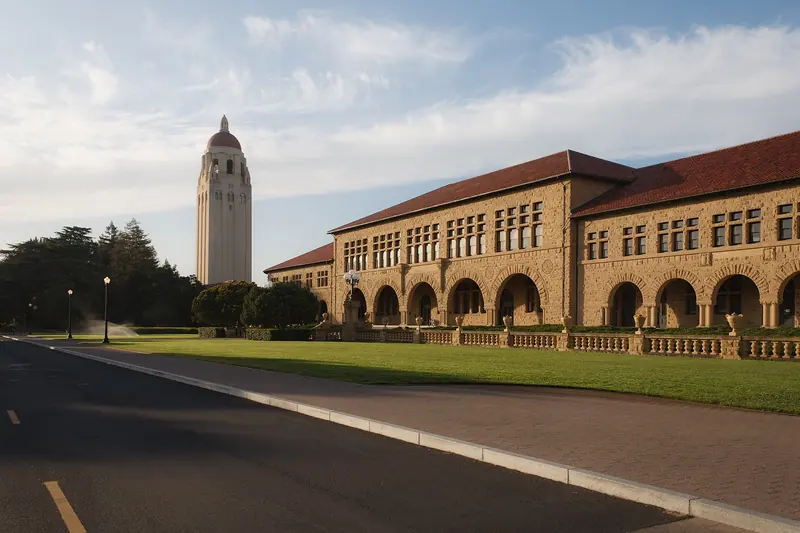

A planned approach
The layout goes back to the university's first master plan. Frederick Law Olmsted's firm prepared it in 1888 and Stanford's archives note that the plan records Palm Drive and the Oval for the first time. Olmsted lined up the Quad on a strong axis. The avenue runs about a mile from the county road, now El Camino Real, to the Oval and the Quad's front entrance. The Quad faces back up the drive toward the town and the bay.
The road itself was cut in 1889. When the university opened in 1891, it was called University Avenue, the same name as the main street of the new town at its other end. The idea was simple: one straight line from the railroad to the university. Our Stanford architecture page covers the wider Olmsted plan and the sandstone buildings at its end.
The palms
Almost all the trees on Palm Drive are Canary Island date palms, with thick trunks and feathery fronds. Stanford's online tree encyclopedia counts 166 palms on the drive itself and 194 once you include the outlying segments along the Oval's footpaths.
- Who chose palms. The tree guide credits David Starr Jordan, Stanford's first president, with proposing the palm theme in 1893, with Leland Stanford's approval. A 2010 Stanford Daily article treats that as campus legend. Both agree that Olmsted did not come up with it.
- Fan palms. Mexican fan palms once alternated with the date palms. Many were removed in the 1920s, reportedly because they struggled next to the eucalyptus trees. A few fan palms still line the drive.
- A near miss. In the 1920s the landscape designer John McLaren proposed replacing the palms with native oaks. The idea caused an uproar and the palms stayed.
- Hybrids. About ten palms on the drive are thought to be hybrids of the Canary Island date palm and a related species.
- Replacements. Gophers killed many young palms in the early years. Gaps still appear when trees are removed and Stanford fills them with transplants, some already full size.
Some trees around the Oval's paths are of the same vintage as the drive and are likely originals. Smaller windmill palms once lined the Oval itself. The Stanford Daily counted about 600 palms across the whole campus in 2010, from 14 genera.
The Arboretum on both sides
Palm Drive cuts straight through the Stanford Arboretum. The groves on either side hold some of the oldest planted trees on campus. The first plantings in the 1880s and 1890s brought trees from around the world. West of the drive, between Palm Drive and Quarry Road, stand the Stanford family mausoleum and the Angel of Grief. Our Arboretum guide has a walking route.
On the same side of the drive, closer to the Oval, are the Cantor Arts Center and the Anderson Collection, along with the Rodin Sculpture Garden. A walk up the drive can easily turn into a museum afternoon. See our guide to the Cantor Arts Center.
The Oval as a gathering place
The Oval is a broad lawn ringed by the road, with palms along its paths. It is where Palm Drive ends and the Main Quad begins. Stand on the grass and face the Quad: Memorial Court and the church mosaic are straight ahead and Hoover Tower rises to the left.
The Oval is Stanford's front lawn in every sense. On sunny weekends it fills with picnics, frisbee, people reading and families on blankets. Students use it between classes and campus groups use it for gatherings. Many self-guided walks start here, including our self-guided campus walk. It is also the most popular backdrop for photos on campus, from graduation portraits to engagement shoots.
Just across the road from the Oval is Memorial Court, the formal entrance to the Main Quad, with Rodin's Burghers of Calais. Before 1906 a huge Memorial Arch stood over that entrance. The earthquake brought it down and it was never rebuilt.
Walking the drive
The best way to see Palm Drive is on foot. Start at the Palo Alto Transit Center by the Caltrain station and follow the drive southwest.
- El Camino Real. Cross at the signal. The first stretch passes the Arboretum on both sides.
- Arboretum Road. The drive crosses it after a few minutes. Turn left here for the stadium and athletics venues. Keep straight for the Quad.
- Campus Drive. Cross carefully. This loop road carries cars, buses and many bikes.
- The Oval. The palms split around the lawn. Head for the center for the classic view of the Quad.
Allow about 20 minutes at an easy pace. The paths are flat and paved, which suits strollers and wheelchairs. On weekdays the free Marguerite shuttle runs from the Transit Center if you would rather ride. Drivers can follow Palm Drive straight in from El Camino Real. Visitor parking near the Oval is paid through ParkMobile, so check the signs before you leave the car.
Good to know
- Palm Drive has a bike lane and a lot of cyclists. Stay on the footpaths.
- Early mornings are quiet, which makes them the best time for photos without crowds.
- On football Saturdays the drive and the roads around it fill with traffic. Walk or take the train.
- Restrooms are not on the Oval itself. The nearest are in campus buildings and the museums during open hours.
Picnics, photos and events
For a picnic, pick up food downtown before you start the walk. Our cheap eats guide lists easy takeout spots near University Avenue. Carry everything out with you, since bins can fill on busy weekends.
Photographers like two angles. The first is straight down the drive between the palms, shot from the middle of the Oval's footpath toward El Camino Real. The second is from the far edge of the Oval toward the Quad, with Memorial Church centered. Keep out of the roadway for both.
During commencement weekend and big campus events, parts of the Oval can be fenced or reserved and parking nearby fills early. Check Stanford's event listings before you come on those weekends. If you are staying overnight for a campus event, compare hotels near Stanford close to the downtown end of the drive.
Frequently asked questions
How many palm trees are on Palm Drive?
Stanford's tree guide counts 166 palms on Palm Drive itself and 194 when the outlying segments around the Oval are included. Most are Canary Island date palms. Gaps from removed trees are filled with transplants, sometimes at full size.
How long is Palm Drive at Stanford?
About a mile. It runs from El Camino Real, next to the Palo Alto Transit Center, to the Oval in front of the Main Quad. The walk takes about 20 minutes at an easy pace.
Can you have a picnic on the Stanford Oval?
Yes. The Oval is an open lawn and on sunny weekends it fills with picnics, frisbee games and families. Take your trash with you and keep off any areas fenced for events or turf care.
Who planted the palms on Palm Drive?
The road was cut in 1889. Stanford's tree guide says David Starr Jordan proposed the palm theme in 1893 and Leland Stanford approved it. Some historians treat that story as campus legend, but they agree the palm idea did not come from Frederick Law Olmsted.
Why are there gaps in the rows of palms?
Palms die or are removed over time. Stanford replaces them with transplanted palms, some already full grown, but gaps can last for years. In the early days gophers killed so many that a dozen at a time had to be replaced.