On this page
Most visitors stay on Palm Drive and never see the groves on either side of it. That is a pity, because the Stanford Arboretum holds the most personal corner of the campus. The family that founded the university is entombed here in a granite and marble mausoleum guarded by sphinxes. A few steps away a marble angel slumps over an altar in grief. Behind them a cactus garden planted for a mansion that was never built still grows in its original beds.
The area is free, open and quiet. It works as a stop on a longer campus walk or as a shady loop on its own. This guide explains what each memorial is, which trees to look for and how to fit the Arboretum into a visit. For transit and parking, start with our Stanford visitor guide.
What the Arboretum is
The Arboretum is the wooded land that spreads west and east of Palm Drive between El Camino Real and the Oval. Leland Stanford wanted an arboretum on his Palo Alto farm long before the university opened in 1891 and the early plantings of the 1880s and 1890s brought trees from around the world. The editors of trees.stanford.edu, a campus tree encyclopedia started as a Stanford Libraries and Stanford Historical Society project, count more than 43,000 trees on campus representing over 400 species.
Not all of that early diversity survived. The same site notes that Stanford once held one of the most varied collections of eucalypts in California, with over 125 species in the early 1970s and 47 today. Native oaks fared better. Senator Stanford asked that no healthy oak be cut on the farm and coast live oak is now the most common tree on university land. Walk the Arboretum in winter and you will see the evergreen oaks and eucalypts holding their color while the deciduous trees stand bare.
The memorial area this page focuses on sits in the section between Palm Drive and Quarry Road, north of Campus Drive. A Stanford Historical Society guide to the area notes that this quiet stretch was once planned as the site of the Stanfords' country mansion.

The Stanford Family Mausoleum
The mausoleum is a small classical temple of granite and white marble. It was completed in 1889 to hold Leland Stanford, Jane Stanford and their only son, Leland Stanford Jr. A Stanford Historical Society handout, quoting Stanford Magazine, puts the cost at more than $100,000. Wikipedia adds that the granite was quarried and dressed in Barre, Vermont, then shipped west by rail and assembled on site. No architect is recorded and it may have been a catalog design from a monument company.
Leland Jr. died of typhoid fever in Florence in March 1884 at age 15. His body went to a temporary vault on the East Coast, then to a smaller brick tomb on the family estate. He was moved to the present mausoleum on June 29, 1893, five days after his father's burial. Jane Stanford died in 1905 and joined them.
The sphinxes
Four marble sphinxes guard the tomb. The historical society credits them to William Couper, around 1908. Look at both ends. Wikipedia describes the pair at the back as Greek-style female sphinxes that originally faced the front. According to that account, the Stanfords disapproved of them and had them swapped with the Egyptian-style male sphinxes now at the entrance.
Visiting etiquette
- The tomb is sealed. You view it from the lawn and the path.
- Keep voices low and do not climb on the sphinxes or the steps.
- Students have placed flowers here for generations. The 1928 to 1929 Handbook of Stanford University described seniors laying flowers on the tomb every Sunday.
- Wikipedia reports that the doors open once a year for a wreath laying tied to the university's founders' celebrations. Check founders.stanford.edu for Founders' Celebration details.
The Angel of Grief
North of the mausoleum, a marble angel kneels with her face buried in her arm across an altar. She is a memorial to Henry Clay Lathrop, Jane Stanford's youngest brother. The statue copies The Angel of Grief Weeping Over the Dismantled Altar of Life, made by the American sculptor William Wetmore Story for his wife's grave in Rome.
Stanford's first angel did not last long. The 1906 earthquake badly damaged it. Charles Lathrop, Jane Stanford's business manager and no relation to Henry, arranged its replacement in 1908. Both the angel and the mausoleum were restored again in 2001. In August 2015 Stanford police asked the public for information after the angel was vandalized, a reminder that this is a memorial and not a prop for photos.
Close by stands the Stanford Family statue, a bronze group cast in 1899 by Larkin G. Mead. It first stood in Memorial Court at the Main Quad, moved several times, was restored in 1982 and reached its current spot beside the mausoleum in 1998.
The Arizona Garden next door
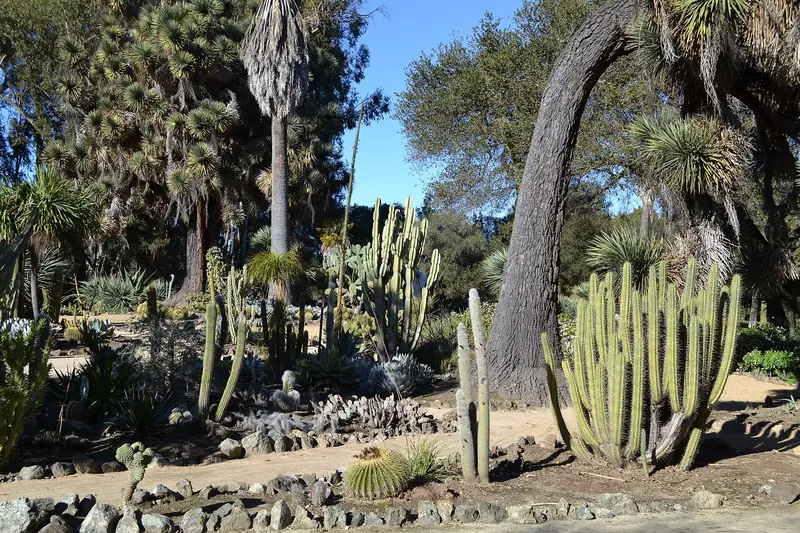
On the south side of the mausoleum, off Quarry Road, is the Arizona Cactus Garden. The landscape architect Rudolph Ulrich laid it out for Jane and Leland Stanford in the early 1880s as the backyard of the planned mansion. When their son died, the family turned to founding a university instead and the house was never built. The garden survived years of neglect and has been restored by grounds staff and volunteers. Look for the two ancient Yucca schottii, which the historical society singles out as its most remarkable plants.
Our Arizona Cactus Garden guide covers the beds, the plants and the best season to visit. Wear closed shoes because spines drift onto the paths.
Trees to look for
You do not need to be a botanist to enjoy the Arboretum, but a few specimens reward a closer look.
- Guadalupe palms: Two rare, very slow-growing Brahea edulis stand just north of the mausoleum. They date from around 1900 and grew at the first women's dormitory until 1996, when they were moved to make room for the new Sequoia Hall.
- Coast live oaks: The native evergreen oak shades much of the grove and is the most numerous tree on Stanford land.
- Eucalypts: Mature eucalyptus trees from the early plantings still tower over parts of the Arboretum, including some rare species.
- A filifera yucca: Another old yucca, Yucca filifera, grows just north of the Cantor Arts Center on the way in.
The tree maps and walks on trees.stanford.edu let you identify what you are standing under. Bird lovers should bring binoculars. Oaks and open lawns draw woodpeckers, jays and raptors. Our birdwatching guide and our page on Palo Alto's urban forest cover more places to look.
Walking routes
The memorial area is compact, so the question is mostly where you start.
| Starting point | Route | Time each way |
|---|---|---|
| Cantor Arts Center | Walk west from the museum through the trees toward Quarry Road and the mausoleum | About 10 to 15 minutes |
| Anderson Collection | Pass Beverly Pepper's Stanford Columns on the Arboretum lawn, then continue west | About 10 to 15 minutes |
| The Oval | Walk north along the Palm Drive edge of the Arboretum, then cut west toward Quarry Road | About 15 to 20 minutes |
A good short loop links all three memorials and the cactus garden:
- Start at the Cantor Arts Center and see the Rodin Sculpture Garden on its east side.
- Walk west into the Arboretum to the Angel of Grief.
- Continue a few steps south to the mausoleum and the Stanford Family statue.
- Circle to the south side for the Arizona Garden.
- Return east through the trees toward the Anderson Collection or Palm Drive.
Our self-guided campus walk folds this loop into a longer route with the Main Quad and Stone River. The museums are covered in our guides to the Cantor Arts Center and the Anderson Collection.
The Stanford Historical Society has run free docent tours of the Arboretum during Reunion Homecoming. Its 2024 tour met at the Cantor entrance, lasted about an hour and capped each group at 25 people. Watch the society's events page if you want a guided version.
The Mausoleum Party
Ask a Stanford alum about the mausoleum and many will mention "Maus," the student Halloween party once held on the lawn in late October. It was a student tradition run by class leadership, not a public event. Wikipedia says it was called off from 2002 to 2005 and revived in 2006.
We could not confirm that it currently happens. The most recent Stanford calendar listing we found for a Mausoleum Halloween event was a spooky walk on October 29, 2022, organized by the Office of Student Engagement and listed as free to Stanford students. Stanford had not published a 2026 Mausoleum event when this page was updated on October 30, 2026. If you are visiting around Halloween, treat the area as a quiet memorial and check the Stanford events calendar for anything new. Our Palo Alto in October page lists public Halloween options in town.
Good to know
- Plan restroom stops at the Cantor or the Anderson Collection during museum hours.
- Some paths under the trees are unpaved, so expect uneven ground with a stroller or wheelchair.
- Weekends are the easy days to park nearby. See our Stanford parking and transit guide for zones and payment.
- Late afternoon light filters well through the oaks and flatters the marble.
Frequently asked questions
Where is Leland Stanford buried?
Leland Stanford, Jane Stanford and their son Leland Jr. are entombed in the Stanford Family Mausoleum in the Stanford Arboretum. It stands between Palm Drive and Quarry Road, north of Campus Drive, a short walk from the Cantor Arts Center.
Can you go inside the Stanford Mausoleum?
No. The tomb is sealed and visitors see it from outside. Wikipedia reports that the doors are opened once a year for a wreath laying tied to the university's founders' celebrations, but Stanford does not run public visits.
What is the Angel of Grief at Stanford?
It is a marble memorial to Henry Clay Lathrop, Jane Stanford's youngest brother, copied from William Wetmore Story's Angel of Grief. The first version was wrecked in the 1906 earthquake and the one you see today was put in place in 1908.
Is the Stanford Mausoleum Party open to the public?
No. The Halloween party at the Mausoleum has been a student tradition and Stanford's most recent calendar listing for a Mausoleum Halloween event, in 2022, was open to students only. Stanford had not published a 2026 event when this page was updated.
How long does it take to walk the Arboretum?
The memorial area and the Arizona Garden take 30 to 45 minutes at an easy pace. Walking in from the Cantor Arts Center takes about 10 to 15 minutes each way.