On this page
Professorville is the easiest historic district in Palo Alto to explore on foot. The streets are flat, the blocks are short and the houses sit close to the sidewalk. Many of them were built between the 1890s and 1920s for Stanford's first faculty, who could only lease land on campus and bought lots in the new town instead. This tour strings together the district's best-documented buildings in a logical order, from a radio pioneer's lab site to a public garden.
Every stop below is a listed landmark, a National Register property, a public building or a house that appears on the City of Palo Alto's Historic Inventory. Addresses are given only where an official list publishes them. For the neighborhood's background, read our Professorville guide first.
Before you go
The route runs about 2 miles one way and takes 1.5 to 2 hours. It starts six blocks from the Palo Alto Caltrain station and ends at Gamble Garden on Embarcadero Road, about a mile from the station. Most streets have wide sidewalks and street trees, so summer afternoons stay pleasant. Late afternoon light is best for photos of brown shingles.
- Getting there: Take Caltrain to Palo Alto and walk east on University Avenue, then south on Emerson Street. Our Caltrain guide covers tickets and timetables.
- Parking: Many blocks near downtown have residential permit rules. Read the signs before leaving a car for two hours.
- Restrooms and food: Plan on downtown before you start. There is nothing commercial inside the district.
The route, stop by stop
- Federal Telegraph plaque, Channing Avenue at Emerson Street. California Historical Landmark No. 836 marks the lab where Lee de Forest worked on the vacuum tube amplifier and oscillator between 1911 and 1913. The building is gone. The bronze plaque on the southeast corner is the thing to see.
- Museum of American Heritage, 351 Homer Avenue. Walk one block north to Homer and turn right. The museum occupies the Williams House, a 1907 design by Ernest Coxhead that the city rates Category 2. It is the rare historic house here you can enter. Its garden is a nice break. Check our museum guide for current days and hours.
- Woman's Club of Palo Alto, 475 Homer Avenue. A clubhouse rather than a home, listed on the National Register on January 7, 2015. Note how its shingles and broad roof match the houses around it.
- T. B. Downing House, 706 Cowper Street. Turn right on Cowper. This house joined the National Register on October 30, 1973, one of the first in Palo Alto to do so. The city inventory puts it in Category 1, its top tier.
- The HP Garage, 367 Addison Avenue. Continue south on Cowper and turn right on Addison. The National Register lists the property as the Hewlett-Packard House and Garage. It is California Historical Landmark No. 976 and was dedicated as the Birthplace of Silicon Valley in 1989. HP owns it and it is not open, but the plaque and garage are visible from the sidewalk. See our HP Garage page.
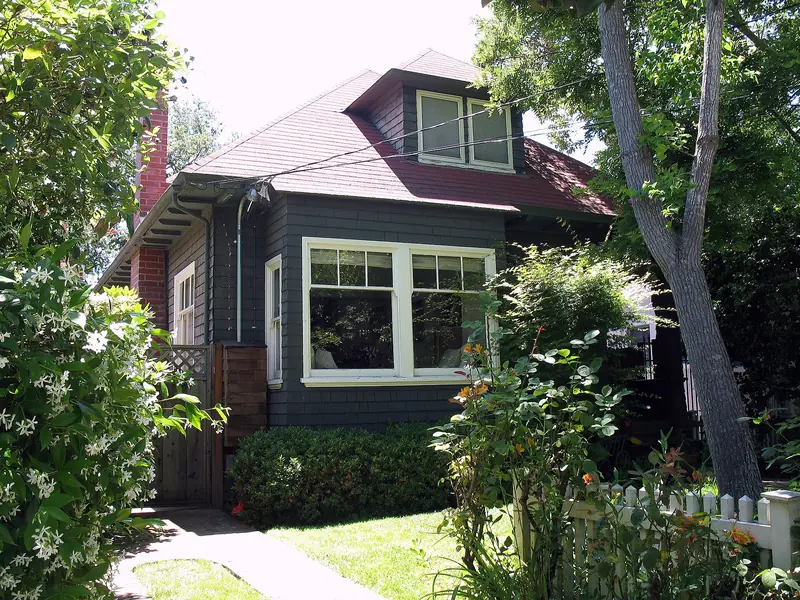
- 944 Bryant Street. Walk to Bryant and turn left. This small cottage is a contributor to the Professorville district. From 1906 Maude Wilson and Alice Kelly ran the Bungalow Photographic Studio here.
- Frank Angell House, 1005 Bryant Street. Built for the founder of Stanford's psychology department and rated Category 2 by the city. The National Park Service has called it a classic example of the district's style. A few doors on, 1044 Bryant is another inventory house.
- Sunbonnet House, 1061 Bryant Street. Bernard Maybeck designed it for Emma Kellogg. The curved porch roof gives it the name. It is also rated Category 2.
- Lincoln Avenue. Detour a block along Lincoln. The city inventory rates several houses here as high as Category 1. Among the early faculty homes are the 1893 house built for engineering professor Charles Wing and the 1901 Colonial Revival home of Nathan Abbott, the first dean of Stanford Law School.
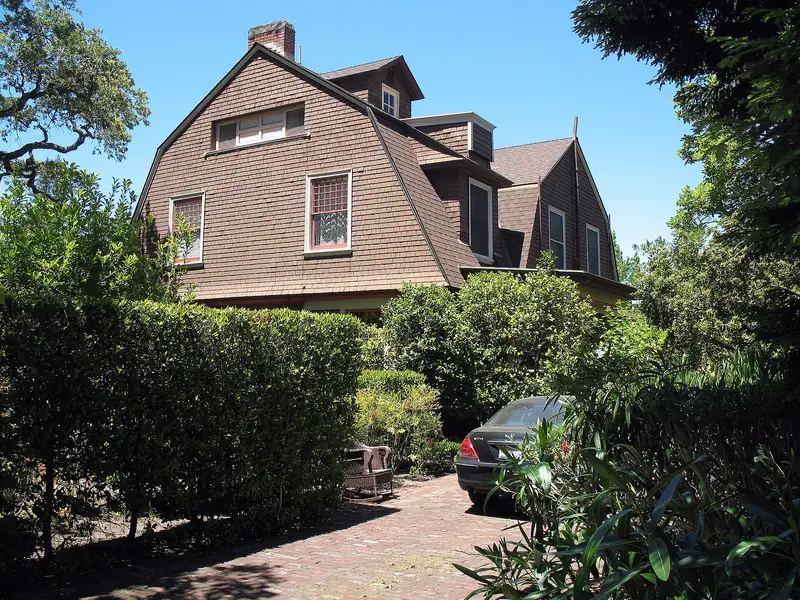
- Kingsley Avenue, 400 block. Head to Kingsley and walk east. The Fernando Sanford House at 450 Kingsley has a Queen Anne corner tower and a Palladian window. Across the street, 433 Kingsley was the home of Michael and Sarah Stein from 1935 to 1949. Both are Category 2. Watch for the Dutch Colonial gambrels that line this street.
- Charles Henry Gilbert house, 433 Melville Avenue. One block south. Arthur B. Clark, a Stanford art professor and the father of Birge Clark, designed it for the founding chair of Stanford's zoology department. Category 2.
- Theophilus Allen House, 601 Melville Avenue. Walk east on Melville past Waverley and Cowper. Listed on the National Register on May 20, 1999. The city rates it Category 1.
- Norris and Pettigrew houses, Cowper Street. Turn right on Cowper. The Norris House at 1247 Cowper, a Birge Clark design, was listed on the National Register on July 24, 1980. The Pettigrew House at 1336 Cowper followed on November 25, 1980. Both are Category 1.
- Elizabeth F. Gamble Garden, 1431 Waverley Street. Cross Embarcadero Road with the signal and finish in the garden. The 1902 Gamble house was the first home built south of Embarcadero. The grounds are free and open daily. See our Gamble Garden guide.

What to look for along the way
Professorville rewards slow walking. The district's National Register nomination counted 105 contributing houses built between the 1890s and 1929. They share a scale and a palette more than a single style. Train your eye on a few details:
- Brown shingles. Unpainted or stained cedar shingles are the signature of the First Bay Tradition, a Bay Area movement that favored natural materials.
- Gambrel roofs. The two-pitched barn roof shows up on the Dutch Colonials of Kingsley Avenue.
- Porches and small-paned windows. Deep porches faced the street when neighbors still walked to campus.
- Garages at the back. Most lots were built out by the 1920s with a detached garage behind the house, like the one at 367 Addison.
- Flag lots. Big early parcels were later split, so you will see newer homes tucked behind older ones.
The neighborhood also mixes in Queen Anne, Craftsman, Tudor and Spanish Revival houses. Our Palo Alto architecture guide explains each style and where else to find it.
How the houses are rated
You will see category numbers throughout this tour. They come from the city's Historic Inventory, first adopted in 1979. Category 1 is an "Exceptional Building" of national or state importance. Category 2 is a "Major Building" of regional importance. Categories 3 and 4 are "Contributing Buildings" that are good local examples of a style. Professorville is also one of two locally designated districts, so houses without a number may still count as district contributors. The city's historic registers page links to the full list. Our historic homes guide explains what the categories mean for owners.

Sidewalk etiquette
Good to know
- Every house on this route except the museum is a private residence. Stay on the public sidewalk.
- Do not walk up driveways, onto porches or into side yards for a better angle.
- Photos from the sidewalk are fine. Skip drones and avoid photographing people.
- Keep groups small and voices low, especially early in the morning.
- Bryant Street is a busy bike boulevard. Cross with care at school times.
Shorter and longer versions
The one-hour version. Skip stops 1 to 4 and start at the HP Garage. Walk Bryant, Kingsley and Melville and finish at Gamble Garden. This is roughly the loop on our neighborhood page.
Add downtown. Before stop 1, walk the 500 block of Ramona Street and see Birge Clark's 1932 post office on Hamilton Avenue. Our downtown architecture walking tour covers those buildings in detail.
Keep going south. From Gamble Garden, continue into Old Palo Alto with our Old Palo Alto walking tour, which starts at the same corner. Together they make a half-day walk of about 4.5 miles.
If you would rather listen than read, browse self-guided audio tours for the Bay Area and pair one with this route.
The story behind the route
Timothy Hopkins laid out University Park in 1887, the town that soon took the name Palo Alto. Its deeds banned the making and sale of alcohol, which pleased Leland and Jane Stanford. When the university opened in 1891, professors who wanted to own their homes looked to the blocks just south of University Avenue. Land there was subdivided from about 1889. Tradespeople, students and families lived alongside the faculty, so the district was never only for professors.
By midcentury many of the big houses had become rentals. Interest in preservation grew in the 1970s, which is why several listings on this route date to 1973 and 1980. The district joined the National Register on October 3, 1980. The city later expanded its local district east to Embarcadero Road in 1993 and publishes design guidelines for owners who remodel. For more of the town's early years, see our founding of Palo Alto page.
Two state landmarks on this route also tie the neighborhood to electronics. De Forest's work at Federal Telegraph and Hewlett and Packard's garage sit less than half a mile apart. Our Silicon Valley history page picks up that thread.
Sources
Listing dates and reference numbers come from National Park Service records as summarized by Wikipedia. Category ratings come from the City of Palo Alto's Historic Inventory list. House histories follow the city's Professorville materials, the district nomination and Palo Alto Stanford Heritage. If a detail on a plaque differs from this page, trust the plaque.
Frequently asked questions
How long does the Professorville walking tour take?
The route is about 2 miles from the Federal Telegraph plaque to Gamble Garden. Allow 1.5 to 2 hours with time to read plaques and look at houses. Add an hour if you go inside the Museum of American Heritage.
Where should I start a Professorville walk?
Start at the state landmark plaque at Channing Avenue and Emerson Street, about a 10 minute walk from the Palo Alto Caltrain station. The route then works south and east and finishes at Gamble Garden on Embarcadero Road.
Can I go inside any Professorville houses?
Only one historic house on the route is regularly open: the 1907 Williams House at 351 Homer Avenue, home of the Museum of American Heritage. Gamble Garden's grounds are also open to the public. Everything else is a private home, so stay on the sidewalk.
Is the HP Garage on the Professorville tour?
Yes. The garage at 367 Addison Avenue is California Historical Landmark No. 976 and on the National Register. HP owns the property and it is not open, but you can see the garage and plaque from the sidewalk.
Are there guided tours of Professorville?
Palo Alto Stanford Heritage has offered docent-led neighborhood walks in some years. Check its announcements, or use this self-guided route any day of the week.