On this page
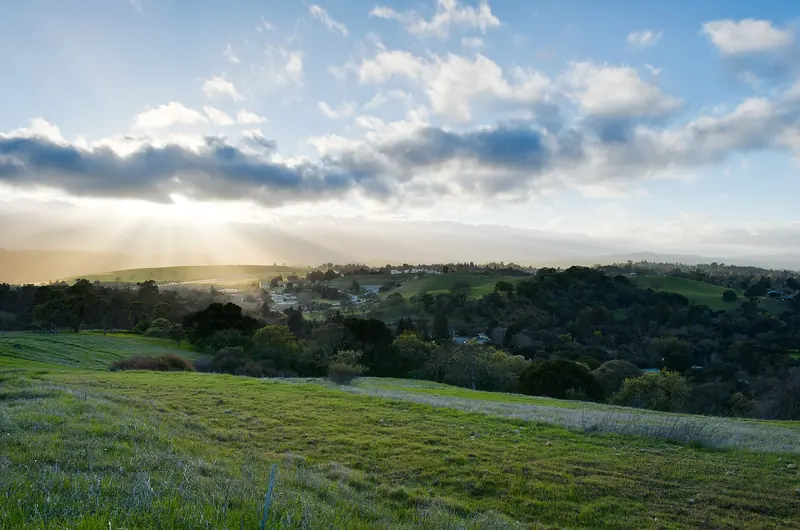
Old campus photos show students paddling boats across open water. Today's visitors usually find a broad grassy bowl ringed by oaks and a walking path. Both are Lake Lagunita. The lake was built as a farm reservoir, became the center of student recreation for a century and is now managed as a seasonal wetland and home to a threatened salamander. Stanford's own conservation staff simply call it Lagunita.
It is a pleasant, flat walk close to the center of campus and one of the best spots on the grounds to see wildlife. This page explains why the lake is usually dry, what Stanford has done to restore its habitat and how to visit without disturbing anything. Our Stanford visitor guide covers parking and transit.
Where it is
Lagunita lies behind Roble Hall on the southwest side of central campus, between the student residences along Santa Teresa Street and Junipero Serra Boulevard. Beyond the boulevard rise the Stanford foothills and the Dish. Tresidder Union and White Plaza are about a 10 minute walk to the northeast, which makes them the natural place to grab food before or after. See our guide to Tresidder and Old Union.
An earthen dam forms about two thirds of Lagunita's edge, according to Stanford's Habitat Conservation Plan documents. The trail follows the top of that dam and the rest of the rim, so you look down into the basin the whole way around.
History: from farm reservoir to boating lake
Stanford's interpretive signs at the lake lay out a long timeline.
- Before the ranchos: The wetland would have drawn plants and animals important to the Muwekma Ohlone people, such as tule rush and elk. Our page on the Ohlone has the wider story.
- 1841: The area became part of the Rancho Rincón de San Francisquito land grant. A map of the period marks an "aguajito," a small watering hole, next to a house that archaeologists link to a shepherd who worked for the grantee. See our page on the Spanish and Mexican era.
- 1876 to 1903: Laborers at Leland Stanford's Palo Alto Stock Farm dug out the existing wetland to create a reservoir. Its first job was watering and feeding around 1,000 horses. Our Stock Farm history explains the horse operation.
- 1893 to 2000: In wet years, water from nearby creeks and reservoirs topped up the basin to the dam's crest for boating in winter and spring. Even then, the lake always dried out by summer.
- 1960s onward: As environmental law and Stanford policy changed, the university moved away from recreation at the lake, which harmed wildlife there and took water from nearby ecosystems.
For much of the 20th century Lagunita was a focal point of student life. Stanford News recounts the Water Carnival of the early 1900s, later revived as the Hydro Follies and Aqua Follies. The Big Game bonfire, lit before the rivalry football game with Cal, was held at the lake too. A 2010 Stanford Magazine article quoted by Stanford News summed up the change by describing a lake that is now dry most of the time and never full.
Why it is usually dry
Lagunita has no creek of its own. Stanford's Conservation Program explains that it is fed by runoff from the foothills and by rain falling directly into the basin. It does not drain into any other body of water. Instead, water leaves by soaking into the ground and by evaporation. The sandy basin is so porous that roughly an Olympic swimming pool's worth of water can seep into the aquifers below in two days. That recharges groundwater the wider community uses.
So the lake follows the weather. After a wet winter, the bowl may hold water through winter and into spring. In a dry year it may not fill at all. It always dries out by summer. Stanford can send water from its non-potable Lake Water system, which draws on Felt and Searsville reservoirs, into Lagunita, but only under special circumstances.
Climate makes filling less likely. The signs at the lake cite droughts in 1976 to 1977, 1987 to 1992, 2007 to 2009, 2012 to 2016 and 2021 to 2023. They also show average temperatures at Lagunita rising by more than 3°F between 1946 and 2023. For the seasons in Palo Alto, see our weather guide.

California tiger salamanders
The California tiger salamander is the reason Lagunita is managed the way it is. The species lives only in California and is at risk of extinction, mostly from habitat loss. Stanford's population is the northernmost on the San Francisco Peninsula and the Conservation Program says salamanders have bred at Lagunita since the early 1900s.
The animals spend most of their lives underground in burrows dug by ground squirrels and other small mammals. Their year runs roughly like this, according to Stanford's signs:
- November to March: On rainy nights, adults migrate to seasonal pools to breed.
- January to March: Eggs laid on plants at the water's edge hatch after 2 to 4 weeks.
- February to July: Larvae grow in the water and transform into juveniles as the pool dries.
- From June: Juveniles move into burrows, where they stay until they are ready to breed.
Stanford tracks the adults by photographing the unique spot pattern on each animal's back and matching it against a database. Its rough estimates of the adult population have centered around 1,500 over recent winters, with swings from year to year. Lagunita also supports a small population of common gartersnakes that are an intergrade related to the endangered San Francisco gartersnake. Stanford estimates fewer than 30 of them.
Restoration and habitat work
Lagunita and both species are covered by Stanford's Habitat Conservation Plan. The U.S. Fish and Wildlife Service approved the plan in 2013, California added minor changes in 2016 and it runs for 50 years. Under it, the public may not enter the basin. Published projects include:
| Project | When | What it does |
|---|---|---|
| Wildlife tunnels | Early 2000s | Three tunnels under Junipero Serra Boulevard let salamanders cross to the Dish foothills. Before them, hundreds could die on the road in one rainy night. |
| Breeding ponds | Working since 2006 | Eight ponds in the Dish foothills give salamanders safer places to breed. In 2024 breeding was recorded in six of the eight. |
| Drift fences | 2017, with USGS | Low fences steer migrating animals into the tunnels. Camera traps record their movements. |
| Cover piles | Ongoing | Log and rock piles shelter ground squirrels, whose burrows the salamanders use. |
| Plant work | Ongoing | Weed control, native plant restoration and more narrow-leaved milkweed for monarch butterflies. |
The Conservation Program counts more than 411 species at Lagunita, from fungi and fairy shrimp to great blue herons that hunt salamander larvae. In the dry season, ground squirrels, gopher snakes and red-tailed hawks take over the bowl.
Walking the loop
The trail circles the basin along the rim and the dam. It is mostly flat and works for a short stroll, an easy jog or a lunchtime break. Twelve wooden posts along the trail carry "Year in the Life of Lagunita" signs and larger panels explain the history, the wildlife and the water. Stanford posts the text of the signs online in English and Spanish.
- Best time: After winter storms, when the bowl may hold water and ducks arrive. Late afternoon brings good light over the foothills.
- Dogs: Stanford asks that dogs stay leashed and that everyone stays on marked trails away from the water's edge. Our dog-friendly places guide lists off-leash options in town.
- Running: The loop pairs well with the Dish trail across the boulevard. Our running routes guide has more.
- Wildlife: Bring binoculars. See our birdwatching guide for other local spots.
Good to know
- Do not walk into the basin, even when it is dry. Eggs, larvae and fairy shrimp cysts live in the soil and access is prohibited under the conservation plan.
- Never pick up a salamander. Federal and state law protect them and any activity that could harm them needs permits.
- On rainy nights from November to March, drive slowly on Junipero Serra Boulevard and nearby campus roads.
- Stanford's Conservation Program takes volunteers and publishes a quarterly newsletter if you want to help.
- Pair the walk with the Dish hike or a stroll through the Arboretum.
Frequently asked questions
Why is Lake Lagunita dry?
Lagunita is a seasonal wetland fed mostly by runoff and rain. Water seeps into the porous basin and evaporates, so it always dries out by summer and in some years does not fill at all. Stanford stopped filling it for recreation as conservation priorities changed.
Can you swim or boat in Lake Lagunita?
No. Boating ran from 1893 to 2000 according to Stanford's interpretive signs. Today the basin is protected habitat under Stanford's Habitat Conservation Plan and access to the lakebed is prohibited.
Are there salamanders at Lake Lagunita?
Yes. Lagunita is a breeding site for the California tiger salamander, a threatened species found only in California. Stanford's Conservation Program estimates the adult population at roughly 1,500 animals, though it varies from year to year.
Can I walk around Lake Lagunita?
Yes. A trail runs around the rim of the basin and 12 wooden interpretive posts along it explain a year in the life of the wetland. Stay on the trail and keep dogs leashed.
What are the tunnels under Junipero Serra Boulevard?
They are wildlife tunnels built in the early 2000s so salamanders can cross between Lagunita and breeding ponds in the Dish foothills without being hit by cars. Drift fences added in 2017 guide the animals into them.