On this page
Students call Stanford "the Farm" for a reason. The campus sits on what was once one of the most famous horse operations in the world, the Palo Alto Stock Farm. Leland Stanford spent a fortune breeding trotters here. He also paid a photographer to settle a question about how horses move. The answer changed photography for good.
This page covers the stock farm from Stanford's first land purchase in 1876 to its closing in 1903, Eadweard Muybridge's experiments on its track and the Red Barn that still stands. For the university that grew out of the farm, see our history of Stanford.
From Mayfield Grange to the stock farm
Leland Stanford had made his fortune with the Central Pacific Railroad and had already served as governor of California. He started buying fast horses in 1869, according to Stanford Magazine. He needed room to breed and train them.
In 1876 he bought Mayfield Grange, about 650 acres along San Francisquito Creek. The estate had belonged to George Gordon, who had assembled it from the old Rancho San Francisquito. Stanford bought another 619 acres from a neighbor, D. Hoag, around the same time. Over the next decade he kept buying. By 1891 his holdings had grown to more than 8,000 acres, including land from the Robles family's old rancho. Our page on the Spanish and Mexican era explains where those parcels came from.
Stanford named the operation the Palo Alto Stock Farm, after the redwood by the creek. The name would later pass to the town next door.
A farm built for speed
At its height the farm was huge. According to the Stanford Red Barn's own history, it had two dozen buildings, 50 paddocks and eight training tracks. It employed 150 workers and boarded 600 horses. Stanford owned more than 700 horses within two decades of his first purchases. The New York Times called the farm "the foremost establishment of its kind in the world."
Stanford focused on trotters, the harness racing horses that pull a light sulky at a fast trot. He had his own ideas about training. Under what became known as the Palo Alto System, horses learned to trot as yearlings instead of waiting until they were adults. Many horsemen doubted him. The results answered them.
Electioneer and the records
The farm's star was a stallion named Electioneer. Stanford bought him in 1877 for $12,000, over the objections of experts, as Stanford Magazine tells it. Electioneer never raced, but he became one of the most successful sires of his era. Over 14 years at the farm he sired 166 colts that could trot a mile in under two and a half minutes, according to the Red Barn history.
- Stanford's horses set 19 consecutive world records.
- In 1891 they held the trotting mile record in every age group.
- Electioneer's daughter Sunol trotted her best mile in 2:08¼.
- A descendant named Cambest later paced a record mile in 1:46.1.
A statue of Electioneer, donated by the Lane family in 1985, stands at the Red Barn today.
Muybridge and the question of flight
Horse people in the 1870s argued about whether a trotting horse ever has all four feet off the ground at once. The eye could not tell. Stanford wanted proof. He hired Eadweard Muybridge, an English-born photographer known for his views of Yosemite and San Francisco.
A story often repeated says Stanford made a large bet on the answer. Historian Phillip Prodger calls that tale apocryphal because no primary account of a wager exists. What is documented is a series of experiments that took years.
- 1873: Muybridge first tries to photograph Stanford's trotter Occident in action. The image is blurred and never published.
- July 1877: He photographs Occident at speed at the Union Park track in Sacramento. The picture sent to newspapers is a retouched painting, not a true photograph.
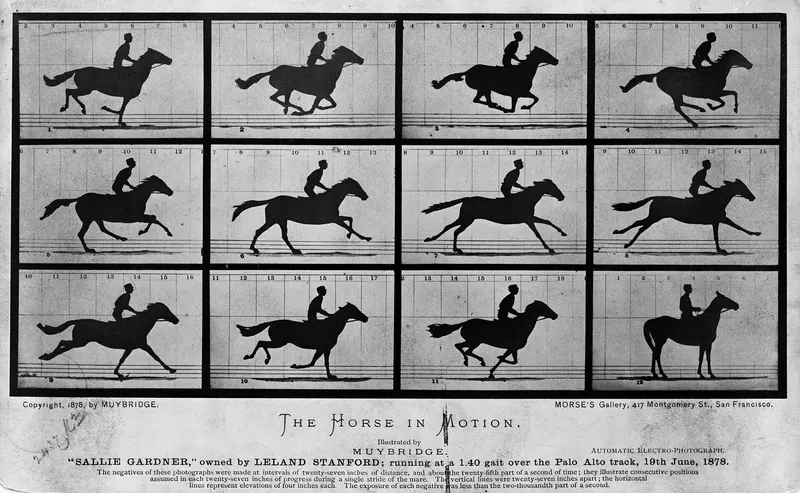
- June 15, 1878: On the stock farm track, before invited turfmen and reporters, the trotter Abe Edgington pulls a sulky past a row of 12 cameras. Wires laid across the track trip each shutter in turn.
- June 1878: The running mare Sallie Gardner is photographed the same way. A saddle girth breaks during the run and the frames record it. Sources date this series June 15 or June 19.
- July 15, 1878: Muybridge registers the photograph cards for copyright.
- October 19, 1878: Scientific American puts engravings from the cards on its cover.
- 1879: Work continues at Palo Alto with 24 cameras.
The pictures showed that a horse at speed does lift all four feet off the ground. It happens when the legs are gathered under the body, not stretched out front and back as painters had drawn for centuries.

From still frames to motion pictures
Muybridge did not stop at proving a point. Around 1880 he introduced the zoopraxiscope, a device that projected images painted from his photographs in sequence so they appeared to move. Historians of film treat it as an important step toward cinema.
The partnership ended badly. In 1882 Stanford published a book called The Horse in Motion, written by his friend J. D. B. Stillman, which used Muybridge's work but did not credit him as an author. The Royal Society of Arts withdrew its support for Muybridge and his lawsuit against Stanford was dismissed. Muybridge moved on to the University of Pennsylvania, which published his huge study Animal Locomotion in 1887 with 781 plates.
The state recognizes the Palo Alto experiments as California Historical Landmark No. 834, honoring Muybridge and the development of motion pictures. Its plaque on Campus Drive West, across from the Stanford driving range, says the research was conducted in 1878 and 1879 using "a battery of 24 cameras fitted with electroshutters." State Parks placed it on April 30, 1983, with E Clampus Vitus. Wikipedia dates the landmark designation itself to 1969.
The farm becomes a university
In 1884 the Stanfords' only son died of typhoid fever at 15. The next year they signed the founding grant for Leland Stanford Junior University and chose the stock farm as its site. The farm and the university ran side by side for years.
That arrangement shaped the town next door too. The university needed housing, so Timothy Hopkins laid out University Park on farmland across the railroad in 1887. Our page on the founding of Palo Alto tells that story.
Leland Stanford died in June 1893. The university was short of money while his estate was in court. Horses were auctioned, often at low prices. In 1918, at a Founders' Day ceremony, university president David Starr Jordan called them "the horses that saved the University," which Stanford Magazine treats as an exaggeration. The farm officially closed in 1903, ten years after Stanford's death.
The Red Barn today
The most visible survivor is the Red Barn, built between 1878 and 1880 as the farm's training stable. It is a wooden building in the Stick-Eastlake style. Its architect is unknown. After a fire destroyed an earlier stable in 1888, Stanford ordered a fireproof brick stable nearby. It survives too and now houses the equestrian team clubhouse.
| Year | Red Barn milestone |
|---|---|
| 1878 to 1880 | Built as the stock farm's training stable |
| 1903 | Stock farm closes |
| 1946 | President Donald Tresidder reopens it for riding |
| 1983 | Restoration led by Ambassador Bill Lane and local equestrians |
| 1985 | Listed on the National Register on December 12 as the Palo Alto Stock Farm Horse Barn |
| 2005 | Reopens in October after a renovation funded by the John Arrillaga family |
Nearby is a quiet horse cemetery in an oak grove. About 15 of Stanford's horses are buried there. A bronze Arabian horse statue marks the spot, a 1926 gift from Timothy Hopkins and his wife.
Good to know
- The Red Barn is a working equestrian center at 621 Fremont Road, run by Stanford Recreation. Riding programs, lessons and boarding take place there.
- Be respectful of riders and horses. Check Stanford's Red Barn page for current access before you go.
- Campus parking rules change often. See our Stanford parking guide before you drive.
A stock farm walk
The farm's traces are spread across the west side of campus. A bike makes the loop easy.
- Start at the Red Barn on Fremont Road off Campus Drive West. Look for the Electioneer statue.
- Find the Muybridge landmark plaque on Campus Drive West across from the driving range.
- Ride or walk toward the Main Quad, which stands on former farm land. Our self-guided campus walk continues from there.
- End at the Cantor Arts Center, which began as the Leland Stanford Junior Museum.
If you want a guide, a Stanford and Silicon Valley tour can cover the campus highlights. For the full sequence of events, see the Palo Alto timeline.
Frequently asked questions
Why is Stanford called the Farm?
The university was built on Leland Stanford's Palo Alto Stock Farm, a horse breeding and training operation he began in 1876. The farm kept running beside the young university until 1903. Students and alumni still call the campus the Farm.
Where did Muybridge photograph the galloping horse?
On the training track of the Palo Alto Stock Farm, now part of the Stanford campus. In June 1878 he used a row of 12 cameras triggered by wires to capture horses in motion. California Historical Landmark No. 834 on Campus Drive West marks the work.
Did Leland Stanford make a bet about horses' hooves?
The story of a large wager is popular but historians such as Phillip Prodger call it apocryphal, since no primary account of a bet exists. Stanford did want to prove that a trotting horse has all four feet off the ground at some point in its stride.
Can you visit the Stanford Red Barn?
The Red Barn is part of the Stanford Red Barn Equestrian Center at 621 Fremont Road, a working facility with riding programs and boarding. The building can be seen from outside and a plaque recalls the Muybridge experiments. Check Stanford Recreation's site for current access before going.
What happened to the stock farm?
After Leland Stanford died in 1893 the university faced a financial crisis and horses were sold at auction. The farm officially closed in 1903. The Red Barn was reopened for riding in 1946.