On this page
Most universities grow out of a church, a state law or a group of founders with a mission. Stanford grew out of grief. Leland and Jane Stanford had one child and lost him at 15. Within two years of his death they had given their Palo Alto farm and much of a railroad fortune to a new university that would carry his name.
This page follows the university from that beginning to the present. It covers the founding grant, the shaky first decade, Jane Stanford's role and her unsolved death, the 1906 earthquake, the Terman years that tied Stanford to the tech industry and the changes of recent decades. For the story of the town that grew up beside the campus, read our history of Palo Alto. For the companies that came out of it, see Silicon Valley history.

Leland Stanford Jr. and the decision to build
Leland Stanford made his fortune as one of the Big Four behind the Central Pacific Railroad. He served as governor of California during the Civil War and later as a U.S. senator. In 1876 he began buying land along San Francisquito Creek for a horse farm. He called it the Palo Alto Stock Farm after the tall redwood by the creek.
His son, Leland Stanford Jr., was born in 1868 when his parents were well into middle age. The boy was curious and collected antiquities on family trips to Europe. In early 1884, while the family was traveling in Italy, he caught typhoid fever. He died in Florence on March 13, 1884, two months before his 16th birthday.
The Stanfords were shattered. The family story holds that Leland Sr. told his wife, "The children of California shall be our children." They considered several ways to honor their son, including a museum and a technical school. They also visited Harvard, MIT, Cornell and Johns Hopkins for advice. In the end they chose a full university built on the stock farm.
The 1885 founding grant
The Stanfords signed the founding grant on November 11, 1885. The document set out the purpose of the new institution: to "promote the public welfare by exercising an influence in behalf of humanity and civilization." It also included some unusual commitments for the era.
- Coeducation: Women and men were to be admitted on equal terms.
- Nonsectarian: The university would not be tied to any religious denomination.
- Practical aims: The founders wanted graduates prepared for "personal success and direct usefulness in life."
- Land: The farm was not to be sold. That rule explains why Stanford still leases rather than sells land for the shopping center and research park.
The landscape architect Frederick Law Olmsted drew the master plan and the Boston firm Shepley, Rutan and Coolidge designed the buildings. The cornerstone was laid on May 14, 1887. Our page on Stanford architecture covers that design story in detail.
Opening day in 1891
For its first president, the Stanfords chose David Starr Jordan, a fish biologist who was then president of Indiana University. He arrived in June 1891 and the university opened on October 1, 1891. The first class, later called the Pioneer Class, numbered 555 students. Tuition was free.
Jordan told the new students that the university was "hallowed by no traditions" and "hampered by none." Among the Pioneer Class was Herbert Hoover, an engineering student who lived in Encina Hall and graduated in 1895. He met his future wife, Lou Henry, in the geology lab. Hoover stayed tied to Stanford for the rest of his life. The tower that carries his name opened in 1941. See our guide to Hoover Tower.
Jane Stanford keeps it alive
Leland Stanford died in June 1893, less than two years after the opening. The timing could hardly have been worse. The Panic of 1893 had hit the economy and the federal government filed a $15 million claim against his estate over railroad loans. Much of the estate was frozen.
Most of the trustees advised closing the university for a few years. Jane Stanford refused. She ran the university almost single-handedly, paid faculty from the household allowance the probate court allowed her and cut her own spending sharply. In 1897 she traveled to London to sell her jewels for the university, though she came home with most of them when the offers disappointed her. The government dropped its lawsuit in 1895 and the estate was released.
Jane Stanford also shaped the campus. She built Memorial Church in her husband's memory and it was dedicated in January 1903. Our Memorial Church guide covers its mosaics and organs. In her will she directed that her jewels be sold to buy books. The Jewel Fund still supports the libraries.
An unsolved death
In January 1905, at her San Francisco mansion on Nob Hill, Jane Stanford drank mineral water that tasted bitter. Tests later found strychnine in it. Shaken, she sailed for Hawaii. On February 28, 1905, she died at the Moana Hotel in Honolulu. A coroner's jury found that strychnine had been put into a bottle of bicarbonate of soda by a person or persons unknown.
David Starr Jordan publicly insisted she died of heart failure. The case faded for nearly a century. In 2022 the Stanford historian Richard White published Who Killed Jane Stanford?, which argues that she was murdered and that university leaders helped bury the story. No one was ever charged.
The 1906 earthquake
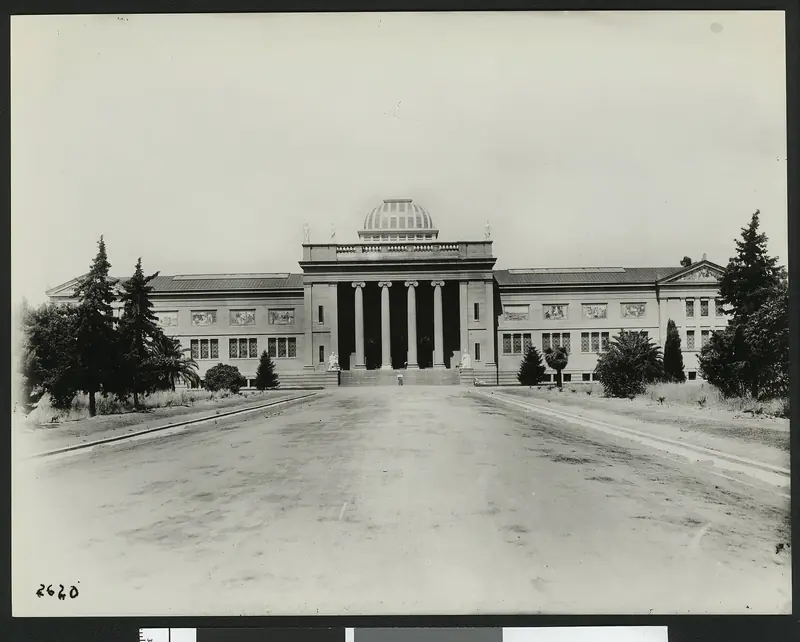
A year after Jane Stanford's death, the April 18, 1906, San Francisco earthquake struck the campus hard. Two people on campus were killed. The Memorial Arch at the entrance to the Main Quad collapsed. Memorial Church lost its spire and much of its interior. A new library and gymnasium that were still under construction were wrecked and wings of the museum were destroyed.
The university repaired the Quad and the church by 1909. The arch and the spire were never rebuilt. Broken sandstone from damaged buildings was stored for decades. Some of it came back to campus in 2001 in Andy Goldsworthy's Stone River, which our guide to public art on campus describes.
Another quake, the 1989 Loma Prieta earthquake, damaged the Main Quad, Memorial Church and the museum again. Some buildings stayed closed for years. The repairs added seismic strengthening that most visitors never notice.
Coeducation and the 500 limit
Stanford admitted women from its first day, which set it apart from most private universities of the time. By the late 1890s women made up a large share of the student body. Jane Stanford worried that the university would become known as a women's college. In 1899 she amended the founding grant to say that the number of women "shall at no time ever exceed five hundred."
The cap shaped campus life for decades. In 1933 the trustees reinterpreted it as a ratio of three men to one woman among undergraduates. In 1973 the trustees asked the courts to remove the restriction formally and admissions became sex blind. Today women and men enroll in roughly equal numbers.
| Year | Milestone |
|---|---|
| 1876 | Leland Stanford begins buying land for the Palo Alto Stock Farm |
| 1884 | Leland Stanford Jr. dies in Florence on March 13 |
| 1885 | Founding grant signed on November 11 |
| 1887 | Cornerstone laid on May 14 |
| 1891 | University opens on October 1 with 555 students |
| 1893 | Leland Stanford dies; Jane Stanford keeps the university open |
| 1899 | Enrollment of women capped at 500 |
| 1905 | Jane Stanford dies in Honolulu on February 28 |
| 1906 | Earthquake damages the Quad and Memorial Church |
| 1941 | Hoover Tower completed for the 50th anniversary |
| 1951 | Stanford Industrial Park proposed |
| 1959 | Medical school moves from San Francisco to campus |
| 1962 | SLAC is founded |
| 1973 | Limit on women formally removed |
| 1989 | Loma Prieta earthquake damages historic buildings |
| 2022 | Doerr School of Sustainability opens |
| 2024 | Jonathan Levin becomes president; Stanford joins the ACC |
Terman, Sterling and the research park
For its first half century Stanford was a respected regional university. It became a national power after World War II. Two men are usually credited. Wallace Sterling, president from 1949 to 1968, raised money and recruited faculty. Frederick Terman, an electrical engineering professor who became dean of engineering and then provost, tied the university to industry and federal research funding.
Terman encouraged his students to start companies nearby rather than head east. Two of them, Bill Hewlett and David Packard, did so in a Palo Alto garage in 1939. In 1951 Terman proposed leasing university land to technology firms. Stanford Industrial Park, created with the City of Palo Alto, got its first tenant, Varian Associates, in 1953. Hewlett-Packard leased land there in 1956 and moved its headquarters to 1501 Page Mill Road in 1960. Renamed Stanford Research Park in the 1970s, it now covers about 700 acres inside Palo Alto. The full story of those companies is on our Silicon Valley history page.
The same era brought the medical school from San Francisco to a new medical center on campus in 1959 and the founding of SLAC, the linear accelerator lab, in 1962. Stanford grew from a regional school into a research university with global reach.
Recent decades
The late twentieth century brought protests over the Vietnam War, the 1989 earthquake and a long period of growth. John Hennessy, a computer scientist, served as president from 2000 to 2016. His years saw a building boom, including the Science and Engineering Quad, Bing Concert Hall and the Anderson Collection. A new Stanford Hospital opened in 2019.
Marc Tessier-Lavigne followed Hennessy in 2016. He resigned in 2023 after a review of research papers from his lab and Richard Saller served as interim president. On August 1, 2024, Jonathan Levin, a former dean of the Graduate School of Business, took office as Stanford's 13th president. The same summer Stanford's teams left the Pac-12 for the Atlantic Coast Conference, a change covered on our Stanford sports page.
In 2022 the university opened the Stanford Doerr School of Sustainability, its first new school in decades. Stanford still owns the land the Stanfords gave it and the farm rule from 1885 remains in force.
Where to see the history on campus
Much of this story can still be seen on a short walk.
- The Main Quad: The 1887 cornerstone, the arcades and the class plaques are covered in our Main Quad guide.
- Memorial Church: Jane Stanford's memorial to her husband, rebuilt after 1906.
- Cantor Arts Center: The museum began as the Leland Stanford Jr. Museum and opened in 1894. It still displays family objects.
- The Stanford Family Mausoleum: Leland, Jane and Leland Jr. are entombed in a granite tomb in the Arboretum, next to the Arizona Cactus Garden.
- Hoover Tower: A reminder of Stanford's most famous early graduate. Its observation deck is closed until January 25, 2027.
Our self-guided campus walk links these stops into one route.
Frequently asked questions
Why was Stanford University founded?
Leland and Jane Stanford founded the university in memory of their only child, Leland Stanford Jr., who died of typhoid fever in Florence in March 1884 at age 15. The couple decided that the children of California would be their children and signed the founding grant on November 11, 1885.
When did Stanford open?
Stanford opened to students on October 1, 1891. The first class, known as the Pioneer Class, numbered 555 students. Herbert Hoover was one of them and graduated in 1895.
How did Jane Stanford die?
Jane Stanford died on February 28, 1905, at the Moana Hotel in Honolulu. A coroner's jury ruled that she died of strychnine poisoning by a person unknown, weeks after an earlier poisoning attempt in San Francisco. The case was never solved, although historian Richard White's 2022 book argues it was murder.
Was Stanford always coeducational?
Yes. Women enrolled from the first day in 1891. In 1899 Jane Stanford capped the number of women at 500. Trustees reinterpreted the cap as a three to one ratio in 1933 and had it formally removed in 1973.
Who is the president of Stanford?
Jonathan Levin became Stanford's 13th president on August 1, 2024. He followed interim president Richard Saller, who led the university after Marc Tessier-Lavigne resigned in 2023.