On this page
The first chapter of Palo Alto's history is also the longest. For thousands of years before 1769, Ohlone people lived on the land between the Santa Cruz Mountains and the bay. They knew every creek mouth, oak grove and tule marsh that later maps would cover with streets. That story did not end when the Spanish arrived. It changed shape, often painfully. It continues today.
This page gives an overview of what is known about Ohlone life in the Palo Alto area, how the mission era upended it and who carries the history now. It draws on the Muwekma Ohlone Tribe's own published history, academic work on mission records and archaeology and public sources such as the City of Palo Alto. For the wider sweep of local history, start with our history of Palo Alto.
A note on names and words
"Ohlone" is a broad name for many independent communities that lived from the San Francisco Peninsula and the East Bay south to Monterey Bay. They spoke related languages but were never one nation with one government. Older books use "Costanoan," from the Spanish word for coast people. The scholar Jack Forbes popularized "Ohlone" in 1969 because he preferred a native term to a colonial one, a choice the Muwekma Ohlone Tribe notes in its own history.
Linguists group the languages around the southern bay as San Francisco Bay Costanoan, with dialects usually called Ramaytush on the Peninsula, Tamyen (also written Thámien) in the Santa Clara Valley and Chochenyo in the East Bay. Each local community had its own name. Mission baptism records, studied closely by historians such as Randall Milliken, are the main written source for those names.
Good to know
- Use the present tense when talking about Ohlone people. They are not a vanished culture.
- Use the names communities use for themselves, such as Muwekma Ohlone, when you know them.
- Archaeological and burial sites are sacred to descendants. Their locations are kept confidential on purpose.
The Puichon of San Francisquito Creek
In 1769 the San Francisco Peninsula held about eight independent local tribes, according to the Muwekma Ohlone Tribe's background history. Two of them were tied to the San Francisquito Creek area. The Puichon lived along the lower creek, on the land that is now Palo Alto, Menlo Park, East Palo Alto and Stanford. The Lamchin lived a little farther north and west, toward today's Redwood City and Woodside.
A local tribe like the Puichon was a community of a few hundred people with one or more main villages and seasonal camps. People married across tribal lines and traded widely, so a family might have relatives in several neighboring communities. Wikipedia's article on El Palo Alto, citing local historians, places a Puichon village near the tall redwood that later gave the city its name. The exact spot is not public and should not be.
San Francisquito Creek mattered because it ran year-round in most years. It brought fresh water from the hills, shade from oaks and willows, steelhead in season and a path between the bay and the mountains. Other creeks that cross Palo Alto, including Matadero and Adobe creeks, supported smaller camps.
Food, fire and the shape of the land
The landscape the Spanish described in 1769 was not wild in the way they imagined. Ohlone people shaped it with care for centuries. Their practices included:
- Acorns. Valley oaks and coast live oaks provided the staple food. Families gathered acorns in fall, dried and stored them, then ground and leached the meal to remove bitter tannins.
- Fire. Regular, controlled burning kept grasslands open, encouraged seed plants and made hunting easier. The open oak savanna around Stanford is partly a legacy of that management.
- The bay. The marshes supplied shellfish, fish, waterfowl and tule reeds. Tule was bundled into boats and used for houses and mats.
- Plants and animals of the hills. Seeds, bulbs, berries, deer, rabbits and many other foods came from the foothills, along with materials for baskets, tools and medicine.
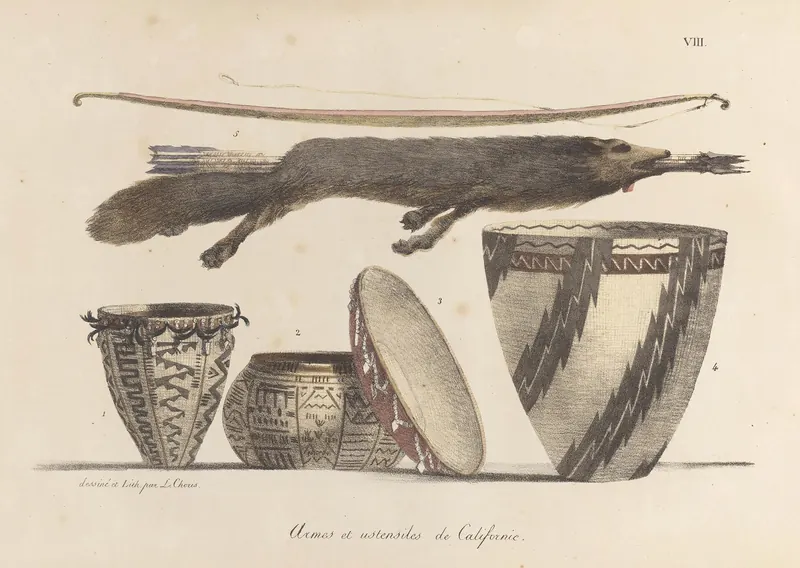
Basketry was a high art. The French artist Louis Choris, who visited the San Francisco mission in 1816 with a Russian expedition, drew Ohlone baskets and tools in close detail. His drawings are among the earliest images of Bay Area native material culture.

Shellmounds and deep time
Around the edge of the bay, generations of village life left large mounds of shell, earth, ash and other material. These shellmounds were places of daily life and also places where ancestors were buried. In 1909 the archaeologist N. C. Nelson recorded more than 425 of them around the bay. Most were later leveled for farms, roads and cities.
Shellmounds and village sites existed along the southern bay shore, including near Palo Alto. They are not marked for visitors and you should not look for them. For descendants they are cemeteries and sacred places, not curiosities. The Muwekma Ohlone Tribe's history lists archaeological sites on the Stanford campus along San Francisquito Creek among the places its ancestors lived and were buried.
Science has confirmed what Ohlone families already knew. A 2022 study in the Proceedings of the National Academy of Sciences, requested and overseen by the Muwekma Ohlone Tribal Council, compared DNA from living tribal members with ancestors from two Bay Area village sites. One site was occupied from about 490 B.C. to A.D. 1775. The researchers found "a deep signal of continuity" between the ancient and modern people. That result challenged an older theory that Ohlone ancestors arrived only around A.D. 500 to 1000.
The mission era
The Portolá expedition camped beside San Francisquito Creek in November 1769. Within eight years Spain had founded two missions within reach of the Peninsula: Mission San Francisco de Asís (Dolores) in 1776 and Mission Santa Clara de Asís in 1777. Mission San Jose followed in 1797. Our page on the Spanish and Mexican era follows the colonists' side of that story.
For Ohlone communities the result was catastrophic. Mission records show families from the Peninsula being baptized at Santa Clara and San Francisco through the 1780s and 1790s. Historians describe the pressures that pushed people in: livestock that ate the seed plants, the end of controlled burning, disrupted food supplies and the pull of relatives already at the missions. Randall Milliken titled his 1995 study of this period A Time of Little Choice.
Inside the missions, people were not free to leave. Crowded living conditions spread disease. Deaths far outnumbered births for decades. Families from different tribes were brought together and intermarried, which is why many Ohlone families today trace ancestry to several communities and languages at once. The Muwekma Ohlone Tribe notes that the three missions of Dolores, Santa Clara and San Jose were the main baptismal centers for its ancestors from 1776 to 1836.
After the missions
Mexico secularized the missions in the 1830s. Promised land rarely reached native families. Most former mission land went to Californio rancheros as grants, including the ranchos that covered today's Palo Alto. Many Ohlone people worked as laborers and vaqueros on those ranchos.
Under American rule after 1848 conditions grew worse. California law allowed forms of forced labor and offered native people little protection. Yet communities held together. In the East Bay, families gathered at rancherias near Pleasanton, Niles, Sunol and Livermore. Federal Indian agent C. E. Kelsey counted these families in a special census in 1905 and 1906. In 1910 his official map designated them the Verona Band. Federal reports into the 1920s continued to list the Verona Band, which is the basis of the Muwekma claim that the United States once recognized them.
The 1920s brought a damaging myth. Influential scholars wrote that Peninsula Ohlone people had died out. Milliken and colleagues later noted that it "was believed that the last known descendent of a native Peninsula group died in the 1920s," a belief that descendants such as the Cordero family disproved.
The Muwekma Ohlone Tribe today
The Muwekma Ohlone Tribe of the San Francisco Bay Area describes itself as the documented successor of the Verona Band. According to the tribe, Muwekma means la gente, or the people, in Chochenyo and Thámien. Its aboriginal homeland, as the tribe defines it, includes San Francisco, San Mateo, most of Santa Clara, Alameda and Contra Costa counties and parts of several neighboring counties.
The tribe's long effort to restore federal status shapes much of its public work. Key steps from the tribe's published timeline:
- 1989: The tribal council files a petition for federal acknowledgment, received by the Bureau of Indian Affairs on May 9, 1989.
- 1996: The bureau preliminarily concludes that the Verona Band was "previously acknowledged between 1914 and 1927."
- 2000 and 2002: Federal Judge Ricardo Urbina writes that the tribe was recognized by the Interior Department early in the twentieth century.
- 2002: The bureau issues a final determination. The tribe continues to contest it and seek reaffirmation.
- 2020s: Cities and universities, including UC Berkeley in 2020 and Union City in 2025, put their support for reaffirmation in writing.
The tribe has also worked on repatriation. Its timeline records the return of 550 ancestral remains from Stanford University between 1989 and 1992. More recent work includes place names, murals and parks around the South Bay, such as Muwékma Park in Sunnyvale, dedicated in 2022.
The Muwekma are not the only Ohlone voice. Other Ohlone organizations, including the Tamien Nation and the Association of Ramaytush Ohlone, also trace ancestry to the Santa Clara Valley and the Peninsula. They do not always agree on territory or history. A respectful reader listens to each and lets tribal members speak for themselves.
How to learn more and visit respectfully
Start with sources written or approved by Ohlone people. The Muwekma Ohlone Tribe's website publishes its history, timeline and ethnohistory reports. Stanford's land acknowledgment and its Native American Cultural Center offer programs during the school year.
To understand the land itself, spend time where Ohlone life was centered. Walk the levees of the Baylands Nature Preserve at high tide and look at the pickleweed and tule. Visit El Palo Alto on San Francisquito Creek, a tree already centuries old before any mission was built. In the hills, the oak grasslands of Foothills Nature Preserve and Pearson-Arastradero Preserve show the kind of country that Ohlone burning kept open.
Some practical guidelines:
- Never dig, collect shells or remove artifacts. State and federal laws protect archaeological sites and native burials.
- If you find bones or artifacts during construction or gardening, stop and contact local authorities.
- Look for events that pay tribal members for their knowledge rather than events that speak about them.
- Support tribal language and cultural programs directly where you can.
The next chapter, when Spanish soldiers and priests arrived, is covered on our Spanish and Mexican era page. For a year-by-year view, see the Palo Alto timeline.
Frequently asked questions
Who lived in Palo Alto before the Spanish?
Ohlone people lived here for thousands of years. Mission records name the local group along lower San Francisquito Creek as the Puichon. Their neighbors to the north near today's Woodside and Redwood City were the Lamchin.
Are there Ohlone people today?
Yes. Ohlone people never disappeared. The Muwekma Ohlone Tribe of the San Francisco Bay Area traces its members to people baptized at Missions Santa Clara, San Jose and San Francisco. Other Ohlone groups are active in the Bay Area too.
Is the Muwekma Ohlone Tribe federally recognized?
Not at present. The tribe describes itself as previously federally recognized through the Verona Band of Alameda County in the early 1900s. It has been seeking reaffirmation since its 1989 petition. Several local governments have passed resolutions in support.
What does Muwekma mean?
According to the tribe, Muwekma means la gente, or the people, in the Chochenyo and Thámien Ohlone languages. Elders of the Verona Band used the word for themselves.
Can I visit Ohlone sites in Palo Alto?
Archaeological sites are not public attractions and their locations are protected. The best ways to learn are the Muwekma Ohlone Tribe's own publications, the Baylands and creek landscapes that sustained Ohlone life. Museum programs that work with tribal members are worth seeking out too.