On this page
Bing Concert Hall is one of the finest rooms for music on the Peninsula. Opened in January 2013 in Stanford's arts district, it seats 842 people on terraces that wrap around the stage. Nobody sits far from the performers and the sound is clear in every section. You do not need any Stanford connection to go. Most events are open to the public and parking is free on evenings and weekends.
This guide covers the building, the type of programming Stanford Live presents, the smaller Bing Studio downstairs and the practical details of a night out: tickets, parking, food and timing.
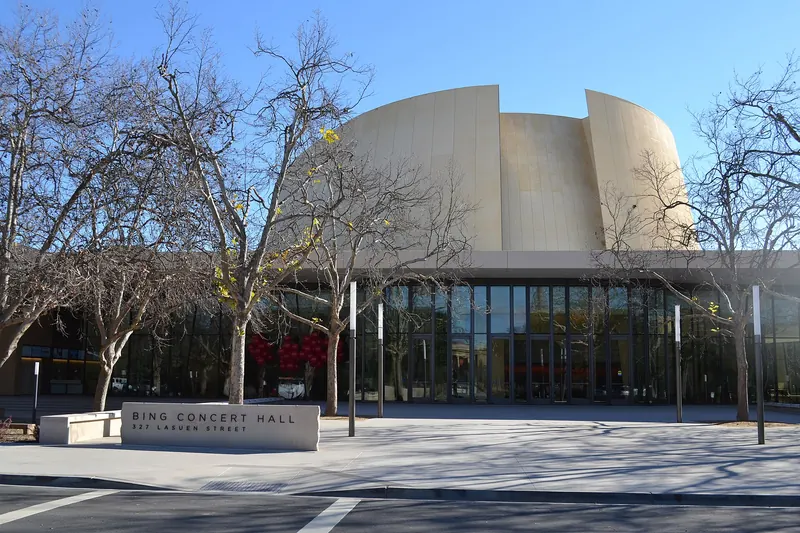

The building
Stanford had long lacked a first-rate concert hall. That changed with a $50 million lead gift from Peter S. Bing and his wife Helen Bing. Peter Bing graduated from Stanford in 1955 and the hall carries the couple's name. The final construction cost was $111.9 million, with many other donors joining.
The architect was Richard Olcott of the New York firm Ennead Architects. The same team later designed the Anderson Collection a short walk away. Our Stanford architecture guide places both buildings in the story of the campus.
Vineyard seating and acoustics
Inside, the hall uses a vineyard layout. Instead of rows facing a stage at one end, the seats sit in terraced blocks that rise on all sides of the performers, like vines on a hillside. The center section starts at stage level. According to Stanford Live, every seat is within 75 feet of the conductor.
The acoustician was Yasuhisa Toyota of Nagata Acoustics, whose firm also worked on Walt Disney Concert Hall in Los Angeles. Halls of this type aim for warmth and clarity with a strong sense of being close to the music. In practice that means even seats behind the stage feel connected to the performance. You hear the orchestra from a different angle and see the conductor's face.
Since 2017 Stanford Live has also used two other layouts for some events:
- End Stage: Extra seats on stage, all facing forward, for events that play to one direction.
- Half Stage: Seats on a terraced stage, which brings the audience even closer.
What plays there
Stanford Live is the university's performing arts presenter. It runs Bing Concert Hall, Bing Studio and Frost Amphitheater. Indoor programs fill much of the academic year, while Frost hosts outdoor shows in the warmer months.
The indoor season mixes classical music, jazz, global music, dance, theater and spoken word. Visiting orchestras, chamber groups and soloists share the calendar with contemporary artists and family shows. Stanford's own music ensembles also perform in the hall. The 2026-2027 season is listed on live.stanford.edu, which is the place to check dates and artists.
Bing Studio
Below the main hall, on its north side, is Bing Studio. It is an underground room with good acoustics and flexible seating, which Stanford Live sets up in three ways:
| Setup | Capacity | Feel |
|---|---|---|
| Cabaret | 160 seats at cocktail tables | General admission, beer, wine and snacks |
| Club | 300 standing, limited table seating | Mostly standing, beer, wine and snacks |
| Theater | 80 to 160 seats | Rows of seats, usually no concessions |
Studio listings have included comedy, jazz and blues, folk, spoken word and theater. Every configuration uses the main Stanford Live ticket office and guests enter through the main doors of the hall.
Tickets
You can buy tickets in three ways:
- Online at live.stanford.edu. Online orders carry an order fee.
- By phone through the Stanford Live ticket office at 650.724.2464.
- In person at the ticket office inside Bing Concert Hall, 327 Lasuen Street. It is open Tuesday to Friday from noon to 5 p.m. Use the doors furthest to the left. Buying in person skips the online order fee.
Stanford Live offers discounts for some groups and members get presales. Details are on its tickets and policies page. Avoid resale sites. The ticket office will not replace tickets bought through eBay, Craigslist, StubHub or other secondary markets.
On the night
- Lobby and will call open 60 minutes before the performance. Bring photo ID to collect tickets.
- Hall doors open 30 minutes before curtain.
- Late arrivals are seated at a break chosen by the artists. Some performances allow no late seating at all, so arrive early.
- Food and drink: Beverages and small snacks are sold before the show and at intermission.
- Reminder email: Ticket buyers get a know-before-you-go email at noon the day before the show with parking details.
- Accessibility: Stanford Live publishes accessibility information for its venues on its accessibility page. Mention any seating needs to the ticket office when you buy so staff can plan ahead.
- Lost something? Fill in Stanford Live's lost item form. It says it will reply within three business days if the item turns up.
Parking and getting there
Bing is on Lasuen Street in the arts district, near the Cantor Arts Center, the Anderson Collection and Frost Amphitheater. Parking is on Lasuen Street, Museum Way, Roth Way and in the Galvez Lot. According to Stanford Live, parking in metered and lettered zones is free on weekdays after 4 p.m. and all day on weekends. Lots near the hall fill quickly before big shows, so allow 30 minutes to park and find your seat. Disabled parking and loading rules are enforced at all times.
Driving from Highway 101, take the Embarcadero Road exit. From Interstate 280, use Sand Hill Road or Page Mill Road. Cyclists will find 244 bike racks in front of the hall. Bikes locked to railings or blocking ramps can be impounded. The Palo Alto Caltrain station is about a 20 minute walk away. Our Stanford parking and transit guide covers the campus rules in detail.
Make an evening of it
- Arrive early on a Thursday through Monday and see the free Cantor Arts Center before the show. Check museum closing times first.
- Downtown Palo Alto is about 10 minutes by car. Stanford Live suggests allowing at least 90 minutes for dinner. Our fine dining guide lists the top tables.
- Coming from out of town? Stanford Live names the Sheraton Palo Alto, the Westin Palo Alto and Nobu Hotel Palo Alto among its partner hotels. See staying near Stanford.
Seat tips
Because every seat is close, there is no truly bad section. A few pointers help, though:
- Seats facing the front of the stage give the most balanced sound for orchestras and the standard view for theater and dance.
- Side and rear terraces put you near the musicians and let you watch the conductor. They suit orchestral fans who like to see how a performance works.
- For a singer or a solo pianist, sit in front, since voices and the piano lid project forward.
- The Studio's cabaret tables fill first at general admission shows. Arrive when doors open if you want a table near the stage.
For more concerts around town, from clubs to outdoor summer shows, see our guide to live music in Palo Alto.
Frequently asked questions
How many seats does Bing Concert Hall have?
Bing Concert Hall has 842 seats arranged in vineyard-style terraces around the stage. Stanford Live says every seat is within 75 feet of the conductor. Some events use other layouts with seats on stage.
Where do you park for Bing Concert Hall?
Park on Lasuen Street, Museum Way, Roth Way or in the Galvez Lot. Stanford Live says campus parking in metered and lettered zones is free on weekdays after 4 p.m. and all day on weekends. Allow 30 minutes to park and find your seat.
Who designed Bing Concert Hall?
Richard Olcott of Ennead Architects designed the building and Yasuhisa Toyota of Nagata Acoustics designed its acoustics. Ennead and Olcott also designed the nearby Anderson Collection.
What is Bing Studio?
Bing Studio is a smaller underground venue on the north side of Bing Concert Hall. It can be set up as a cabaret with 160 seats at tables, a club for 300 standing or a theater for 80 to 160 seats.
How do I buy tickets for Bing Concert Hall?
Buy through Stanford Live online, by phone or in person at the ticket office inside Bing Concert Hall. The office is open Tuesday to Friday from noon to 5 p.m. and in-person purchases skip the online order fee.