On this page
Memorial Auditorium is the big stage that most Stanford students remember. They sit in it during orientation and come back for touring dance companies and famous speakers. Locals know it as Mem Aud. It stands on Jane Stanford Way facing Hoover Tower, a broad building with a tall arched entry and a red tile roof.
It is also a memorial, which many people walking past do not realize. This guide covers why it was built, how the building is laid out, the moments that made it famous and what you can see there in the 2026 to 2027 season.

Built as a war memorial
Stanford's tradition of war memorials began with Jane Stanford, who established Memorial Court at the front of the Main Quad in 1900 to recognize Stanford volunteers in the Spanish-American War. In 1937, according to Stanford, the university extended that tribute with Memorial Auditorium to honor members of the community who died in World War I.
Today Stanford says the building commemorates the alumni, students, staff and faculty who have died in every war since. A memorial in the lobby honors those who died in the wars in Afghanistan and Iraq. On Veterans Day the university places wreaths at both Memorial Court and Memorial Auditorium and the president's Veterans Day letter has asked people to note the names on its walls.
Wikipedia's history of the hall says its construction was funded primarily through student contributions. The building is formally called Memorial Hall and the large theater inside it is Memorial Auditorium proper, though almost everyone uses the second name for the whole thing.
Architecture
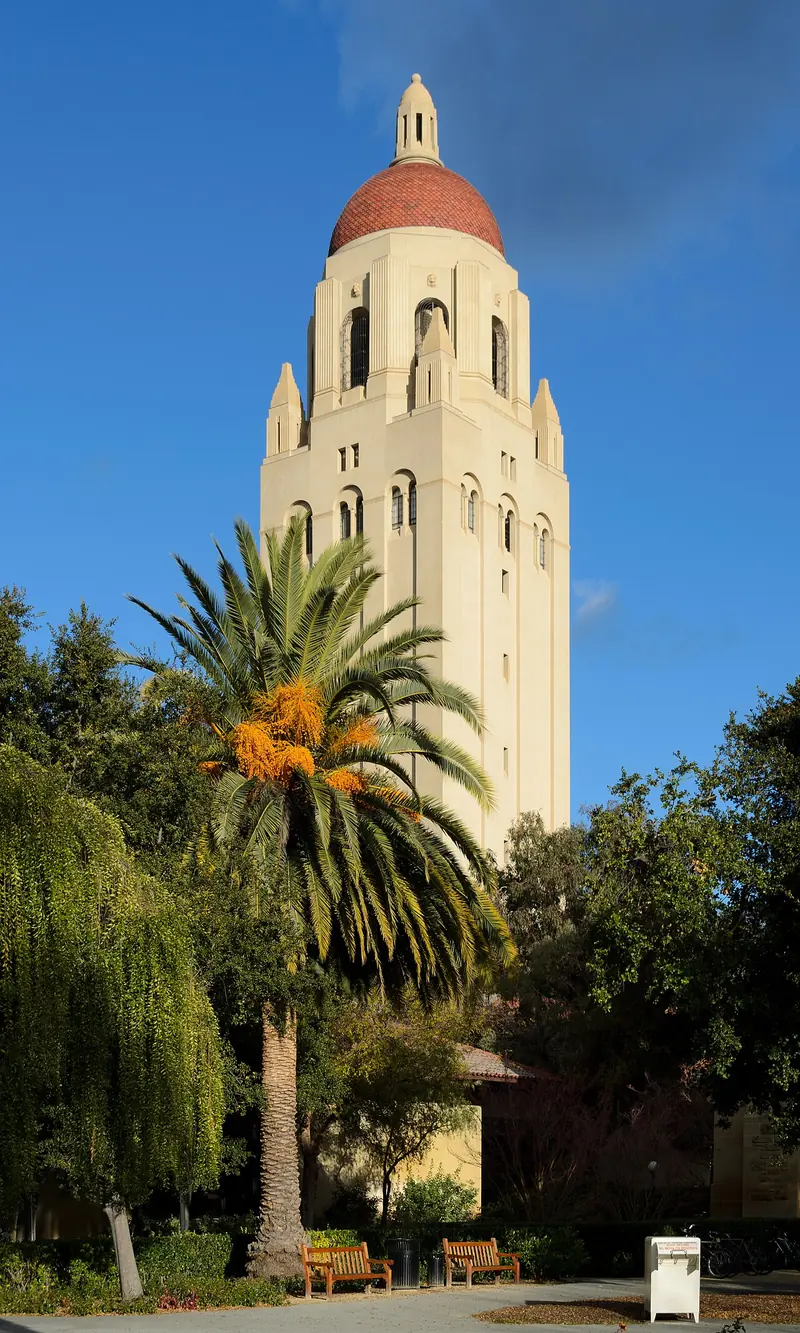
The design is credited to Arthur Brown Jr., the San Francisco architect best known for San Francisco City Hall, working with the firm Bakewell and Weihe. Brown also designed Hoover Tower across the street a few years later, which is one reason the two buildings look like a pair. Our Stanford architecture guide places them in the wider story of the campus.
Look for these features from outside:
- a great central arched entry facing Jane Stanford Way
- large arched entries on the sides and covered colonnades along them
- plain wall surfaces broken into rectangular panels
- a red tile roof that matches the rest of central campus
In 1997 the firm Sebastian and Associates modified the front with new entry stairs, a terrace and an accessibility ramp.
Inside the building
Memorial Hall holds more than one theater. The main auditorium has a large proscenium stage with an orchestra pit, theatrical lighting and rigging, plus orchestra and balcony seating. Stanford's event services office lists its capacity as 1,714, with 904 seats on the lower level. Other sources, including our theater guide, round the figure differently, at about 1,700.
| Space | Size | Used for |
|---|---|---|
| Memorial Auditorium (main stage) | About 1,700 seats | Touring productions, musicals, speakers, large university events |
| Pigott Theater | About 200 seats | Smaller theater productions |
| Prosser Studio Theater | About 60 seats | Studio and experimental work |
The building is also home to Stanford's theater and performance studies department, so on any weekday students and faculty are rehearsing, building sets and teaching classes inside. As a university venue, the main hall can only be booked by Stanford schools, departments and student groups. Only events of 500 or more may be scheduled there.
Moments in its history
As the largest indoor hall on campus, Mem Aud has hosted many of Stanford's biggest talks. The best known came on April 14, 1967, when Martin Luther King Jr. delivered his speech "The Other America" there, a year before his death. In it he described two Americas, one of opportunity and one of poverty and racial injustice.
The hall also serves the university's daily life. According to Wikipedia, much of New Student Orientation takes place inside, the student film series Flicks has screened movies there and Hot Chips, a long-running technical symposium on microprocessors, meets there in the summer.
What about Cubberley?
Visitors sometimes mix up Memorial Auditorium and Cubberley Auditorium. They are different buildings. Cubberley Auditorium is a smaller hall in the School of Education building, named for Ellwood P. Cubberley, the education professor and dean whose name is also on the Cubberley Education Library and was on Palo Alto's Cubberley High School, now the site of the Cubberley Community Center. None of the Stanford sources on Memorial Auditorium credit Cubberley with a role in its creation.
A short timeline
| Year | Event |
|---|---|
| 1900 | Jane Stanford establishes Memorial Court to honor Spanish-American War volunteers |
| 1937 | Memorial Hall opens as a memorial to the World War I dead |
| 1967 | Martin Luther King Jr. speaks on April 14 |
| 1997 | New entry stairs, terrace and ramp at the front |
| 2027 | Stanford Live presents Kodo, The Surge and Camille A. Brown and Dancers |
Events there today
Stanford Live
Stanford Live uses Mem Aud for productions too large for Bing Concert Hall. Its published 2026 to 2027 season lists three shows here:
- Wednesday, January 20, 2027, 7:30 p.m.: Kodo: LUMINANCE, the Japanese taiko drum ensemble from Sado Island, including its O-daiko drum solo and Maki Ishii's Monochrome.
- Saturday, January 30, 2027, 7:30 p.m.: The Surge: An Ode to Sinéad O'Connor, a new dance work for ten women directed and choreographed by Sonya Tayeh.
- Wednesday, March 17, 2027, 7:30 p.m.: I AM by Camille A. Brown and Dancers.
For these shows Stanford Live opens the lobby an hour before the performance. Buy tickets through Stanford Live online, by phone or at the ticket office in Bing Concert Hall.
Student theater
Ram's Head Theatrical Society, Stanford's student theater company, has long staged the Big Game Gaieties in the days before the Big Game against Cal; check its site for this year's venue. The Gaieties is a long-running part of Big Game week. Ram's Head also mounts a licensed Broadway musical in the hall each spring. Check the Ram's Head website for dates and tickets.
Speakers and university events
Major lectures and academic conferences also use the hall and some are open to the public. Watch the Stanford events calendar for listings.
Where to sit
About 900 of the seats are on the main floor and the rest are in the balcony. The floor puts you closer to dancers' faces and footwork. The balcony gives a fuller view of large ensembles and stage patterns, which suits a company like Kodo or a big dance piece. Ask the ticket office which sections suit your needs before you buy.
Visiting tips
- Getting there: Mem Aud is on Jane Stanford Way across from Hoover Tower, about a 25 minute walk from the Palo Alto Caltrain station, or a short ride on the free Marguerite shuttle on weekdays.
- Parking: Stanford Live says metered and lettered campus zones are free on weekdays after 4 p.m. and all day on weekends, which covers most evening shows. Our parking and transit guide has details.
- Accessibility: The 1997 renovation added a ramp at the front entrance. Tell the ticket office about seating needs when you buy.
- Before the show: Walk across the street to Hoover Tower, whose ground floor exhibits are open on weekdays, or stroll to the Main Quad.
Good to know
- Mem Aud is a working academic building with classrooms and rehearsal space, so plan to go inside for a scheduled event.
- Pay your respects at the lobby memorial if you attend a show. Names of the fallen are on the walls.
- Hoover Tower's observation deck is closed until January 25, 2027, so plan a return trip for the view.
Frequently asked questions
Why is it called Memorial Auditorium?
Stanford built it in 1937 to honor members of the university community who died in World War I. Stanford says it now commemorates alumni, students, staff and faculty who have died in every war since and a lobby memorial honors those who died in Afghanistan and Iraq.
How many seats does Memorial Auditorium have?
Stanford's event services office lists the main hall at 1,714 seats, with 904 on the lower level and the rest in the balcony. Other sources round it to about 1,700. Stanford Live calls it the largest indoor campus facility designed for regular performance use.
Where is Memorial Auditorium at Stanford?
It stands on Jane Stanford Way directly across from Hoover Tower, a short walk east of the Main Quad. Stanford lists the address as 551 Jane Stanford Way, formerly Serra Mall.
What events are held at Memorial Auditorium?
Stanford Live presents large dance and music productions there, such as Kodo on January 20, 2027. Ram's Head Theatrical Society stages its spring musical in the hall and it hosts major speakers, orientation events and conferences.
Is Memorial Auditorium the same as Cubberley Auditorium?
No. Cubberley Auditorium is a smaller lecture hall in the School of Education building, named for education dean Ellwood P. Cubberley. Memorial Auditorium is the large war memorial hall across from Hoover Tower.