On this page
Stanford students still call their campus the Farm. The Red Barn is the reason the name sticks. The big wooden barn on the west side of campus was built in the late 1870s as the training stable for Leland Stanford's Palo Alto Stock Farm, where champion trotting horses were bred. The farm closed more than a century ago. The barn did not. Horses still live there, riders still train in its arenas and Stanford's equestrian team calls it home.
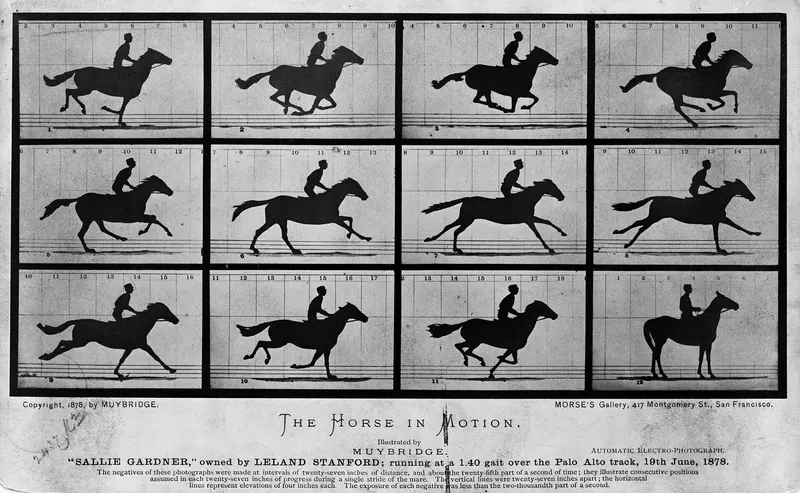
This page focuses on the barn as a place to visit today. For the full story of the stock farm and Eadweard Muybridge's experiments, read our page on the Palo Alto Stock Farm.
A note on landmark status
The Red Barn is often described as a National Historic Landmark. It is not. It is listed on the National Register of Historic Places, a broader federal list, as the Palo Alto Stock Farm Horse Barn. The listing dates to December 12, 1985. Stanford does have National Historic Landmarks on campus, such as the Lou Henry Hoover House, but the barn is not one of them.
The state plaque near the barn is also easy to misread. California Historical Landmark No. 834, designated on November 3, 1969, commemorates Eadweard Muybridge and the development of motion pictures. It marks the photographic research done at the farm in 1878 and 1879, not the barn as a building.
From stock farm to equestrian center
Leland Stanford bought his first land here in 1876, about 650 acres along San Francisquito Creek. Over the next decade he expanded it to more than 8,000 acres of orchards, vineyards, pasture, stables and training tracks. At its height, according to the Red Barn's own history, the trotting farm had two dozen buildings, 50 paddocks and eight tracks. It employed 150 workers and boarded 600 horses.
| Year | What happened |
|---|---|
| 1876 | Stanford buys the first 650 acres along San Francisquito Creek |
| 1877 | Stanford buys the stallion Electioneer for $12,000 |
| 1878 to 1880 | The Red Barn is built as the farm's training stable |
| 1878 and 1879 | Muybridge photographs horses in motion at the farm |
| 1888 | A fire destroys another stable; Stanford orders a fireproof brick replacement |
| 1903 | The stock farm officially closes |
| 1946 | President Donald Tresidder reopens the Red Barn for riding |
| 1983 | Ambassador Bill Lane and local riders lead a restoration of the run-down barn |
| 1985 | National Register listing; the Lane family donates the Electioneer statue |
| 2004 | Stanford resumes direct management and begins a second renovation |
| 2005 | The Red Barn Equestrian Center reopens in October |
Between 1984 and 2004 an independent company, Equestrian Associates, ran the barn under contract. When Stanford took it back in September 2004, the John Arrillaga family funded a renovation that upgraded the barn and nearby buildings and expanded the riding arenas. The renovations kept much of the original material.

What to look for
Two buildings survive from the stock farm. The first is the Red Barn itself, a Victorian wooden barn in the Stick-Eastlake style, with its architect unknown. The second is the brick stable Leland Stanford ordered after an 1888 fire destroyed an earlier stable. He wanted it fireproof. It now houses the equestrian team clubhouse and other center facilities.
- The Electioneer statue and kiosk. At the entrance to the equestrian center, donated in 1985 by Ambassador and Mrs. L.W. "Bill" Lane Jr. and family. Electioneer sired 166 colts that could trot a mile in under 2 1/2 minutes, according to the Red Barn's history.
- The horse cemetery. In an oak grove near the brick stable, about 15 of Stanford's prized horses are buried. A bronze Arabian horse statue marks the spot. Timothy Hopkins and his wife gave it in 1926 after it stood at their Menlo Park estate, Sherwood Hall.
- The Muybridge plaque. On Campus Drive West, across from the golf driving range. It records the experiments that proved a trotting horse lifts all four feet off the ground at once.
Most people come to photograph the barn itself, so bring a camera even if you cannot go inside. Our guide to Stanford architecture places it alongside the campus's other early buildings.
The equestrian center today
The Stanford Red Barn Equestrian Center is run by Stanford Recreation. It is home to the Stanford Equestrian Team, resident trainers and a range of riding programs. The facility is serious about horses, which is worth keeping in mind before you wander in.
| Facility | Details from the Red Barn |
|---|---|
| Stabling | Box stalls in the historic Red Barn and the School Barn, plus outdoor stalls with paddocks |
| Show Arena | 120 by 260 feet, footing for dressage and show jumping |
| Covered arenas | Two at 110 by 220 feet with lights, one for boarders and the Neukom Family Student Covered Arena |
| Other arenas | A dressage arena, a covered lunging arena and a covered Eurocisor |
| Turnout | 20 paddocks of 40 by 60 feet |
Student boarders can bring a horse to Stanford if space allows, with a waiting list when demand runs high. The center also has locker rooms, grooming stalls, wash racks and picnic areas for its riders.
Riding lessons for the public
You do not need to be a student to ride here. The Stanford Riding Academy offers English and western lessons to Stanford students, faculty and staff, community members and Stanford affiliates. Some details:
- Disciplines. Hunt seat classes run from walk, trot and canter up to jumping at roughly 2 feet to 2 feet 6 inches. Western classes run from walk, jog and lope to reining and ranch riding.
- Experience. All riders should already be able to groom and tack up a horse on their own. This is not a first-time pony ride.
- Schedule. Classes run on a quarterly schedule on Saturdays and Sundays. Hunt seat focuses on weekly group lessons with a few private slots. Western offers group and private lessons.
- Getting started. Every new rider takes an evaluation lesson first. Community riders contact the program to fill out a questionnaire.
Fees are due at the start of each quarter and are set by the program. The Red Barn also lists a physical wellness class for Stanford students, a pre-collegiate summer program and youth teams. For more horse-friendly outings around town, our Palo Alto with kids guide has ideas for younger animal fans.
How to visit
The Red Barn's facilities page says the barn is open to current boarders from 6 a.m. to 8 p.m. All other visitors should contact the Red Barn to arrange a tour. That is the honest answer to whether you can drop in: plan ahead if you want to go inside.
Good to know
- Do not feed or touch horses without permission. Many are privately owned or in training.
- Give riders and horses plenty of room. Keep children close and voices low near the arenas.
- Dogs and horses do not always mix. Leave pets at home.
- Campus parking rules apply. Read the posted signs and see our Stanford parking guide.
The barn sits at 621 Fremont Road off Campus Drive West, on the opposite side of campus from Palo Alto's downtown. It pairs well with a visit to the Stanford Golf Course area nearby or a hike on the Dish in the foothills above campus. For a guided overview of campus history, our history of Stanford traces how this horse farm became a university.
Frequently asked questions
Is the Stanford Red Barn a National Historic Landmark?
No. It is listed on the National Register of Historic Places, added on December 12, 1985 as the Palo Alto Stock Farm Horse Barn. The nearby state plaque is California Historical Landmark No. 834, which honors Muybridge's motion photography rather than the barn itself.
Can you visit the Stanford Red Barn?
It is a working equestrian center, not a museum. The Red Barn says the facility is open to its boarders from 6 a.m. to 8 p.m. and that all other visitors should contact the Red Barn to arrange a tour.
Who built the Stanford Red Barn?
Leland Stanford had it built between 1878 and 1880 as the training stable for his Palo Alto Stock Farm. It is a Victorian building in the Stick-Eastlake style and its architect is unknown.
Can the public take riding lessons at Stanford?
Yes. The Stanford Riding Academy offers English and western lessons to students, faculty, staff and community members. Classes run quarterly on Saturdays and Sundays and every rider starts with an evaluation lesson.
Where is the Stanford Red Barn?
It is at 621 Fremont Road on the west side of campus, off Campus Drive West near the golf course driving range. A plaque for Muybridge's horse photographs stands on Campus Drive West.