On this page
Stanford Stadium is the biggest building most visitors never step inside. It stands at the northeast edge of campus, a short walk from El Camino Real and the Palo Alto Caltrain station. On a football Saturday it draws tens of thousands of fans. The rest of the year it sits quietly behind the trees of the athletics district.
The stadium has two lives. The first began in 1921 with a huge earthen bowl that once held close to 90,000 people and hosted a Super Bowl and the World Cup. The second began in 2006, when Stanford replaced it with a tighter stadium of 50,424 seats. Our Stanford sports and game days page covers tickets, bag rules and tailgating across all sports. This page goes deeper on the stadium itself.

The 1921 bowl
Stanford played rugby instead of American football from 1906 to 1917, after President David Starr Jordan objected to the violence of the sport. Army officials running campus athletics during World War I ordered a return to football in 1918 and the program was back for good in 1919. A bigger stadium soon followed.
On June 1, 1921, President Ray Lyman Wilbur turned the first shovel of dirt. Crews dug a bowl and piled the earth into a horseshoe, then set wooden bleachers on a steel frame on top. The work took about five months. Stanford Magazine puts the cost at $211,000 and says the stadium was designed for about 65,000 people. The hollow left by the excavation later became the baseball park at Sunken Diamond.
The new stadium opened with the Big Game against Cal on November 19, 1921. Cal won 42 to 7. Expansions in the 1920s added thousands of seats and the bowl peaked at somewhere between 85,000 and 90,000, depending on the source. A 1935 Big Game drew a reported 94,000.
A century of big events
The old bowl hosted far more than football. On August 11, 1928, more than 70,000 people came to hear Herbert Hoover accept the Republican nomination for president. Our guide to Hoover Tower covers his long link to Stanford.
| Date | Event |
|---|---|
| 1928 | Herbert Hoover accepts the Republican nomination |
| July 1962 | U.S. vs. Soviet Union track meet draws more than 150,000 over two days |
| 1984 | Olympic soccer matches |
| January 1985 | Super Bowl XIX: 49ers beat the Dolphins 38 to 16 |
| October 1989 | 49ers play the Patriots here after the Loma Prieta earthquake damaged Candlestick Park |
| June and July 1994 | Six FIFA World Cup matches, including Brazil vs. the United States on July 4 |
| July 4, 1999 | Women's World Cup semifinal: U.S. 2, Brazil 0, before 73,123 |
Super Bowl XIX was the first Super Bowl played in the Bay Area. The 1962 track meet with the Soviet Union, at the height of the Cold War, helped the athletic department's finances after a winless football season in 1961. The stadium also had a running track around the field for much of its life, which is one reason the seats sat so far from the action.
The 2006 rebuild
By the early 2000s the old bowl had poor sightlines, long stairways, too few restrooms and a track that pushed fans away from the field. Stanford's board approved a rebuild in June 2005. Demolition started right after the last home game of 2005, a 38 to 31 loss to Notre Dame on November 26.
The new stadium cost about $90 million and kept the old bowl's setting while removing the track. Capacity dropped sharply, but every seat moved closer to the grass. A wet winter and construction delays pushed the 2006 opener to San Jose. The rebuilt stadium finally opened on September 16, 2006, with a 37 to 9 loss to Navy. Stanford Magazine notes that the rebuild took more than twice as long as the original construction.
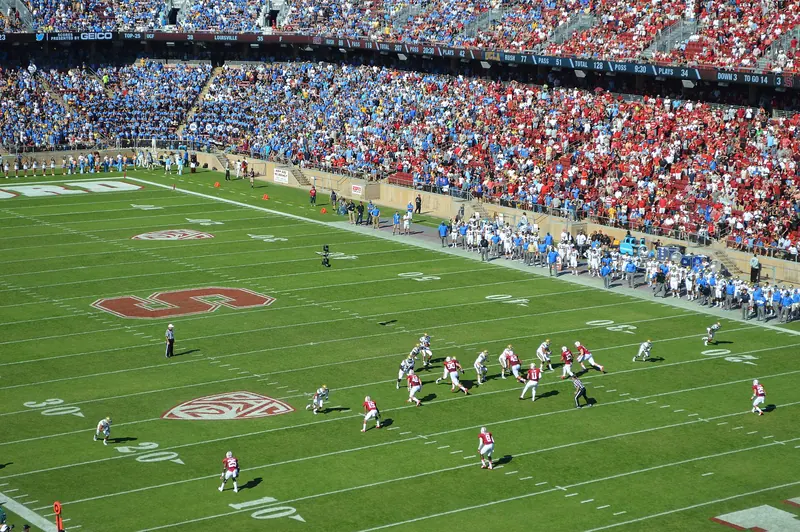
Today the field, named Louis W. Foster Family Field after a 1995 gift, is natural grass and sits 29 feet below ground level. The stadium covers about 18.4 acres. Twin HD scoreboards and a ribbon board were added in 2013, when the current capacity of 50,424 was set.

The Big Game
Stanford and Cal first played in 1892 and the rivalry is simply called the Big Game. The winner takes home the Stanford Axe. The game usually alternates between Stanford Stadium and California Memorial Stadium in Berkeley.
The 2025 Big Game was played at Stanford on November 22, 2025. The 129th meeting is in Berkeley on Saturday, November 21, 2026. The next Big Game at Stanford Stadium is expected in 2027. Big Game week brings campus traditions too. Before the game, students skewer a stuffed Cal bear on top of the Claw fountain in White Plaza.
Both schools joined the Atlantic Coast Conference in 2024, so the game now counts as a conference game in the ACC.
Game days in 2026
Stanford's 2026 schedule has six home games. When this page was updated, one remained: SMU on Saturday, November 28, the last home game of the regular season. Kickoff times for late season games are often set only a week or two ahead, so check the schedule on gostanford.com.
- Tickets are sold by Stanford Athletics at tickets.gostanford.com. The ticket office is at Gate 2 of the stadium. Gostanford lists its hours as Monday to Friday from 9 a.m. to 4 p.m., closed holidays.
- Mobile tickets go in your phone wallet before you leave. Screenshots are not accepted.
- Lots open five hours before kickoff and the stadium uses a clear bag policy. The full rules are on our athletics page.
- Other venues. Hoover Tower closes on home football game days and campus roads near the stadium are busy all afternoon.
Getting there by Caltrain and on foot
Caltrain's special Stanford station on Embarcadero Road sits right by the stadium, but it opens only for select events and will not open for 2026 football. Ride to Palo Alto station instead. Caltrain's directions are to walk along Palm Drive and turn left on Arboretum Road. Allow a little over 20 minutes on foot.
If you drive, Stanford's parking and transit guide covers lot passes and the game day traffic plan. Leave plenty of time, especially after the final whistle, when everyone heads for the same exits.
Concerts, soccer and softball
The rebuilt stadium still hosts events beyond Cardinal football. The San Jose Earthquakes have played at least one match here every year since 2011, including their home game against the LA Galaxy. In spring 2025 Stanford softball moved its home games here during renovations at its own stadium and set an NCAA record crowd of 13,207 on April 19, 2025. Coldplay played two nights, May 31 and June 1, 2025.
Outside events the stadium is generally not open to visitors, though you can walk around the outside on the way to the Stanford Visitor Center at 295 Galvez Street. Coming from out of town for a game? Hotels near campus fill early on football weekends, so compare hotels near Stanford Stadium as soon as the schedule is set.
Frequently asked questions
How many people does Stanford Stadium hold?
Stanford Stadium seats 50,424. The rebuilt stadium opened in 2006 with a much smaller capacity than the old bowl, which held close to 90,000 at its peak. The smaller size put fans much closer to the field.
When was Stanford Stadium built?
Construction began on June 1, 1921. It took about five months. The first game was the Big Game against Cal on November 19, 1921, which Cal won 42 to 7. Stanford tore most of the old stadium down after the 2005 season and reopened the new one on September 16, 2006.
Is the 2026 Big Game at Stanford Stadium?
No. The 129th Big Game is on Saturday, November 21, 2026, at California Memorial Stadium in Berkeley. The 2025 game was played at Stanford, so the next one at Stanford Stadium is expected in 2027.
Can I take Caltrain to Stanford Stadium?
Yes, but use Palo Alto station in 2026. Caltrain's Stanford station by the stadium will not open for 2026 football games. From Palo Alto station, walk along Palm Drive and turn left on Arboretum Road. The walk takes a little over 20 minutes.
Has Stanford Stadium hosted a Super Bowl?
Yes. Super Bowl XIX was played there in January 1985, when the San Francisco 49ers beat the Miami Dolphins 38 to 16. It was the first Super Bowl played in the Bay Area.