On this page
If the Main Quad is Stanford's formal front room, White Plaza is its kitchen table. This open square south of the Quad is where students cross between classes, set up tables for their clubs, stage rallies and sit on the rim of a strange bronze fountain everyone calls the Claw. On a weekday at noon it is one of the busiest spots on campus.
For visitors it is useful too. The Stanford Bookstore, both student unions and the main food court are on or beside it. This page covers how the plaza came to be, the story behind the fountain, its role in student life, the buildings around it and the changes planned for the next few years.
A memorial to two brothers
White Plaza honors two Stanford students who never graduated. William N. White and John B. White II were brothers in the class of 1949. Both died in separate accidents before finishing their degrees. Their parents, Mr. and Mrs. Raymond B. White, funded White Memorial Plaza and its fountain in their memory.
A historical marker in front of Old Union dates the plaza and the fountain to 1964. Tresidder Union had opened just two years earlier, so the new square tied the old student union and the new one together.
The Claw
The White Memorial Fountain is the sculpture everyone remembers. The artist Aristides "Aris" Demetrios won a national sculpture competition for it in 1963. According to Stanford, he entered three designs and they placed first, second and third. He was in his early 30s at the time.
- Form. A 16-foot tangle of welded bronze and copper rising from a shallow pool with blue-tiled walls. Four curved cement benches frame the pool.
- Water. Wikipedia counts 65 jets. Stanford notes about five dozen valves, which Demetrios came back to fine-tune in 2011 after restoring the fountain in 2010.
- Design. Demetrios told the Stanford Daily that he studied the site daily for a month. He noticed that crowds would block the lower six feet of any sculpture, so he designed the piece to work both above and below that line. He meant each form to begin as something solid and end in water.
- Meaning. He described the fountain as a metaphor for the lost potential of the young men it honors.
Demetrios died in December 2021 in Santa Barbara at 89. The fountain remains his best known public work. Our guide to public art on the Stanford campus places it among the university's other outdoor pieces.
Traditions at the fountain
The Claw is part sculpture, part campus prop. Students wade in it, dangle their feet, dance and splash on hot days. The Stanford Daily has described people studying, playing music and even kayaking in it. During Dead Week, the quiet week before finals, the marching band, the Stanford Tree and the Dollies make visits.
The best known ritual comes in the fall. Before the Big Game against Cal, students skewer a stuffed bear standing in for Cal's mascot, Oski, on the top of the fountain. The tradition is known as the Bearial. In 2026 the Big Game is in Berkeley on November 21. Our Stanford Stadium page explains the rivalry and where it is played.
The center of student life
White Plaza works as Stanford's public square. Stanford lists career fairs, craft fairs, performances and student activities among the events it hosts during the year. On ordinary weekdays you will often see student groups at tables, recruiting members and handing out flyers. Bikes stream through at every class change.
It has also been the main stage for protest. The marker in front of Old Union calls the plaza a long-standing site of student activism. In the late 1960s it was a center of campus demonstrations, as our page on Palo Alto in the 1960s describes. It is still the natural place for a campus rally.
Good to know
- Weekdays during the academic year are busiest. Summer and weekends are calm.
- Watch for bikes. Lasuen Mall and the paths around the plaza carry heavy bike traffic at class changes.
- The White Plaza post office closes on October 31, 2026. A PostalAnnex on the second floor of Tresidder handles shipping.
- Restrooms and seating are in Tresidder and Old Union.
The buildings around the plaza
Most of what visitors need on campus sits around this one square.
| Building | What it is |
|---|---|
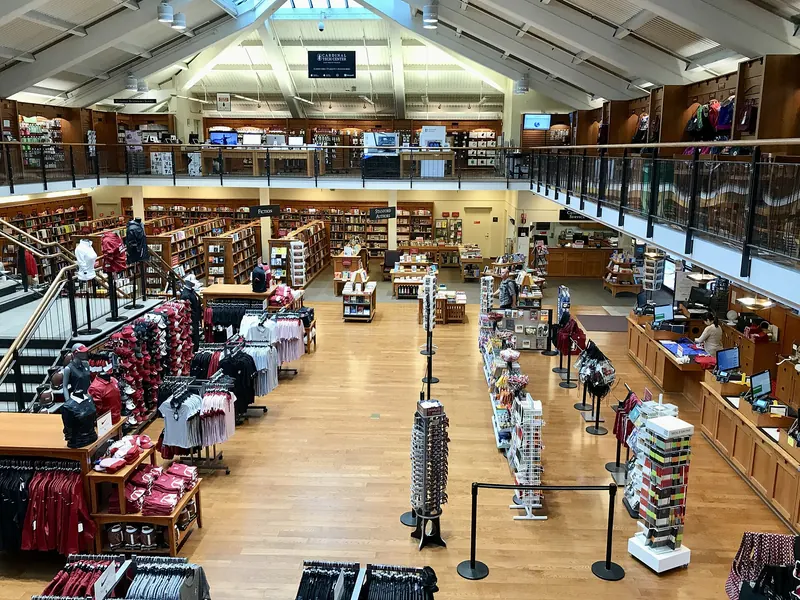
| Stanford Bookstore | Stanford gear, books and textbooks, open to everyone, at 519 Lasuen Mall |
| Old Union | Spanish Colonial complex from 1915 to 1923 with the Axe and Palm, student government and cultural centers |
| Tresidder Memorial Union | 1962 student union with the Union Square food court, CoHo and the Campus Bike Shop |
| Dinkelspiel Auditorium | Concert and event hall close to the plaza |
| Faculty Club | Next to Tresidder |
Our guide to Tresidder and Old Union lists what visitors can use inside each union. For food, the campus dining guide has the counters and published hours. The Stanford Bookstore page covers store hours and other Stanford shops.

The Town Center plans
White Plaza is set to change. Stanford has hired the Seattle firm LMN Architects to develop a framework plan for a "town center" in the White Plaza area. Stanford's report describes the goal as making the area the heartbeat of campus, with more room for food, informal cultural events and green space. It also proposes less bike traffic, so the area becomes a place to stay rather than a route to pass through. Pilot projects such as a festival and a pop-up pavilion were planned to test ideas.
Stanford has said the Claw will be preserved. The Stanford Daily has reported that construction is set to begin in 2027 and that the bookstore will shrink and focus more on events, with its merchandise moving elsewhere on campus. Details and timing may shift, so check Stanford's announcements before planning around them.
Getting there
White Plaza sits just south of the Main Quad along Lasuen Mall. From the Oval at the top of Palm Drive, walk through the Quad and keep heading south for about 10 minutes. A Marguerite shuttle stop is behind Tresidder on Lagunita Drive. Visitor parking nearby is paid through ParkMobile. Our Stanford parking and transit guide explains the zones.
For a short loop, start at the Oval, walk through Memorial Court and the Quad arcades, then come out at White Plaza for lunch at Tresidder. Afterward, head west past the Faculty Club toward Lake Lagunita or east toward Hoover Tower and back to Palm Drive. The whole circuit takes about an hour with a stop to eat, longer if you browse the bookstore.
The plaza is a natural lunch stop on a campus walk. From here, Memorial Church, Hoover Tower and Lake Lagunita are each a short walk away. If you are in town for a campus event and want to stay close, compare hotels near Stanford along El Camino Real.
Frequently asked questions
What is the Claw at Stanford?
The Claw is the nickname of the White Memorial Fountain in White Plaza. Aristides Demetrios designed it after winning a national competition in 1963 and it was installed in 1964. It is a 16-foot sculpture of welded bronze and copper standing in a shallow, blue-tiled pool.
Who is White Plaza named after?
It honors William N. White and John B. White II, brothers in the Stanford class of 1949 who died in separate accidents before they could graduate. Their parents, Mr. and Mrs. Raymond B. White, paid for the plaza and the fountain.
Can you walk in the Claw fountain?
Students have long waded in the pool on hot days and during celebrations. It is a working fountain with slippery tile, so if you do step in, take care. Keep children close and stay out when the area is roped off.
What happens to the Claw before the Big Game?
Each autumn before the Big Game against Cal, students skewer a stuffed bear representing Cal's mascot, Oski, on the top of the Claw. The tradition is known as the Bearial.
Is White Plaza going to change?
Probably. Stanford's Town Center project, planned with LMN Architects, aims to remake the White Plaza area as a social hub. Stanford has said the Claw will be preserved. The Stanford Daily has reported that construction is set to begin in 2027.