On this page
On a hillside above the Stanford campus stands a house that looks like a stack of white blocks. Its flat roofs and stepped, terraced shape set it apart from everything around it. It was finished in 1920, when most American houses still wore pitched roofs and porches. It was designed not by a famous architect but by Lou Henry Hoover, who studied geology at Stanford and would later become First Lady.
The Lou Henry Hoover House is a National Historic Landmark and the official residence of Stanford's president. It is not open to the public. This page tells its story so you can appreciate it from a respectful distance and find the places on campus where the Hoovers' history is on display.
Two Stanford geologists
Both Hoovers were born in Iowa in 1874. Herbert Hoover was a member of the first class at Leland Stanford Junior University, which opened in 1891. Lou Henry entered Stanford in 1894. The National Park Service notes that they met in a geology lab. They married in 1899 and spent the next years moving around the world for Herbert's mining work.
By the end of World War I Herbert was famous for leading relief efforts in Europe. In 1919 he was named Director General of Post War Relief and Rehabilitation. The same year he founded the war library at Stanford that grew into the Hoover Institution. Our guide to the Hoover Institution Library and Archives covers that side of the story. The couple wanted a permanent home near the university where they had met. Lou took charge of building it.
Lou Henry Hoover's design
The Hoovers first hired Louis Christian Mullgardt, a known California architect. According to the National Park Service, they dismissed him after he announced his appointment publicly before the war had ended. They turned instead to Arthur B. Clark, a Stanford art professor who practiced architecture on the side. Clark agreed to serve as architect on one condition: Mrs. Hoover would design the house.
She did. Clark, his son Birge Clark and the draftsman Charles Davus served as advisers. Birge helped his father supervise construction just before he opened his own practice in Palo Alto in 1922. He went on to shape much of the downtown streetscape.
What makes it unusual
- Style. Historians call it an early example of the International Style with elements of Mission Revival. Some see Pueblo influence and some have suggested North African models. The Park Service describes it simply as blocks piled up.
- Site. The house is built into San Juan Hill. It rises two stories in front and three at the back, which makes it look smaller than it is.
- Fireproofing. Herbert Hoover insisted the house be fireproof. It sits on a reinforced concrete slab and its walls are hollow tile.
Construction ran from 1919 to 1920 and the house was finished in June 1920. It was the Hoovers' first and only permanent home.
Why the design still stands out
Timing is what makes the house remarkable. The phrase International Style became widely known through a 1932 exhibition at the Museum of Modern Art in New York, a dozen years after the Hoovers moved in. Lou Henry Hoover arrived at many of the same ideas on her own: plain walls, flat roofs, rooms that step down a slope and a clear break from ornament.
Compare it with the buildings Birge Clark later designed in town. His downtown work, such as the 1932 post office on Hamilton Avenue and much of the 500 block of Ramona Street, leans toward Spanish Colonial Revival with tile roofs. The Hoover House, built while he was still working with his father, looks far more modern. Our page on Palo Alto architecture shows how both strands shaped the area. The house also predates by decades the flat-roofed modern homes that spread across Palo Alto after World War II.
Election nights on San Juan Hill
Herbert Hoover served as Secretary of Commerce from 1921 under Warren G. Harding and stayed in the job under Calvin Coolidge. He ran for president in 1928. On election night he waited for the returns at the house and learned that he had defeated Alfred E. Smith.
During his presidency, from 1929 to 1933, the family made only brief visits. Four years later he was back at the house for election night again, this time to learn of his loss to Franklin D. Roosevelt. After 1932 the Hoovers returned to the house and kept an apartment in New York as a second home.
Those two nights put a house on a Stanford hillside into the story of national politics.

From family home to president's house
Lou Henry Hoover died in 1944. Herbert Hoover then deeded the house to Stanford University. The National Park Service says the gift was meant to provide a residence for professors. The house later became the official residence of the president of Stanford, the role it still plays.
The house has been updated along the way. Solar panels were added in 2008, according to the house's Wikipedia entry.
Landmark designations
Few homes in the area carry as many official listings.
| Designation | Date |
|---|---|
| California Historical Landmark No. 913 | October 14, 1977 |
| National Register of Historic Places (No. 78000786) | January 30, 1978 |
| National Historic Landmark | February 4, 1985 |
The National Historic Landmark listing is the highest of the three. It sets the house apart from other historic campus buildings such as the Red Barn, which is on the National Register but is not a National Historic Landmark. Our guide to historic landmarks of Palo Alto lists the state landmarks in the area, including this one. The landmark listing covers about 2.1 acres.
Can you see it?
The short answer is no. The National Park Service lists the house as not open to the public and Stanford manages it as a private residence. There are no tours. San Juan Hill is a residential area of campus homes, so please do not walk onto the grounds, look through windows or stop in driveways for photos.
Good to know
- The house is a private home. Respect the residents' privacy.
- Historic photos in books and online archives are the best way to see the house.
- The Stanford Historical Society runs historic house and garden tours. Check its calendar for current dates.
Where to learn about the Hoovers on campus
You can still follow the Hoovers around Stanford in public places.
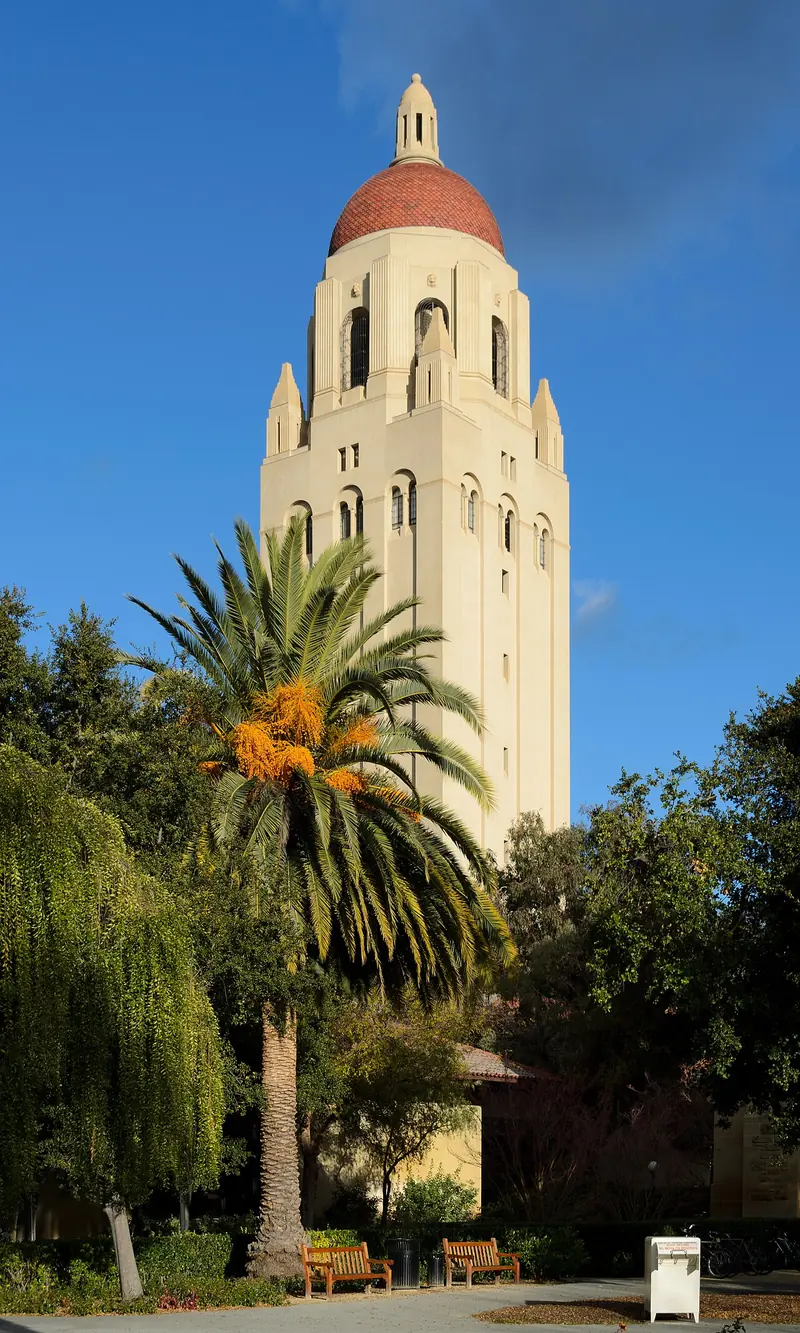
- Hoover Tower. The 1941 tower holds exhibits on the Hoovers. Its Lou Henry Hoover Room hosts rotating shows and its carillon is named for her. From August 17, 2026 to January 25, 2027 the galleries are open weekdays from 10 a.m. to 4 p.m. and the observation deck is closed.
- Hoover Institution Library and Archives. Researchers can request papers tied to the Hoovers' public lives.
For the wider story of the founders and early students, read our history of Stanford.
Frequently asked questions
Can you tour the Lou Henry Hoover House?
No. The house is the official residence of Stanford's president and the National Park Service lists it as not open to the public. Please do not enter the grounds. Hoover Tower's ground-floor exhibits are the best public place to learn about the Hoovers.
Who designed the Lou Henry Hoover House?
Lou Henry Hoover designed it herself. Arthur B. Clark, a Stanford art professor, agreed to serve as architect on the condition that she lead the design. His son Birge Clark and draftsman Charles Davus advised.
Is the Hoover House a National Historic Landmark?
Yes. It was designated a National Historic Landmark on February 4, 1985. It is also on the National Register of Historic Places (1978) and is California Historical Landmark No. 913 (1977).
Did Herbert Hoover live at Stanford?
Yes. The house was the Hoovers' only permanent home. Herbert Hoover waited there for election returns in 1928, when he won the presidency. He was there again in 1932, when he lost to Franklin D. Roosevelt.
Who lives in the Lou Henry Hoover House today?
The president of Stanford University. Herbert Hoover gave the house to Stanford after Lou Henry Hoover died in 1944 and it later became the president's official residence.