On this page
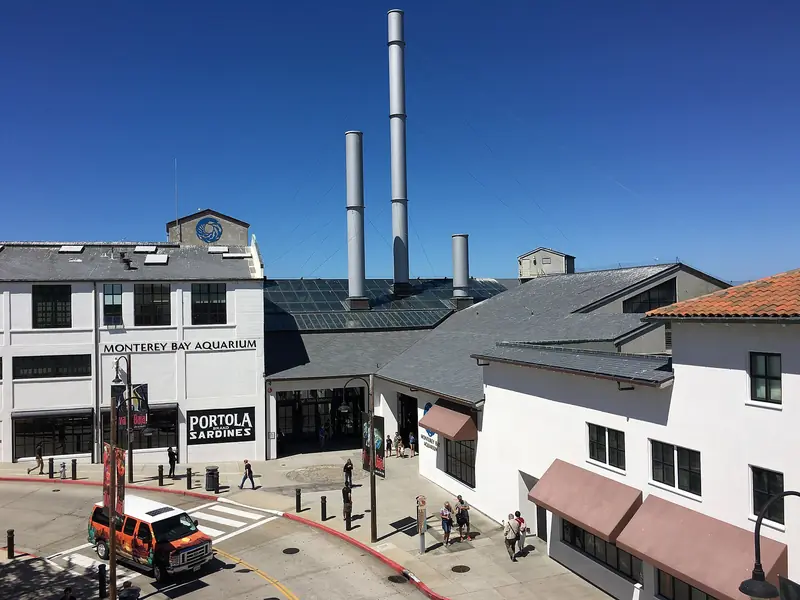
Stanford's oldest outpost is not on the Farm at all. It is on a granite point at the edge of Monterey Bay, where harbor seals haul out on the rocks and kelp forests start a few steps offshore. Hopkins Marine Station has been Stanford's marine laboratory since 1892. It sits right next to the Monterey Bay Aquarium and the two share more history than most aquarium visitors realize.
This page covers how the station began, why it moved to its present point, how its scientists helped create the aquarium and what the public can see. It is written for Palo Alto readers planning a coast trip and for anyone curious about the Stanford name on the low buildings at the end of Cannery Row.
The station at a glance
Hopkins sits at 120 Ocean View Boulevard in Pacific Grove, on the rocky headland between Lovers Point and Cannery Row. Stanford's 2022 photo tour describes an 11 acre site with 10 faculty labs, nearly two dozen graduate students and 13 postdoctoral scholars. Since September 2022 it has been part of the Stanford Doerr School of Sustainability and its Oceans Department. Undergraduates come for quarter-long courses and research projects.
The research ranges from molecules to whole ecosystems. Scientists here study mussels, squid, sea urchins, sea squirts, kelp and corals, along with top predators such as tuna and sharks. Staff and students can walk off Agassiz Beach and snorkel or dive into a kelp forest without a boat. Few labs anywhere have that kind of access.
History since 1892
The story starts with the Chautauqua summer assemblies held in Pacific Grove from 1880, which included courses in marine botany and zoology. Stanford's first president, David Starr Jordan, was a fish biologist. He saw the value of a seaside lab before the university was a year old.
On June 27, 1892, Stanford opened the Hopkins Seaside Laboratory on a treeless bluff at what is now Lovers Point. For about 25 years it offered summer classes and lab space for visiting scientists. It was named for Timothy Hopkins, a longtime Stanford trustee. Palo Alto readers know his name from the town's early days. Hopkins laid out the University Park tract that grew into Palo Alto, which our founding of Palo Alto page explains.
In 1916 a land exchange with the Pacific Improvement Company gave Stanford about five acres on Point Almeja, also called China Point or Point Cabrillo. The site had been home to a Chinese American fishing village that burned in 1906. Researchers at the station have since used archaeology to study that community. The new lab was named the Hopkins Marine Station of Stanford University on October 26, 1917. It opened for the 1918 summer quarter.
| Year | Event |
|---|---|
| 1892 | Hopkins Seaside Laboratory opens at Lovers Point |
| 1917 | Renamed Hopkins Marine Station on its new point |
| 1931 | State designates the Hopkins Marine Life Refuge offshore |
| Early 1930s | Graduate student Willis Hewatt starts his tide pool transect |
| 1962 to 1968 | The research ship Te Vega sails the Pacific and Indian oceans |
| Late 1960s | Stanford buys the Hovden Cannery next door |
| 1984 | Monterey Bay Aquarium opens on the cannery site |
| 1989 | Miller Library opens |
| 1994 | Tuna Research and Conservation Center opens |
| 2022 | Joins the Stanford Doerr School of Sustainability |
Stanford calls Hopkins the oldest marine laboratory on the West Coast. Rankings for the whole country differ. Stanford's 2022 photo tour called it the third oldest in the United States, while other sources place it second, after the Marine Biological Laboratory at Woods Hole, Massachusetts.
Research landmarks
Some of the station's work has run longer than most careers. In the early 1930s a graduate student named Willis Hewatt laid out a strip of shore about one yard wide and 100 yards long and recorded every animal on it. Undergraduates rediscovered his survey about 60 years later. Students now repeat it every spring, which gives scientists a rare long record of change on one stretch of California shore.
The waters around the point are protected too. California named the Hopkins Marine Life Refuge in 1931, making it one of the oldest marine refuges in the state. It became the Hopkins State Marine Reserve in 2005 and the area is now part of the Lovers Point-Julia Platt State Marine Reserve, where fishing and collecting are not allowed.
The Harold A. Miller Library looks straight out over the water. Its collections include marine science records back to the 1800s, among them field notes by Ed Ricketts, the marine biologist who became "Doc" in John Steinbeck's Cannery Row. His lab stood just down the street.
How Hopkins helped create the aquarium
The Monterey Bay Aquarium owes its location to Hopkins scientists. In the late 1960s they grew worried about industry on Cannery Row and persuaded Stanford to buy the Hovden Cannery property next door, partly to keep a hotel from going up beside the station. The cannery stopped canning in the early 1970s and Hopkins used the building for storage.
In the late 1970s four marine biologists began planning an aquarium on the Hovden site. Two of them, Chuck Baxter and Robin Burnett, were on the Hopkins faculty. The others were Nancy Burnett and Steve Webster. Nancy Burnett took the idea to her parents, David and Lucile Packard, whose family foundation paid for a feasibility study. Julie Packard joined the group and later became the aquarium's longtime leader. The Packards formed the Monterey Bay Aquarium Foundation in April 1978. The foundation bought the Hovden property from Stanford for nearly $1 million and the aquarium opened on October 20, 1984.
The partnership did not end there. In 1994 the aquarium and Hopkins opened the Tuna Research and Conservation Center, which the two jointly own and operate in Pacific Grove. Stanford professor Barbara Block and aquarium scientists have used it to study captive tuna and to tag wild Pacific bluefin. Their tagging studies follow the fish across the Pacific.

Visiting: what the public can see
Hopkins is a working research station, not an attraction. Its website lists an address, a phone number and a general email, but Stanford does not publish public visiting hours, tours or admission for the station. Do not walk in through the gates. Labs, tanks and dive operations are in use every day.
There are still ways to see it:
- Public talks. The station's events listings include evening talks at Hopkins that are open to the public, such as an October 20, 2026, talk on coral bleaching recovery. Check the listing for each event's details.
- Open house. Graduate students revived a public open house in 2017 after years of only occasional events. Stanford reported in 2018 that it had become annual, with touch tanks, talks and squid dissections. Watch the events page for the next date rather than assuming one.
- The view from outside. The shoreline path along Ocean View Boulevard passes the station's inland side. From there you can see the point, the low station buildings and the seals on the rocks.
- The aquarium next door. The best public window on the same waters the station studies, from kelp forests to open ocean fish.
Collecting is banned in the marine reserve around the point. That includes tide pool animals and shells. Watch from a distance and keep dogs leashed near the rocks.
Planning a trip from Palo Alto
Pacific Grove is about 90 miles from campus. Stanford puts the drive at about two hours. Most people take Highway 101 south and Highway 156 and Highway 1 toward Monterey, or Highway 17 and Highway 1 along the coast through Santa Cruz. Weekend traffic on 17 can be slow, so leave early.
A Hopkins outing fits easily into a day on the Monterey Peninsula. Pair the aquarium with a walk along the shore to Lovers Point, then continue to Carmel. Our guide to Monterey and Carmel has the full plan. If you would rather break up the drive, Santa Cruz is a good halfway stop. Monterey hotels fill on summer weekends and during big golf events, so compare Monterey hotels early if you plan to stay over.
Good to know
- Coastal mornings are often foggy and cool even in summer. Bring a layer.
- Street parking near Cannery Row fills on weekends. Arrive early or use a garage in Monterey.
- For a Stanford field station closer to home, see Jasper Ridge Biological Preserve in the foothills.
Why it matters to Stanford
Hopkins shows how early Stanford reached beyond the Farm. Jordan's interest in fish shaped the station's first decades. Its location next to some of the richest coastal waters in the world has kept it at the center of ocean science since. For more on the university's first years, see our history of Stanford. To explore the main campus itself, start with our guide to visiting Stanford.
Frequently asked questions
Can you visit Hopkins Marine Station?
Not as a drop-in visitor. Hopkins is a working research station and Stanford does not publish public visiting hours. The public can come to occasional talks and open houses listed on the station's events page. You can see the grounds and the point from the shoreline path along Ocean View Boulevard.
Is Hopkins Marine Station part of the Monterey Bay Aquarium?
No. Hopkins belongs to Stanford and the aquarium is an independent nonprofit next door. The two are closely linked. Hopkins faculty helped conceive the aquarium on the old Hovden Cannery site that Stanford owned and the two jointly run the Tuna Research and Conservation Center.
How old is Hopkins Marine Station?
It opened on June 27, 1892, as the Hopkins Seaside Laboratory. It is the oldest marine laboratory on the Pacific coast of the United States. It moved to its present site and took its present name in 1917.
Who was Hopkins Marine Station named after?
It honors Timothy Hopkins, a longtime Stanford trustee and benefactor. Hopkins also played a big part in founding the town of Palo Alto by laying out the University Park tract that became its first neighborhoods.
How far is Hopkins Marine Station from Stanford?
It is about 90 miles south of the main campus. Stanford describes it as roughly a two-hour drive. It sits at the border of Pacific Grove and Monterey, beside the aquarium on Cannery Row.