On this page
Stanford counts Nobel laureates the way most universities do: carefully and with its own rules. The number you see quoted depends on the date and on who is included. A professor who did prize work elsewhere and later joined the faculty usually counts. A visiting lecturer usually does not. Alumni who won while working somewhere else sit in a separate category.
This page sets out the list as Stanford itself publishes it, field by field, with the dates attached. It also covers the two Stanford winners announced in October 2026. For the wider story of how a regional school turned into a research power after World War II, read our history of Stanford.
The count, as Stanford states it
Two official Stanford sources give numbers and they do not quite match, because they were published at different times.
| Source | Date | What it says |
|---|---|---|
| Stanford Report, Nobel Prize topic page | Viewed October 2026 | "Stanford University is home to 22 living Nobel laureates." It lists 16 more Stanford laureates who have died. |
| Stanford Facts, faculty page | Fall 2025 figures | 22 Nobel laureates in the community of scholars; 36 Nobel Prize winners since the founding |
The Stanford Report list holds 38 names: 22 living and 16 deceased. The Stanford Facts total of 36 was published before the two October 2026 prizes. Neither source says the two figures use identical rules, so treat them as separate snapshots. Our tallies below follow the named list on the Stanford Report Nobel page, which Stanford also uses to separate its own laureates from "other Nobel connections."
| Field | Living | Deceased | Total |
|---|---|---|---|
| Economic sciences | 10 | 4 | 14 |
| Physics | 4 | 7 | 11 |
| Chemistry | 5 | 4 | 9 |
| Physiology or medicine | 3 | 1 | 4 |
| Peace | 0 | 1 (Pauling, also counted in chemistry) | 1 prize |
Two new laureates in October 2026
October 2026 was a big month on campus. On Monday, October 5, the Nobel Assembly named Karl Deisseroth, a Stanford professor, as one of three winners of the Nobel Prize in Physiology or Medicine. He shared it with Peter Hegemann of Humboldt University of Berlin and Georg Nagel of the University of Würzburg. Their work led to optogenetics, a method that uses light-sensitive proteins from algae to switch chosen nerve cells on and off. Stanford Medicine lists the application and expansion of optogenetics among its 2007 research highlights. Stanford Report covered the announcement, a campus celebration and the reactions of family and colleagues.
A week later, on October 12, the economics prize went to Stanford economist Robert E. Hall and to Michael Woodford of Columbia University. News reports summarized their work as research on the foundations of the models governments and central banks use to manage downturns and shocks. Stanford Report ran the story under the headline "Robert E. Hall wins Nobel Memorial Prize in Economic Sciences." Strictly speaking, the economics award is the Sveriges Riksbank Prize in memory of Alfred Nobel, though Stanford and the Nobel Foundation list it with the others.
Physics
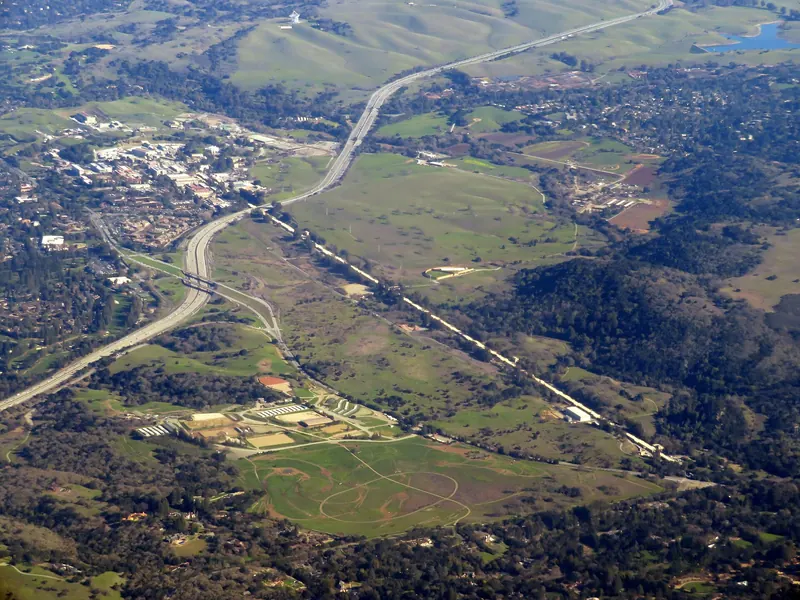
Physics gave Stanford its first laureate and several of its most famous. Three of these prizes trace back to work at SLAC, the two-mile linear accelerator in the foothills.
- Felix Bloch, 1952: nuclear magnetic resonance, the physics behind MRI scanners. He was Stanford's first Nobel laureate.
- William Shockley, 1956: the transistor, shared with John Bardeen and Walter Brattain for work at Bell Labs. Shockley later taught at Stanford. Our page on Shockley and the semiconductor boom tells the rest of that story.
- Robert Hofstadter, 1961: electron scattering experiments that measured the size and shape of protons and neutrons.
- Burton Richter, 1976: discovery of a new heavy particle at SLAC, shared with Samuel Ting.
- Arthur Schawlow, 1981: laser spectroscopy.
- Richard E. Taylor, 1990: SLAC experiments that showed protons and neutrons are built from smaller parts, later called quarks.
- Martin Perl, 1995: discovery of the tau lepton at SLAC.
- Douglas Osheroff, 1996: superfluidity in helium-3.
- Steven Chu, 1997: cooling and trapping atoms with laser light. He later served as U.S. secretary of energy.
- Robert Laughlin, 1998: theory of the fractional quantum Hall effect.
- Carl Wieman, 2001: Bose-Einstein condensation in dilute gases. He joined Stanford years after the prize.

Chemistry
Stanford's chemistry laureates range from the theory of the chemical bond to tools now used in every biology lab.
- Linus Pauling, 1954 and 1962: the nature of the chemical bond, then the Nobel Peace Prize for his campaign against nuclear testing.
- Paul Flory, 1974: the physical chemistry of polymers.
- Paul Berg, 1980: recombinant DNA. Stanford Medicine credits him with the first recombinant DNA molecule combining DNA from two species, in 1972.
- Henry Taube, 1983: how electrons move between metal atoms in chemical reactions.
- Roger Kornberg, 2006: the molecular basis of how genes are copied into RNA. His father, Arthur, won in medicine in 1959.
- Brian Kobilka, 2012: the structure and workings of G-protein-coupled receptors, a target of many common drugs.
- Michael Levitt, 2013: computer models of complex chemical systems.
- W.E. Moerner, 2014: super-resolved fluorescence microscopy.
- Carolyn Bertozzi, 2022: bioorthogonal chemistry, reactions that work inside living cells without disturbing them.
Physiology or medicine
The medical list is short but spans almost seven decades. Arthur Kornberg won in 1959 for the synthesis of DNA, the same year the medical school moved to campus. Our history of Stanford Medicine covers that move. Andrew Fire won in 2006 for RNA interference, a way cells silence genes. Thomas Südhof won in 2013 for work on how nerve cells release chemical signals. Karl Deisseroth joined them in 2026. Visitors can see the medical campus from outside on a walk past the School of Medicine.
Economic sciences
Economics is Stanford's largest Nobel field. The list mixes faculty from the economics department, the Graduate School of Business and the Hoover Institution. Stanford Report notes that six GSB professors have received the prize over the past century.
| Year | Laureate | Known for |
|---|---|---|
| 1972 | Kenneth J. Arrow | General equilibrium and welfare theory |
| 1976 | Milton Friedman | Monetary history and theory |
| 1990 | William F. Sharpe | Asset pricing |
| 1992 | Gary Becker | Economics of human behavior |
| 1993 | Douglass North | Economic history and institutions |
| 1997 | Myron S. Scholes | Pricing of options |
| 2001 | A. Michael Spence | Markets with unequal information |
| 2001 | Joseph E. Stiglitz | Markets with unequal information |
| 2011 | Thomas J. Sargent | Cause and effect in the macroeconomy |
| 2012 | Alvin Roth | Market design and matching |
| 2020 | Paul Milgrom | Auction theory |
| 2020 | Robert Wilson | Auction theory |
| 2021 | Guido Imbens | Methods for finding causal relationships |
| 2026 | Robert E. Hall | Economic fluctuations and stabilization |
Friedman, Becker and North appear on an older Stanford list of Nobel winners under the Hoover Institution. The Hoover's archives and exhibits sit at the foot of Hoover Tower. See our guide to the Hoover Institution Library and Archives. The GSB campus is covered on our Knight Management Center page.
What the list includes and leaves out
Stanford's list is about affiliation, not where the prize work happened. A few examples show the range:
- Work done elsewhere: Shockley and Chu did their prize work at Bell Labs. Wieman did his in Colorado before moving to Stanford.
- Work done here: Bloch, Hofstadter, Richter, Taylor, Perl, Berg and Deisseroth are among those whose prize research is tied to Stanford labs.
- Hoover scholars: Friedman, Becker and North are counted through the Hoover Institution, which is part of Stanford.
- Other connections: Alumni and visiting faculty who won while based elsewhere appear in a separate "other Nobel connections" section, not in the 38.
Stanford also counts honors beyond the Nobel. Stanford Facts for Fall 2025 lists 34 MacArthur Fellows, 7 winners of the A.M. Turing Award while on the faculty and 4 Pulitzer Prize winners. Two Stanford Turing winners, John McCarthy and Edward Feigenbaum, worked in artificial intelligence, a story told on our page about Stanford and the history of AI.
Seeing Nobel history on a visit
Most of the rooms where this work happened are active labs, closed to the public. Some places are easy to visit.
- SLAC: free public tours run about twice a month, usually on Fridays, for visitors 12 and older. Registration opens online and fills fast.
- The Science and Engineering Quad: walk the courtyards where physics and engineering meet. Our engineering quad guide has a route.
- Public talks: laureates still teach and speak on campus. Our page on public lectures at Stanford explains where to find free events.
Laureate announcements come in early October each year. In 2026 Stanford Report covered a campus celebration for Deisseroth within days of his prize, so watch its news pages if a Stanford name is called.
Frequently asked questions
How many Nobel laureates does Stanford have?
It depends on the date and the definition. In October 2026 Stanford Report's Nobel page said Stanford is home to 22 living Nobel laureates and listed 16 deceased Stanford laureates, 38 people in all. Stanford Facts, using Fall 2025 figures, gave 22 Nobel laureates in the Stanford community and 36 Nobel winners since the university's founding.
Who won a Nobel Prize at Stanford in 2026?
Two Stanford faculty members won in October 2026. Karl Deisseroth shared the Nobel Prize in Physiology or Medicine with Peter Hegemann and Georg Nagel for work behind optogenetics. Robert E. Hall shared the economics prize with Michael Woodford.
Which field has the most Stanford Nobel laureates?
Economic sciences. Stanford's list names 14 economics laureates, including Hoover Institution scholars such as Milton Friedman and Gary Becker. Physics follows with 11 names, then chemistry with 9 and physiology or medicine with 4.
Did any Stanford laureate win twice?
Yes. Linus Pauling won the 1954 Nobel Prize in Chemistry and the 1962 Nobel Peace Prize. He is the only person on Stanford's list with two prizes.
Can I see where Stanford's Nobel Prize research happened?
Partly. SLAC, where research contributed to the 1976, 1990 and 1995 physics prizes, offers free public tours about twice a month. Most labs on the main campus are working spaces, but the buildings of the Science and Engineering Quad and the medical school can be seen from outside.