On this page
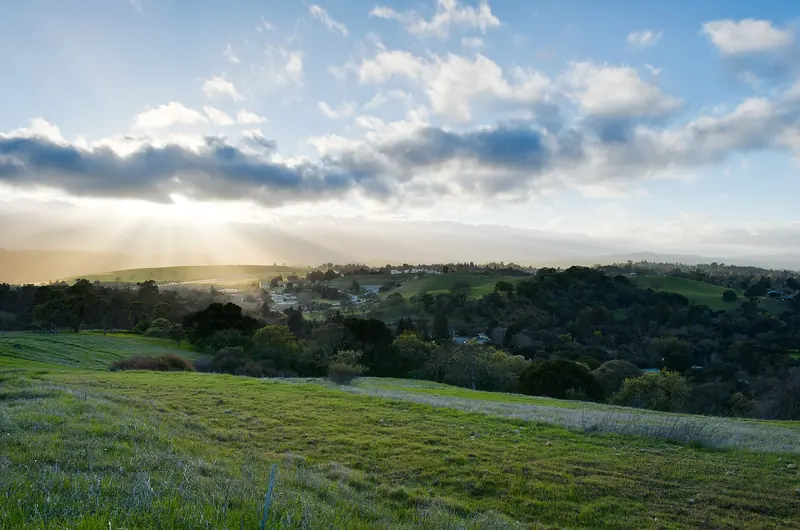
On the brown hills above the Stanford golf course, just north of the big radio dish that gives the Dish trail its name, a small building with a silver dome keeps watch over the Peninsula. This is the Stanford Student Observatory, a teaching facility built by students in the 1970s. Most of the year it serves astronomy classes. A few nights a year it opens to the public for free stargazing.
The short answer for visitors: public nights still run, but they are irregular, free and need registration. When this page was updated on October 30, 2026, the most recent night had been October 6, 2026 and no new date had been posted. Below you will find how the program works, what to expect, the observatory's unusual history and where to look at the sky on the many nights Stanford's dome stays closed.
How the public nights work
Stanford's physics department runs the observatory for its students and faculty. Its observatory page says the facility is not open to the public on a regular basis but now offers public viewing events through the stargazing program of the Kavli Institute for Particle Astrophysics and Cosmology (KIPAC). KIPAC is a joint institute of Stanford and SLAC National Accelerator Laboratory. Our page on research labs near Palo Alto covers SLAC.
KIPAC's event listings describe each night the same way. You observe planets, star clusters, nebulae and galaxies through several telescopes. Events are free, open to everyone and by registration only. All nights are weather permitting and KIPAC shares a detailed observing plan with registrants. KIPAC also offers viewings during special events such as solar and lunar eclipses and planet transits.
Recent dates
The schedule is the main hurdle. These are the public nights KIPAC lists for the past year or so:
| Date | Time |
|---|---|
| Tuesday, November 18, 2025 | 6:30 p.m. to 8:30 p.m. |
| Tuesday, February 3, 2026 | 7 p.m. to 9 p.m. |
| Wednesday, March 11, 2026 | 8:30 p.m. to 10:30 p.m. |
| Tuesday, October 6, 2026 | 8 p.m. to 10 p.m. |
Start times follow the season, from 6:30 p.m. in late fall to after 9 p.m. in early summer. Nights tend to fall midweek and dates appear only weeks ahead. The reliable way to hear about the next one is KIPAC's outreach mailing list, linked from its telescope viewings page. Register as soon as a date appears.

Getting there and parking
The observatory is at 44 Vista Lane, off Junipero Serra Boulevard in the foothills west of central campus. It sits near the Carnegie Foundation for the Advancement of Teaching and the Center for Advanced Study in the Behavioral Sciences (CASBS). KIPAC's directions for the October 2026 night were:
- By car: Park at the Carnegie Foundation lots or the CASBS lot. The gates opened at 7:30 p.m.
- If the lots are full: Park in the open area on the left before the large black gate on Vista Lane, with the golf course on your right, then walk around the gate.
- Walk up: Allow about five minutes uphill from the gate to the observatory.
- By bike, skateboard or scooter: Bring it up and lock it at the observatory or at the bike rack in the upper Carnegie lot.
Directions can change from event to event, so read the page for the night you register for. Our Stanford Golf Course guide describes the area below the observatory and our parking and transit guide covers the rest of campus.
Good to know for a stargazing night
- Dress warmly. The hills cool off quickly after sunset, even after a hot day.
- Bring a red-light flashlight or dim your phone. White light ruins night vision for everyone.
- Expect a short climb in the dark on uneven ground.
- If the sky clouds over, the event may be canceled. Watch your email on the day.
What is inside
According to the physics department, the observatory has a main building with lab space, a teaching room with a small library, a washroom and two small darkrooms. Outside stairs lead to an observing floor about 35 feet above the ground under a 15 foot dome.
- The 24-inch telescope: A custom Cassegrain and Newtonian telescope built by Torus Precision Optics of Iowa City, on a massive German equatorial mount weighing about 1,200 pounds.
- The new 0.7 meter telescope: KIPAC describes it as newly installed and uses it with the historic 24-inch on public nights.
- The accessible dome: A smaller fiberglass dome on a ground-level concrete pad southwest of the main building, added so students with disabilities can use the facility. It houses a 16-inch telescope donated by alum David Siminoff.
- Portable telescopes: KIPAC brings digital eVscopes and optical telescopes for public nights.
Physics classes use the observatory in spring, summer and fall. Physics 50 teaches small-telescope observing to non-science undergraduates, Physics 100 adds measurement and spectroscopy and Physics 301 gives graduate students hands-on equipment projects.
A student-built observatory
The observatory exists because a group of freshmen asked for it. In the early 1970s, physics and engineering students at a dorm dinner with their adviser, physics chair Walter Meyerhof, complained about the limited astronomy on campus. Meyerhof's reply, as Nick Suntzeff later recalled it, was "Well, why don't you try to build it!"
They did, over the next four years. Student leaders Michael Kast and Nick Suntzeff ran the project. Architecture student Kenneth Kornberg drew the design and Greg Howell led much of the construction. Physics students Sally Ride and Doane Farmer also put in long hours. Ride later became the first American woman in space. The team scrounged parts:
- The dome was a discard from the Leuschner Observatory, apparently built in 1905.
- The telescope mount, one of the earliest made by Boller and Chivens, came from North American Rockwell, where it had tracked missiles.
- The pier tube was a scrap wind tunnel from an engineering junk heap.
Suntzeff remembered that the dome was too big for the freeway and that the crew simply hoped the Highway Patrol would not notice. In the late 1990s the department rebuilt the mount with computer control. A crane lifted it out of the dome on December 7, 1997. The current 24-inch optics came with that upgrade.
Stargazing nearby when Stanford is closed
With only a few Stanford nights a year, most local stargazers rely on a weekly program a few miles south. Foothill College Observatory in Los Altos Hills runs free public sessions with volunteers from the Peninsula Astronomical Society. The college's observatory page lists:
| Program | When | Cost |
|---|---|---|
| Friday evening public viewing | Every clear Friday, 9 p.m. to 11 p.m. | Free |
| Saturday solar viewing | Every clear Saturday, 10 a.m. to noon | Free |
| Special events | Eclipses and other sky events | Free |
The observatory is near Parking Lot 4 and the Krause Center for Innovation on the Foothill campus. The observatory page has described parking as free, but the college district's parking page says visitors need a daily digital permit, so check before you go. The Almanac reported in July 2026 that club volunteers took over the sessions in the late 1970s, after Proposition 13 cut community college budgets. The society also holds free monthly meetings with astronomy speakers on the second Friday of each month and one or two large star parties a year.
Other options take more effort. Light from the Bay Area washes out faint objects anywhere near Palo Alto, so serious observers drive to darker skies along the coast or in the Santa Cruz Mountains. Check park hours first, since many local preserves, including Foothills Nature Preserve, close at sunset. The paved Dish trail is a daytime walk only, but it gives you a close look at the observatory dome from below. For more evening ideas, see our date night guide.
Frequently asked questions
Is the Stanford Student Observatory open to the public?
Not on a regular basis. Stanford's physics department says the observatory is a teaching facility, but it now offers public viewing events through KIPAC's stargazing program. These nights are free, open to everyone, weather permitting and by registration only.
How often are Stanford stargazing nights?
Only a few times a year. KIPAC's listings show public nights on November 18, 2025, February 3, 2026, March 11, 2026 and October 6, 2026. No upcoming night was posted on October 30, 2026, so join KIPAC's outreach mailing list to hear about the next one.
Where is the Stanford Student Observatory?
At 44 Vista Lane in the hills above the Stanford golf course, north of the Dish radio telescope. You can see it from Junipero Serra Boulevard and Interstate 280 as a brown cantilevered building with a silver dome.
Where can I go stargazing near Palo Alto every week?
Foothill College Observatory in Los Altos Hills holds free public viewing every clear Friday from 9 p.m. to 11 p.m. and solar viewing on clear Saturdays from 10 a.m. to noon. Volunteers from the Peninsula Astronomical Society run it. The college's parking rules can require a daily visitor permit, so check before you go.
Where do I park for a Stanford stargazing night?
For the October 2026 night, KIPAC told guests to use the Carnegie Foundation lots or the CASBS lot on Vista Lane, with gates opening at 7:30 p.m. Expect about a five minute uphill walk to the observatory. Check each event page because directions can change.