On this page
Every Stanford diploma carries the name of a boy who died before the first building went up. Leland Stanford Jr. was 15 when typhoid fever killed him in Florence in 1884. His parents, one of the richest couples in America, turned their grief into a university on their Palo Alto horse farm and a museum to hold the things he had collected. Both still stand.
Our page on Leland, Jane and Leland Jr. Stanford covers all three family members, the founding grant and Jane Stanford's death. This page stays with the son: what is known of his life, how his death set events in motion and where to see traces of him on campus today.
A late and only child
Leland and Jane Stanford had been married for almost 18 years without children when their son was born in Sacramento on May 14, 1868. Jane was 39 and Leland 44. The boy was christened Leland DeWitt Stanford and later took his father's name.
He grew up amid enormous wealth. His father led the Central Pacific Railroad and drove the ceremonial last spike of the transcontinental railroad in 1869, when Leland Jr. was a baby. The family moved from Sacramento to San Francisco and built a mansion on Nob Hill. From 1876 they also had the Palo Alto Stock Farm, the country estate along San Francisquito Creek where Leland Sr. bred trotting horses.
The farm was part of the boy's world. In 1879 Eadweard Muybridge, who was then photographing the farm's horses in motion, made a picture of Leland Jr. on his pony, Gypsy. The Cantor Arts Center lists it among its holdings. Our pages on Eadweard Muybridge and the stock farm tell that story.
A young collector
Leland Jr. traveled widely with his parents and was taught by tutors. On trips to Europe he gathered antiquities and curiosities, as children of rich families then often did on a Grand Tour. Accounts of his collecting describe a serious interest in ancient objects and in history. Family accounts say he hoped to share his collection in a museum one day.
That wish is one of the few of his that later writers repeat with confidence. His parents took it seriously. After his death they made a museum for his collection part of the plan for the university from the start. Jane Stanford kept adding to it until her death in 1905.
Florence, 1884
In 1884 the family was traveling through Europe when Leland Jr. fell ill with typhoid fever. His parents moved him from Athens to Naples, then to Rome and finally to Florence in search of better care. He died in Florence on March 13, 1884, two months short of his 16th birthday.
Before leaving Europe with his body that April, the Stanfords rewrote their wills to leave their fortune to a new institution at Palo Alto, according to our Stanford family page. Later accounts add a story that Leland Sr. dreamed his son urged him to live for humanity. It is often repeated on campus tours, but historians treat it as family legend rather than documented fact.
His body went first to a temporary vault in the East and then to a smaller brick tomb on the Palo Alto estate. The granite Stanford Family Mausoleum in the Arboretum was finished in 1889. Leland Jr. was moved into it on June 29, 1893, five days after his father's burial.
A university in his name
On November 11, 1885, the Stanfords signed the grant founding the Leland Stanford Junior University. They gave it the Palo Alto, Vina and Gridley farms. The grant states that the idea for the school "came directly and largely from our son and only child Leland" and orders that it bear his name for all time.
The university opened on October 1, 1891, on the stock farm land. Its legal name has never changed, though nearly everyone calls it Stanford. The students and faculty who arrived that fall, including a young Herbert Hoover, came to a campus built as a memorial. Our history of Stanford University picks up the story from opening day and our Main Quad page describes the sandstone heart of the memorial.
| Date | Event |
|---|---|
| May 14, 1868 | Leland Stanford Jr. born in Sacramento |
| 1879 | Muybridge photographs him on his pony at the stock farm |
| March 13, 1884 | Dies of typhoid fever in Florence |
| November 11, 1885 | Founding grant signed for Leland Stanford Junior University |
| October 1, 1891 | The university opens |
| June 29, 1893 | Moved to the Stanford Family Mausoleum |
| 1894 | Leland Stanford Jr. Museum opens |
The Leland Stanford Jr. Museum
Jane Stanford made the museum her personal project. It opened in 1894 as the Leland Stanford Jr. Museum, with her son's collection at its core and many purchases she added.
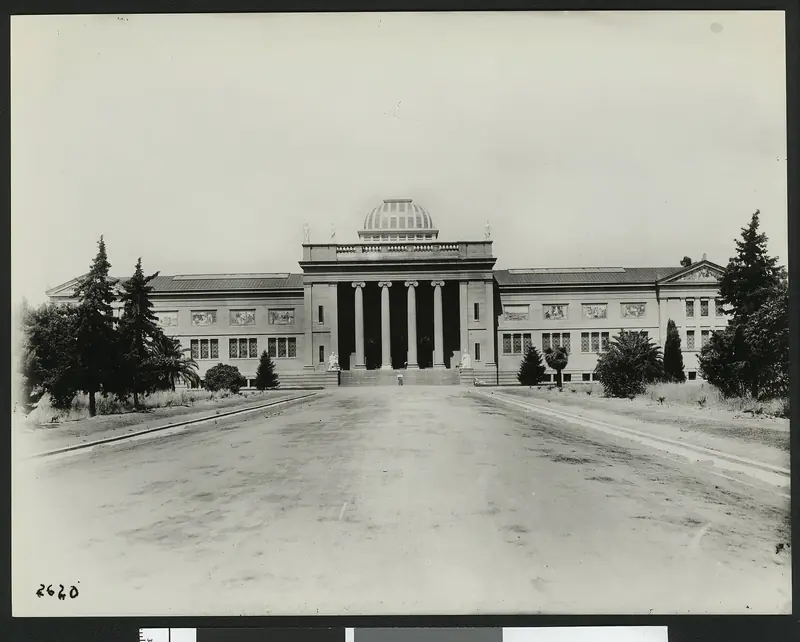

Its later history reads like a run of bad luck. The 1906 earthquake destroyed the Roman, Egyptian and Asian galleries and damaged about three quarters of the building beyond repair, according to the museum's Wikipedia entry. Our page on the 1906 earthquake describes the wider damage on campus. Curatorial work stopped and the building decayed. In 1945 the museum closed to take stock of its holdings. It reopened in 1954.
The 1989 Loma Prieta earthquake hit it again and forced another closure. Our Loma Prieta page covers that quake. A rebuilding project broke ground on October 26, 1995, added a 42,000 square foot wing and retrofitted the old building. In late 1999 it reopened as the Iris & B. Gerald Cantor Center for Visual Arts, now called the Cantor Arts Center.
The family story is still on show. The museum's exhibition JANE!, curated by Patrick R. Crowley and running until May 2028, looks at Jane Stanford's life and her unsolved death in 1905. Its objects include her gowns, Egyptian artifacts she bought for the museum and a jar of her beauty cream recovered from the family's Palo Alto mansion, which the 1906 earthquake destroyed. That house, on the stock farm, was the country home Leland Jr. knew as a boy and the place where his father died in 1893.
Where to find Leland Jr. today
- The Cantor Arts Center. The museum still holds collections and memorabilia of the Stanford family. Our collection highlights page describes the family objects and the current show on Jane Stanford. Admission is free and the museum is closed Tuesday and Wednesday. See our Cantor visitor guide.
- The Stanford Family Mausoleum. It stands in the Arboretum near the Arizona Cactus Garden, a short walk from the museum. The grounds are open and free. Our Arboretum guide shows the way.
- The name itself. Look for "Leland Stanford Junior University" on official seals and documents.
Good to know
- The mausoleum is a grave site. Keep visits quiet and do not climb on the steps or the sphinxes.
- For a deeper read on the family as collectors, Stanford's museum has recommended Carole Osborne's book Museum Builders in the West: The Stanfords as Collectors and Patrons of Art, 1870 to 1906.
Frequently asked questions
Why is Stanford called Leland Stanford Junior University?
Leland and Jane Stanford founded it in memory of their only child, Leland Jr., who died of typhoid fever in 1884 at 15. The 1885 founding grant ordered that the university carry his name for all time. Leland Stanford Junior University is still its legal name.
How did Leland Stanford Jr. die?
He caught typhoid fever in early 1884 while traveling in Europe with his parents. They moved him through Naples and Rome to Florence for care, where he died on March 13, 1884, two months before his 16th birthday.
What happened to Leland Stanford Jr.'s collection?
The objects he gathered on family trips became the core of the Leland Stanford Jr. Museum, which opened on campus in 1894. The building survived two major earthquakes in damaged form and reopened in 1999 as today's Cantor Arts Center, which still shows Stanford family collections.
Where is Leland Stanford Jr. buried?
In the Stanford Family Mausoleum in the Stanford Arboretum, with his parents. He was moved there on June 29, 1893, after resting first in a temporary vault in the East and then in a smaller tomb on the family's Palo Alto estate.
Did Leland Stanford Jr. ever see the university?
No. He died seven years before it opened on October 1, 1891. He did know the Palo Alto Stock Farm, the family estate the campus was built on. Eadweard Muybridge photographed him there on his pony in 1879.