On this page
Most people link the 1906 earthquake with San Francisco and its fires. Palo Alto and Stanford sit about 30 miles to the south and only a few miles east of the San Andreas Fault. They took a hard hit too. On campus, the newest and grandest buildings came down. In town, brick storefronts on University Avenue collapsed into the street. Two people died at Stanford.
This page walks through the damage building by building, then shows how the university and the young town rebuilt. It also points out what you can still see today, from the stumps of the Memorial Arch to a downtown hall that lost its upper wall. For the longer arc of the university, read our history of Stanford.
The morning of April 18
The earthquake struck just after 5 a.m. on Wednesday, April 18, 1906. Stanford's own centennial site gives 5:12 a.m. and a 2013 Stanford Daily history gives 5:07. Accounts of how long the shaking lasted range from about 20 seconds to 47 seconds. Modern estimates put the magnitude at about 7.7 to 7.9.
Stanford was in a fragile moment. Jane Stanford had died in February 1905. The university was still finishing the expensive outer ring of buildings she had pushed through in her last years. Many of those were brand new or still under construction. They were built of stone over unreinforced brick, which looks solid but fails badly in strong shaking.
What fell at Stanford
The inner Quad, built under Leland Stanford's own supervision, came through with about $50,000 of damage. The outer Quad, Memorial Church and the museum fared far worse, with about $1.7 million in losses according to Stanford Daily reporting.
Memorial Church
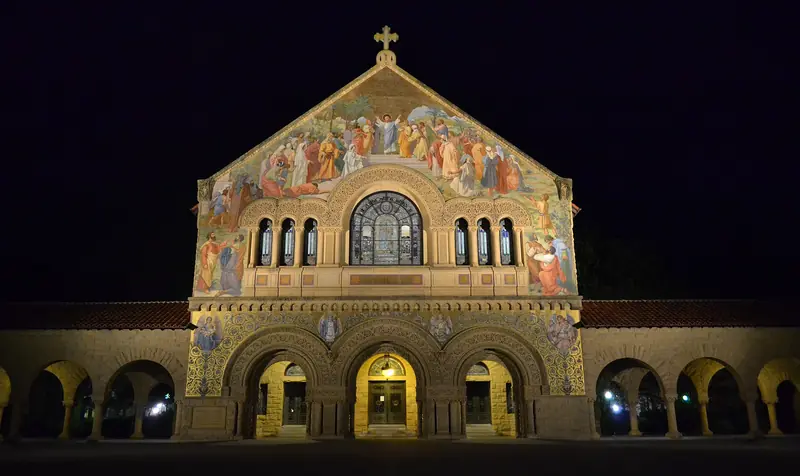
Jane Stanford's church honoring her husband had been dedicated only in 1903. The quake brought its spire and clock tower crashing down through the roof into the nave. The front was shattered, including the great mosaic on the facade. The church was taken apart and rebuilt stone by stone from 1908 to 1917, with the facade mosaic recreated. The spire was never put back. Our Memorial Church guide covers the building as it stands now.

The Memorial Arch
A huge stone arch had stood over the entrance to the Quad since about 1899. The quake knocked off its heavy cap and sculpted frieze and opened seams down its sides. Falling stone crushed part of the Assembly Hall next to it. Engineers priced the repair at $131,000 plus $30,000 for a new frieze. The university took the upper part down instead. Only the bases remain, capped with red tile roofs.
The gymnasium and the new library
Two of the newest buildings on campus were total losses. The gymnasium, designed by architect Charles Hodges, was judged destroyed beyond repair. A new library under construction was wrecked as well. Neither was rebuilt in its original form. Stanford built a new Main Library, which opened in 1919 and is now the Bing Wing of Green Library. See our Green Library page. Hodges resigned and the New York Times linked his departure to criticism of the damage.
The Agassiz statue
The best-known picture of the 1906 quake at Stanford shows a marble statue of the naturalist Louis Agassiz stuck headfirst in the ground. It had stood on a second-story ledge of the zoology building, now Building 420. The ledge failed and the statue plunged into the earth up to its hips. A quip usually credited to university president David Starr Jordan said Agassiz was great in the abstract but not in the concrete. Only the nose broke. The statue was fixed and remounted more securely. In October 2020 it was removed after the Psychology Department asked for it to go, because Agassiz had promoted racist theories of human origins.
Deaths and other damage
- Encina Hall. About 300 students ran into the corridors of the men's dorm. Junius Hanna, a sophomore, was killed when a chimney fell through the roof. Some sources spell his name Hannah.
- The power house. Campus fireman Otto Gerdis was killed when the power house chimney collapsed just after he shut off steam and electricity. His name also appears as Gerdes.
- The museum. Large parts of the Leland Stanford Junior Museum were ruined.
- Palm Drive. The entry gates collapsed completely.
- The Mausoleum. The first Angel of Grief statue, from 1901, was wrecked. A replacement went up in 1908. It is part of our Arboretum guide.
Damage in the town of Palo Alto
Palo Alto was barely 12 years old as a city. Within about a minute, roughly half its chimneys were down and nearly every business was damaged, according to accounts gathered by the local history site PaloAltoHistory.org.
- F. C. Thiele's new $30,000 store on University Avenue collapsed.
- Fuller's grocery on High Street fell in.
- The four-year-old Simkins Building lost its ground-floor walls. Local papers said its upper stories were about three feet out of plumb.
- The Stanford Building of Frazer and Company lost its walls and left early sleepers exposed.
- Fraternal Hall at 140 University Avenue lost its cornice and a second-story wall, which fell on Crandall's bicycle shop. The building still stands and is listed on the National Register. See our landmarks guide.
The town avoided the fires that destroyed San Francisco. Engineer Robert McGlynn cut the supply at the city power plant while its 60-foot tower swayed. Palo Alto kept its water and electricity running. Estimates of the town's losses run from about $150,000 to more than $165,000 in 1906 dollars. South of town, the old Robles family adobe on the former rancho was ruined for good.
Birge Clark, later the city's leading architect, was a boy of 13 that morning. The U.S. Geological Survey later published an interview with him about what he saw. Read about his career on our Birge Clark page.
Relief for San Francisco
Palo Alto turned quickly to helping the city to the north. A relief committee formed that evening at the Circle near the station. Women served 250 to 300 meals a day at the Congregational Church. Volunteers sent about 75,000 loaves of bread, 10,000 gallons of milk and 1,200 sacks of clothing to San Francisco. Town leaders braced for 6,000 refugees. About 550 came.
President Jordan closed the university on April 19 and sent students home. Some stayed to help in San Francisco at a relief station called Camp Stanford, at 25th and Guerrero streets. The 1906 to 1907 term opened on August 23. The seniors, nicknamed the Calamity Class, celebrated graduation in September.
Rebuilding the campus and the town
A Commission of Engineers inspected the campus in the weeks after the quake. By May it reported that the buildings needed for teaching could be ready by the next term. Reconstruction began in July 1906 and most of the outer Quad was back in use about a year later. Private gifts paid for much of it.
- 1906 to 1907: Outer Quad repairs, including the physics corner and assembly hall.
- 1908: Memorial Church reconstruction begins. The Lawson report, a landmark scientific study of the quake, is published.
- 1917: Memorial Church restoration is declared complete.
- 1919: The new Main Library opens.
The damage hurt Stanford's standing. Stanford's centennial researchers found that applications fell and did not recover until 1915. The university raised faculty salaries by 60 percent to keep its professors.
Downtown recovered faster. Most merchants were trading again within two weeks. The First National Bank put up a sign promising a modern new building on its corner. In June 1906 the city cleared rubble from the street in front of the ruined Thiele store and dumped it back on the owner's lot.
Town boosters also saw an opening. About two weeks after the quake a promotion committee raised $2,167 to lure San Franciscans south with the slogan "Why not live in Palo Alto? The home city of California." School enrollment rose from 672 to 725 by June. Palo Alto's population nearly tripled between the 1900 and 1910 censuses. Our page on the founding of Palo Alto covers the town's first years.
The quake's legacy
The disaster pushed Stanford toward the study of earthquakes. Stanford geologist John C. Branner and his colleagues contributed to the 1908 Lawson report and the university later became a center for seismology and earthquake engineering. Its John A. Blume Earthquake Engineering Center continues that work.
The next big test came on October 17, 1989, when the Loma Prieta earthquake hit. No one on campus was hurt, but the Quad, Memorial Church and the main library needed years of repairs. Memorial Church reopened in 1992 and the main library in 1999. Palo Alto residents can find current advice on our earthquake preparedness page.
Where to see 1906 today
- Memorial Arch bases at the Quad entrance from the Oval, with their dedication plaque. See our Main Quad guide.
- Memorial Church, with its spireless roofline and recreated mosaic.
- Building 420 on the Quad. The Humboldt statue still stands beside the spot where Agassiz stood until 2020.
- The Angel of Grief in the Arboretum, the 1908 replacement for the statue the quake destroyed.
- Fraternal Hall at 140 University Avenue in downtown Palo Alto.
Frequently asked questions
How much damage did the 1906 earthquake do to Stanford?
Heavy damage. Memorial Church lost its spire and front, the new gymnasium and new library were wrecked and the Memorial Arch had to come down. President David Starr Jordan estimated losses at $2.8 million. Stanford's archivist later put the figure nearer $1.75 million.
Did anyone die at Stanford in the 1906 earthquake?
Two people died. Student Junius Hanna was killed when a chimney fell through the roof of Encina Hall. Campus fireman Otto Gerdis died at the power house after shutting off steam and electricity. Sources spell both surnames in more than one way.
What happened to the Agassiz statue in 1906?
The statue of naturalist Louis Agassiz fell headfirst from a ledge on the zoology building and stuck in the ground. Only its nose broke. It was put back more securely, then removed in October 2020 at the request of the Psychology Department because of Agassiz's racist scientific views.
Why doesn't Stanford Memorial Church have a spire?
The 1906 earthquake brought the spire and clock tower down through the roof. The church was taken apart and rebuilt between 1908 and 1917, but the spire was left off.
Was Palo Alto damaged in 1906?
Yes. About half the town's chimneys fell and nearly every business was damaged. Several new brick stores on University Avenue and High Street collapsed. Quick action at the power plant prevented fires and most merchants reopened within two weeks.