On this page
Everyone in Palo Alto lives in the shadow of the Stanford name. It is on the university, the shopping center, the hospital and half the street signs on campus. The three people behind it are easy to flatten into a legend: a tycoon, his devoted wife and the boy who died young. Their real lives were more complicated. In one case they were also more mysterious.
This page looks at each of them in turn, then at the founding grant that tied their fortune to the Palo Alto farm and at Jane Stanford's death in 1905. The university's own story, from opening day to the present, is on our page about the history of Stanford University.
Leland Stanford: storekeeper to railroad baron
Amasa Leland Stanford was born on March 9, 1824, in Watervliet, New York, near Albany. He was one of eight children of a farmer of some means. He studied law, was admitted to the bar in 1848 and moved west to Port Washington, Wisconsin, to practice. In 1852 a fire destroyed his law library and other property. He followed his brothers to California and the Gold Rush.
He did not dig for gold. He kept a general store for miners at Michigan Bluff in Placer County, then moved to Sacramento in 1856 and went into wholesale trade. There he joined Collis Huntington, Mark Hopkins and Charles Crocker as the four main investors in engineer Theodore Judah's plan for a railroad over the Sierra Nevada. They incorporated the Central Pacific on June 28, 1861, with Stanford as president.
Governor and senator
Stanford won the governorship in 1861 as California's first Republican governor and served from January 1862 to December 1863. The Great Flood of 1862 was so bad that he reportedly rowed to his own inauguration. His record was mixed. He cut the state debt and backed the first state normal school, which became San José State University. He also told the legislature in 1862 that Chinese immigration should be discouraged by every legitimate means, while his railroad came to rely on thousands of Chinese workers.
On May 10, 1869, Stanford drove the ceremonial last spike of the first transcontinental railroad at Promontory, Utah. He also led the Southern Pacific from 1868 to 1890, when his partner Huntington forced him out. The family moved to San Francisco in 1874 and built a mansion on Nob Hill. Stanford served in the U.S. Senate from 1885 until his death. Many historians count him among the robber barons of the Gilded Age.
Farms, vines and horses
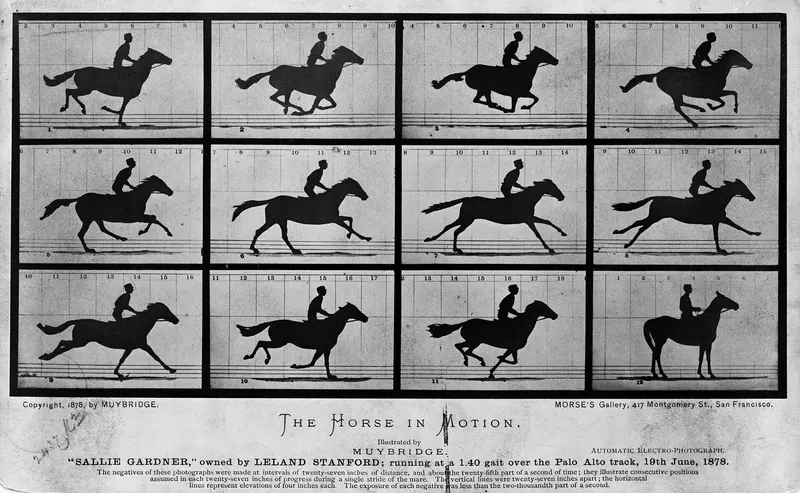
Stanford spent his money on land. He owned the 55,000-acre Vina ranch in Tehama County, with a vineyard of about 3,575 acres that was then called the largest in the world. He held the Gridley farm in Butte County. And from 1876 he assembled the Palo Alto Stock Farm along San Francisquito Creek, where he bred champion trotting horses. Our page on the Palo Alto Stock Farm covers the horses and the Muybridge photographs taken there in 1878.

Jane Lathrop Stanford
Jane Elizabeth Lathrop was born on August 25, 1828, in Albany, New York, the daughter of shopkeeper Dyer Lathrop. She attended the Albany Academy for Girls. She married Leland on September 30, 1850. She moved with him to Wisconsin. When he left for California in 1852 she stayed in Albany with her family. He came back for her in 1855 and the couple settled in California the next year.
For 18 years they had no children. As the wife of the governor and later of a railroad president, Jane ran large households in Sacramento and San Francisco. Her real public life began after tragedy. She shaped the university's buildings, its museum and its church and outlived her husband by almost 12 years. In those years she was the university's chief funder and, in practice, its boss.
Leland Stanford Jr.
Their only child was born on May 14, 1868, in Sacramento, when Jane was 39 and Leland was 44. He was christened Leland DeWitt Stanford and later took his father's name. He grew up in great wealth, traveled widely and collected antiquities and curiosities on the family's trips to Europe.
In 1884 the family was on a Grand Tour when he fell ill with typhoid. His parents moved him from Athens to Naples, then Rome, then Florence in search of better care. He died in Florence on March 13, 1884, two months before his 16th birthday. Before leaving Europe that April with his body, his parents rewrote their wills to leave everything to a new institution at Palo Alto. His collection became the core of the museum built in his memory, today's Cantor Arts Center.
The founding grant
The Stanfords needed a legal way to give away a fortune for a school. The California Legislature passed an act for that purpose, approved on March 9, 1885, Leland's 61st birthday. On November 11, 1885, the couple signed the "Grant Founding and Endowing the Leland Stanford Junior University." The text, reprinted in the university's 1908 trustees' manual, holds some details that rarely make the brochures:
- The land: It conveyed three properties, the Palo Alto Farm, the Vina Farm and the Gridley Farm, to the trustees forever.
- The principal: The trust property was to "forever remain intact," with only the income spent.
- The name: The founders wrote that the idea "came directly and largely from our son and only child Leland" and ordered that the school bear his name for all time.
- The board: It named 24 trustees, including Timothy Hopkins, Charles F. Crocker and Supreme Court Justice Stephen J. Field. The board was told to meet in San Francisco on November 14, 1885.
- Teaching: It barred sectarian instruction yet required teaching the immortality of the soul and the existence of a benevolent Creator.
- Admission: It described a university "for both sexes."
The grant says nothing about alcohol. The dry rules that shaped Palo Alto came from deeds, the city charter and state law, a story told on our page about Palo Alto's alcohol ban.
Leland's death and Jane's rescue
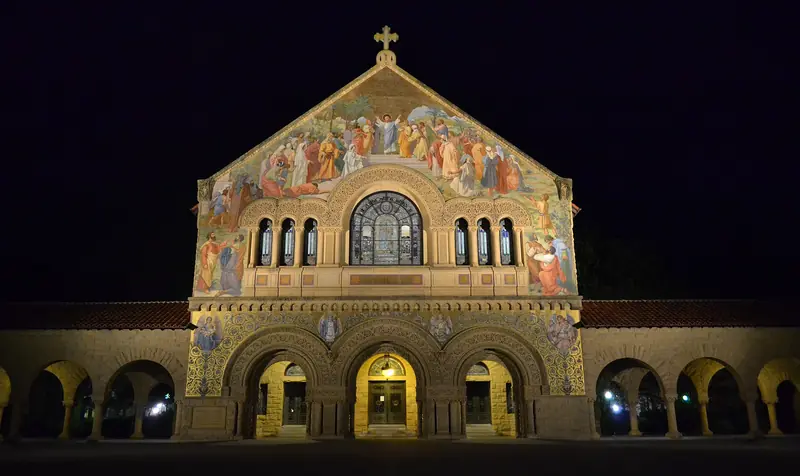
The university opened on October 1, 1891. Less than two years later, on June 21, 1893, Leland Stanford died of heart failure at his home on the Palo Alto farm. He was 69 and had long suffered from locomotor ataxia. His estate was frozen by a federal claim. Jane kept the university open on a court allowance until the U.S. Supreme Court ruled for the estate in March 1896. She later directed that her jewels be sold after her death to buy books. She also built Memorial Church in her husband's memory.

Jane Stanford's death in 1905, as reported
The facts below follow contemporary reports as summarized by historians. Some details remain disputed.
- January 14, 1905: At her Nob Hill mansion, Jane Stanford drinks bottled mineral water that tastes bitter. She makes herself vomit. A pharmacy analysis weeks later finds strychnine. A private detective agency investigates the household and finds staff intrigue but no culprit.
- February 1905: Shaken, she sails for Hawaii with her longtime secretary, Bertha Berner.
- February 28, 1905: At the Moana Hotel in Honolulu she asks for bicarbonate of soda in the evening. Soon after drinking it she is seized by violent spasms and dies. Accounts quote her saying, "This is a horrible death to die."
- March 1905: A coroner's jury finds that she died of strychnine poisoning given by a person or persons unknown. The San Francisco Evening Bulletin headlines "Mrs. Stanford Dies, Poisoned."
David Starr Jordan, the university president, sailed to Honolulu, hired a local doctor and declared that she had died of heart disease. A New York Times dispatch of March 11, 1905, suggested the jury had been coached. Jordan's version stood for decades. Historians note that Jane Stanford was then president of the board of trustees and reportedly planned to remove Jordan.
Later writers reopened the case. Stanford physician Robert Cutler's 2003 book concluded that she was poisoned and that Jordan went to Hawaii to hush it up. Historian Richard White's 2022 book Who Killed Jane Stanford? also argues for murder. No one was ever charged and the source of the strychnine was never found.
Where to find the Stanfords today
All three Stanfords lie in the granite Stanford Family Mausoleum in the Arboretum, completed in 1889. Our guide to the Arboretum and the Mausoleum shows the way. From there it is a short walk to the Cantor Arts Center, which still displays family objects. The Main Quad and Memorial Church are a few minutes farther. For the town the Stanfords' plans created, read about the founding of Palo Alto. For the railroad that paid for all of it, see our railroad history.
Frequently asked questions
How did Leland Stanford make his money?
He started as a storekeeper during the Gold Rush and became one of the Big Four investors behind the Central Pacific Railroad, which he led as president. He also controlled the Southern Pacific from 1868 to 1890 and held stakes in Wells Fargo and Pacific Life. He owned large farms and vineyards as well.
What did Leland Stanford Jr. die of?
Typhoid fever. He fell ill in early 1884 during a family trip through Europe and was moved through Naples and Rome to Florence, where he died on March 13, 1884. He was two months short of his 16th birthday.
Who killed Jane Stanford?
No one knows. A coroner's jury in Honolulu found in 1905 that she died of strychnine poisoning given by a person or persons unknown. University president David Starr Jordan insisted she died of natural causes. Later books by Robert Cutler and Richard White argue she was murdered, but no one was ever charged.
What does the Stanford founding grant say?
Signed November 11, 1885, it gives the Palo Alto, Vina and Gridley farms to 24 trustees to found a university for both sexes. It says the principal must remain intact forever, names the school after Leland Jr. and bars sectarian teaching. It contains no rule about alcohol.
Where are the Stanfords buried?
Leland, Jane and Leland Jr. are entombed in the Stanford Family Mausoleum in the Arboretum on campus, near the Arizona Cactus Garden. The grounds are open and free to visit.