On this page
For the first 22 years of Stanford University, one man spoke for it. David Starr Jordan hired the first faculty, welcomed the first students and steered the school through a frozen estate, a suspicious death and an earthquake. The town that grew at the university's gates was full of the professors he recruited. His name ended up on a campus building, a Palo Alto middle school, a Sierra peak and dozens of fish.
Jordan was also one of the most influential American advocates of eugenics, the movement that ranked human groups and pushed for forced sterilization. That record led Stanford, Indiana University and the Palo Alto school district to remove his name between 2017 and 2021. This page covers both sides as documented, without trying to settle a verdict for the reader.
From upstate New York to Indiana
Jordan was born on January 19, 1851, in Gainesville, New York, in Wyoming County. He grew up on a farm and was drawn early to plants and animals. He entered Cornell University with its first freshman class and left in 1872 with a master's degree in botany.
He soon turned to fish. Jordan became one of the leading ichthyologists of his era and described a huge number of species, many of which now carry his name. He taught at several Midwestern schools before joining Indiana University. In January 1885 he became its president. At 34 he was the youngest university president in the country.
Leland and Jane Stanford needed someone to open the university they had founded in memory of their son. They wanted a modern school that would teach practical subjects alongside the classics. Jordan, a scientist with administrative experience and plenty of energy, accepted. He arrived in California in June 1891.
Opening the university on the farm
Stanford opened on October 1, 1891. The first class, later called the Pioneer Class, numbered 555 students. Tuition was free. Jordan told the newcomers that the university was "hallowed by no traditions" and "hampered by none." Among those students was Herbert Hoover, whose story is on our page about Herbert Hoover in Palo Alto.
Stanford credits Jordan with several lasting choices. He introduced a major subject system, in which students concentrated in one department. He favored practical arts and a modern approach to teaching. He pushed early for a seaside laboratory, which became Hopkins Marine Station in Pacific Grove. Stanford's tree guide also credits him with proposing the palm theme for Palm Drive in 1893, a story some historians treat as campus legend.
Not every decision was popular. Jordan disliked the violence of American football. From 1906 to 1917 Stanford played rugby instead, until wartime officials ordered football back.
Jordan and the young town of Palo Alto
Palo Alto grew up with Jordan's university. Timothy Hopkins laid out University Park in 1887. The townsite took the name Palo Alto in 1892, the year after Stanford opened. It incorporated on April 16, 1894. Our page on the founding of Palo Alto tells that story in detail.
Many of the faculty Jordan hired settled just across the tracks. Their shingled houses south of University Avenue earned the area the name Professorville. Faculty families sat on early civic boards, filled the churches and clubs and sent their children to the town's schools. In that sense the first generation of Palo Altans was partly Jordan's doing.
Jordan also shaped the town's attitude toward alcohol. Stanford allowed students to drink in its first years. After what Jordan called "a wave of beer drinking" in 1907, a student affairs committee banned alcohol on campus in 1908. The broader dry rules came from deeds, town ordinances and state law. Our page on Palo Alto's alcohol ban explains how they fit together.
The town returned the attention. When Palo Alto opened a new middle school in 1937, it named the school after Jordan. The name stayed for 81 years.
The hard years: 1893 to 1906
Leland Stanford died in June 1893. A federal claim froze his estate and the young university nearly ran out of money. Jane Stanford kept it open on a court allowance until the U.S. Supreme Court ruled for the estate in March 1896. Stanford's own history credits Jordan with guiding the school through that crisis alongside her.
Relations between the two grew strained over the following decade. In 1905 Jane Stanford died in Honolulu. A coroner's jury found that she had died of strychnine poisoning given by a person or persons unknown. Jordan sailed to Hawaii, hired a local doctor and declared that she had died of heart disease. Historians note that she reportedly planned to remove him. Books by Stanford physician Robert Cutler in 2003 and historian Richard White in 2022 argue she was murdered and that Jordan's account helped bury the case. No one was ever charged. The details are on our page about the Stanford family.
A year later the April 1906 earthquake wrecked much of the campus. Jordan closed the university on April 19 and sent students home. He estimated losses at $2.8 million, a figure Stanford's archivist later put closer to $1.75 million. A quip usually credited to him said the toppled statue of Louis Agassiz was great in the abstract but not in the concrete. Our page on the 1906 earthquake covers the damage.
Fish, mountains and peace
Outside the president's office Jordan stayed busy. He kept publishing on fish and edited a volume on the 1906 earthquake. He served as a Sierra Club director from 1892 to 1903. In 1926 the U.S. Geographic Board named Mount Jordan, a peak of about 13,340 feet in Tulare County, after him at the club's request.
He was also a well-known peace activist. Jordan led the World Peace Foundation from 1910 to 1914 and chaired a world peace conference in 1915. He opposed American entry into World War I, then changed his position in 1917.
In 1913 he stepped up to the honorary post of chancellor and John Casper Branner became president. The trustees did not renew Jordan's chancellorship in 1916. He remained on campus and died at his home there on September 19, 1931, after a series of strokes.
The eugenics record
Eugenics was the belief that society should improve its population by encouraging some people to have children and preventing others. In the early 1900s it had broad support among American scientists and reformers. It led to race-based immigration limits and to tens of thousands of forced sterilizations, many of them in California.
Stanford's own campus history describes Jordan as a leader and driving force of that movement. The record documented by Stanford and others includes:
- Books. The Blood of the Nation (1902, expanded 1910), The Human Harvest (1907) and War and Breed (1915). His peace arguments rested partly on the eugenic claim that war killed off the fittest men.
- Organizations. While Stanford's president he became the first chair of the American Breeders Association's Eugenics Committee, often cited as the first eugenics body in the United States.
- Sterilization. Stanford says he served on the first board of the Human Betterment Foundation, founded in Pasadena in 1928 to promote compulsory sterilization. Wikipedia notes the foundation listed him as a member.
- Influence. Stanford's account says his teaching inspired Dr. Leo Stanley, who sterilized at least 600 prisoners at San Quentin.
Stanford's 2020 review also found that Jordan denigrated many races and cultures. Student researchers with the Eugenics at Stanford project argued that he "was not simply a man of his time" but helped make his time.
Renaming at Palo Alto, Stanford and Indiana
The renamings came in quick succession. A Palo Alto parent's petition, prompted by a student report on Jordan's views, started the local debate.
| When | Where | What happened |
|---|---|---|
| 2017 | Palo Alto Unified School District | The board voted to rename Jordan and Terman middle schools, both named for men tied to eugenics. |
| March 2018 | Palo Alto Unified School District | The board voted 5 to 0 for Frank S. Greene Jr. Middle School. |
| Spring 2020 | Stanford | The Department of Psychology and a student group asked Stanford to remove Jordan's name from its building. |
| October 7, 2020 | Stanford | Trustees approved removing the name from Jordan Hall, Jordan Quad, Jordan Modulars and Jordan Way. |
| October 2020 | Indiana University | Trustees removed his name from a biology building, a garage and a campus creek. |
Stanford's committee, chaired by law professor Bernadette Meyler, also recommended moving the statue of Louis Agassiz, Jordan's mentor, from the building's facade. Agassiz promoted the view that human races had separate origins and were unequal. The university said its aim was to present Jordan's full legacy rather than erase it.
Good to know
- Stanford's decision on Jordan Hall came in 2020, not 2023. We found no separate 2023 renaming.
- The building has been called Building 420 since then. We could not confirm a permanent new name.
- The district's other renamed school, Terman, honored psychologist Lewis Terman. His son is the subject of our page on Frederick Terman.
Where to see Jordan's traces
Building 420, the former zoology building of 1899, still stands on the Main Quad. It carried Jordan's name from 1917 until 2020. The Agassiz statue came down from its facade in October 2020. Stanford has added explanatory signs about the renaming. Hopkins Marine Station still runs on the Monterey Peninsula.
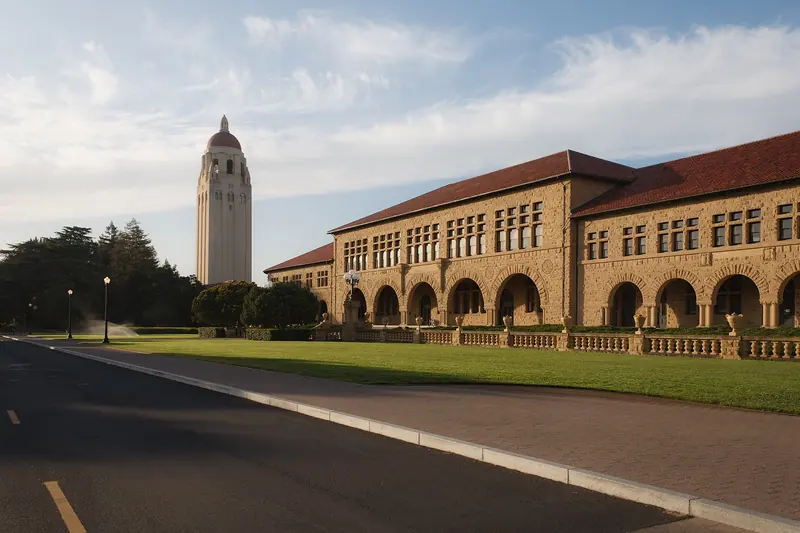

In Palo Alto, Greene Middle School keeps teaching on the site of the old Jordan school. Our guide to Palo Alto middle schools covers it today. For the wider story of the university he led, read our history of Stanford.
Frequently asked questions
Who was David Starr Jordan?
He was a fish biologist and the first president of Stanford University, serving from 1891 to 1913 and then as chancellor until 1916. Before Stanford he led Indiana University. He was also a prominent peace activist and a leading promoter of eugenics.
Why did Stanford remove Jordan's name from Jordan Hall?
A review committee found that Jordan was a leader and driving force of the eugenics movement and that honoring him where people work and study would undermine Stanford's values. The Board of Trustees approved removing his name from Jordan Hall, Jordan Quad, Jordan Modulars and Jordan Way. Stanford announced the decision on October 7, 2020.
What is Jordan Hall called now?
Stanford said in 2020 that the building would be called Building 420 until a new name was chosen. We could not confirm that a permanent new name has been announced, so expect to see Building 420 on maps and signs.
Did Stanford rename Jordan Hall in 2023?
No. The decision came in October 2020, after a review that began that spring. Some accounts give later dates because signs and maps changed gradually, but the trustees' approval was in 2020.
What happened to Jordan Middle School in Palo Alto?
The Palo Alto school board voted in 2017 to rename it because of Jordan's eugenics advocacy. In March 2018 the board chose the name Frank S. Greene Jr. Middle School, honoring an African American technology pioneer and investor.