On this page
Herbert Hoover is usually tied to Iowa, where he was born, or to Washington, where his presidency collided with the Great Depression. Yet the place he called home for most of his adult life was a hillside on the Stanford campus at the edge of Palo Alto. He arrived as one of the university's first students. He met his wife in a campus lab. He won and lost the presidency while waiting for returns in the house she designed.
This page follows Herbert and Lou Henry Hoover through their Stanford years, the house and the institution that carries their name. It sticks to their local story. For the university around them, see our history of Stanford.
A teenager in the Pioneer Class
Hoover was born on August 10, 1874, in West Branch, Iowa. He was orphaned young and raised partly by an uncle in Oregon. In 1891, at 17, he sat the entrance exams for the brand new Leland Stanford Junior University. By most accounts he failed every subject except mathematics and was admitted on condition that he make up the rest.
He joined the first class, later called the Pioneer Class, when the university opened on October 1, 1891. He lived in Encina Hall and is often described as one of the first students to move in. Stanford's first president, David Starr Jordan, ran a school with no traditions yet. Hoover helped invent some.
- Geology. He started in mechanical engineering, then switched to geology after working for Professor John Casper Branner.
- Student business. He co-founded the Romero Hall Boarding Club, an early student cooperative. He was also elected student body treasurer.
- Sports. He managed the baseball and football teams and helped organize the first Big Game against the University of California in 1892.
He graduated in 1895 with a geology degree and very little money. Within a few years his work as a mining engineer in Australia and China made him wealthy.
Lou Henry in the geology lab
Lou Henry was born on March 29, 1874, in Waterloo, Iowa. The National Park Service gives her birth date as March 28. Her family moved to California and settled in Monterey. After earning a teaching credential, she enrolled at Stanford to study geology with Branner. In his lab she met Herbert, then a senior. In 1898 she became the first woman to earn a bachelor's degree in geology at Stanford.
The two married on February 10, 1899, at the Henry family home in Monterey. They left almost at once for China, where they lived through the Boxer Rebellion in 1900. Over the next decade they lived mostly in London and traveled widely. Together they translated De Re Metallica, a 16th century Latin mining text by Georgius Agricola. They published it at their own expense. The translation earned them a gold medal in 1914.
Trustee, war relief and a library
Even while abroad, Hoover kept close ties to Stanford. He joined the Board of Trustees and campaigned for Branner to become president, which he did in 1913. His friend Ray Lyman Wilbur, another early Stanford student, became president in 1916 and later served as Hoover's Secretary of the Interior.
World War I made Hoover famous. He organized food relief for occupied Belgium and later ran the U.S. Food Administration. He also saw how quickly the paper record of the war could vanish. In June 1919, while at the Paris Peace Conference, he sent Wilbur a telegram offering $50,000 to collect documents on the war. That telegram is treated as the founding document of what became the Hoover Institution. The first shipment of materials reached Stanford in 1921. The collection was renamed the Hoover War Library in 1922.
The house on San Juan Hill
The Hoovers had long planned a house at Stanford, but the war delayed it. Lou Henry Hoover designed it herself. Arthur B. Clark, a Stanford art professor, agreed to serve as architect on the condition that she lead the design. His son Birge Clark, later Palo Alto's best-known architect, advised. The house was finished in June 1920. Its flat roofs and stacked, terraced shape looked nothing like the pitched-roof houses of the day.
It became the couple's only permanent home. In August 1928 Hoover gave a campaign speech to a huge crowd at Stanford Stadium after his nomination. On election night that November he listened to the returns in the house and learned he had won the presidency. Four years later he was back in the same rooms when he lost to Franklin D. Roosevelt.
After Lou Henry Hoover died, Herbert gave the house to Stanford. It later became the official residence of the university's president. It is California Historical Landmark No. 913 (1977) and was named a National Historic Landmark on February 4, 1985. It is not open to the public. Our page on the Lou Henry Hoover House has the full story.
Lou Henry Hoover's local life
Lou Henry Hoover was an energetic organizer in her own right. She joined the Girl Scouts in 1917 and served as the national organization's president from 1922 to 1925 and again from 1935 to 1937. She founded racially integrated troops in Washington and in Palo Alto, according to her Wikipedia biography. In 1937 she returned to Stanford's music life and backed the Friends of Music program for the rest of her life.
She died of a heart attack on January 7, 1944, in New York City. After a service in New York, a second service was held in Palo Alto, where she was buried. When Herbert died on October 20, 1964, also in New York, she was moved to lie beside him in West Branch, Iowa.
The Hoover Institution and Hoover Tower
The war library kept growing. In 1938 it took the name Hoover Library on War, Revolution and Peace. Stanford approved a $600,000 budget for a separate building. Construction of the tower began in 1939. Hoover Tower, 285 feet tall, was dedicated on June 20, 1941, as part of Stanford's 50th anniversary. Hoover spoke at the ceremony. The carillon's largest bell reads "For Peace Alone Do I Ring."
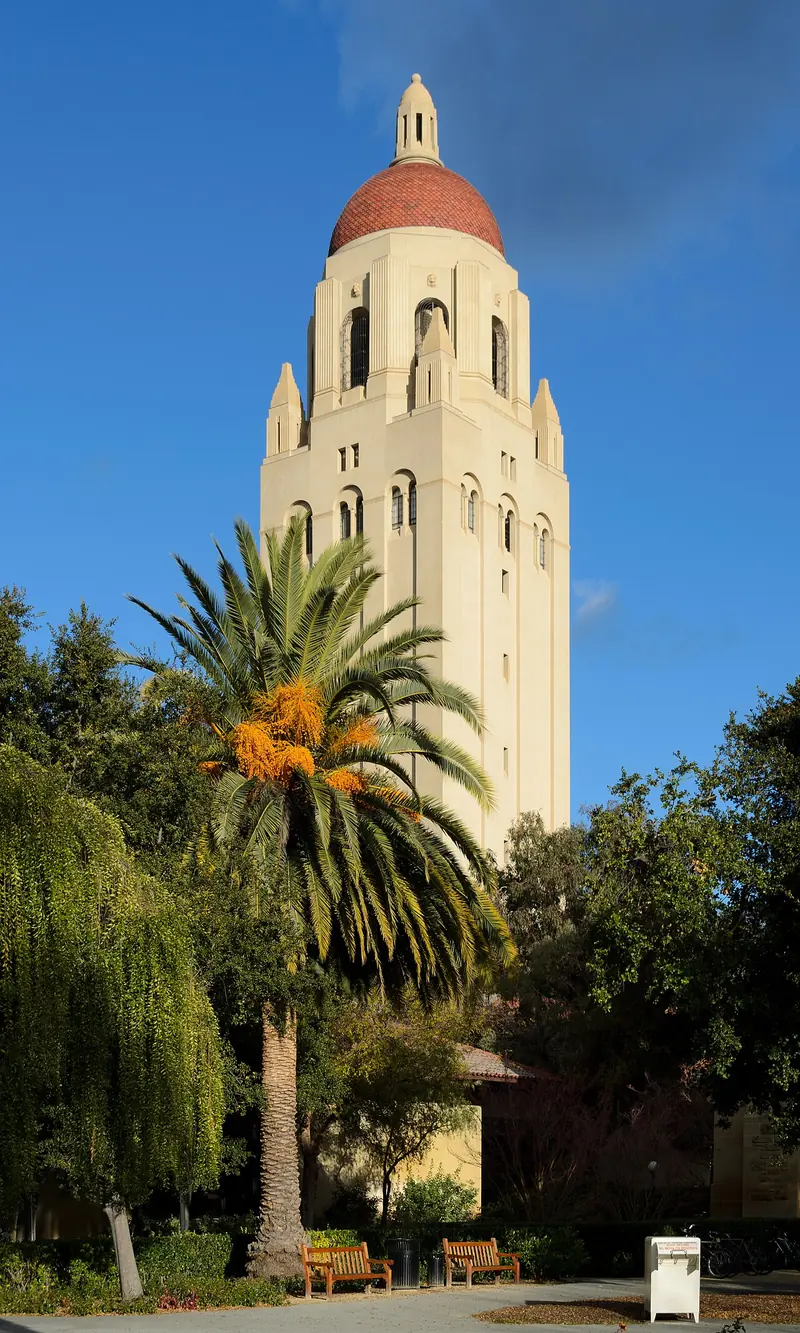

The name changed again in the 1940s and 1950s, ending as the Hoover Institution on War, Revolution and Peace. In 1959 Stanford's trustees defined it as "an independent institution within the frame of Stanford University." Hoover wrote that year that its purpose included "to recall the voice of experience against the making of war." W. Glenn Campbell, the last director Hoover approved, led it from 1960 to 1989. Condoleezza Rice has been director since 2020. The institution's independence and its policy work have often been debated on campus, a story our Stanford history page touches on.
Hoover timeline
- 1891: Herbert Hoover enters Stanford with the Pioneer Class.
- 1895: He graduates in geology.
- 1898: Lou Henry graduates, Stanford's first woman with a geology degree.
- February 10, 1899: The couple marry in Monterey.
- June 1919: Hoover offers $50,000 to start the Hoover War Collection.
- June 1920: The house on San Juan Hill is finished.
- November 1928: Hoover wins the presidency while at home at Stanford.
- November 1932: He loses to Roosevelt, again listening from Stanford.
- June 20, 1941: Hoover Tower is dedicated.
- January 7, 1944: Lou Henry Hoover dies.
- October 20, 1964: Herbert Hoover dies at 90.
- February 4, 1985: The house becomes a National Historic Landmark.
Seeing the Hoovers' Stanford today
Start at Hoover Tower, 550 Jane Stanford Way. The ground floor galleries are open Monday to Friday, 10 a.m. to 4 p.m., from August 17, 2026, to January 25, 2027. They are closed on weekends. The observation deck is closed from August 14, 2026, to January 25, 2027. When it reopens, tickets have been $8. Our guide to the Hoover Institution Library and Archives exhibits explains what is on display. Check the Hoover Institution site before you go.
From the tower, walk to Encina Hall, where Hoover lived as a student. The Main Quad, which he saw rise in sandstone, is a few minutes away. The Lou Henry Hoover House on Mirada Road is private, so admire it only from a respectful distance and do not enter the grounds.
Frequently asked questions
Did Herbert Hoover live in Palo Alto?
He lived on the Stanford campus, which sits next to Palo Alto but outside its city limits. He was a student there from 1891 to 1895. From 1920 the house Lou Henry Hoover designed on San Juan Hill was the couple's only permanent home. He received the news of his 1928 election there.
Where did Herbert Hoover meet Lou Henry?
They met in the Stanford geology lab of Professor John Casper Branner. Herbert was a senior and Lou was a new geology student. They married on February 10, 1899, at her family's home in Monterey.
Can you visit the Hoover house at Stanford?
No. The Lou Henry Hoover House is the official residence of Stanford's president and is not open to the public. Hoover Tower's ground floor exhibits are the best public place to learn about the Hoovers.
What is the Hoover Institution?
It began in 1919 as the Hoover War Collection, funded by a $50,000 gift Herbert Hoover offered by telegram from the Paris Peace Conference. It is now a public policy research center and archive at Stanford, housed in and around Hoover Tower. Condoleezza Rice has been its director since 2020.
Where are Herbert and Lou Henry Hoover buried?
Both are buried in West Branch, Iowa, Herbert's birthplace, at the Herbert Hoover Presidential Library and Museum site. Lou was first buried in Palo Alto after her death in 1944 and was later moved to lie beside her husband.