On this page
Ray Lyman Wilbur spent almost his whole adult life within a mile or two of Palm Drive. He came as a freshman in 1892. He was the campus doctor during a deadly epidemic, the dean who brought the medical school into the university and the president who served longer than anyone else. He went to Washington for four years as a cabinet secretary and came back. Palo Alto children went to a junior high named for him for more than 30 years.
Few local histories give him a page of his own. This one draws on Wikipedia, his papers at the Hoover Institution, a Stanford Magazine profile and our own pages on the town. It looks at his life and at the many places where Stanford and Palo Alto still bear his mark.
From Iowa to the Farm
Wilbur was born on April 13, 1875, in Boonesboro, Iowa. When he was 12 his family moved to Riverside, California. His brother Curtis D. Wilbur later became Secretary of the Navy and chief justice of the California Supreme Court.
He enrolled at Stanford in the fall of 1892 as a physiology major, about a year after the university opened. He did not drink and worked as a lab assistant. As a freshman he met another student, Herbert Hoover, who was promoting a laundry service on campus. They became lifelong friends. Wilbur was elected president of the senior class. He earned his A.B. in 1896 and his A.M. in 1897. Our page on Herbert Hoover in Palo Alto covers the other half of that friendship.
The only doctor on campus
Wilbur taught physiology at Stanford from 1896 while he studied medicine at Cooper Medical College in San Francisco. He received his M.D. in 1899. On December 5, 1898, he married Marguerite May Blake of the Class of 1897. They had met at Stanford's seaside lab in Pacific Grove, today's Hopkins Marine Station. They had five children.
He later wrote that he was "the only medical man on the Stanford campus." In 1903 he fought a typhoid outbreak that killed nine students, keeping people away from a ranch suspected of supplying contaminated milk. He practiced medicine full time from 1903 to 1909, then returned as a professor of medicine.
In 1908 Stanford took over Cooper Medical College, a controversial move. Wilbur called it "the first great gift to a Stanford that was to be one of the great universities of the world." He became dean of the new medical school in 1911. Our history of Stanford Medicine follows that school forward.
A long presidency
Wilbur was inaugurated as Stanford's president on January 22, 1916. He promised to come "dressed as a man, not as a priest, scholar or doorkeeper." He told students there was "no need to supply money for orchids for dance partners, or for taxi hire." He called hazing "a combination of cowardice and bullying, absolutely un-American."
The list of what he built or started is long:
- The Lower Division, independent study and a reorganized graduate program
- The Graduate School of Business and the Food Research Institute
- Roble Gym, the Sunken Diamond, the golf course and the summer quarter
- Departments grouped into schools, with paid department secretaries
- The 1922 "First Million" campaign, Stanford's first organized fundraising drive
He also opposed cars on campus and threatened fraternity chapters that failed academic or financial standards. His home, the Knoll, was built for him on a hill above the campus. It now houses the music center described on our CCRMA page.
The 1918 flu and the stadium
His medical training mattered again in 1918. When the influenza pandemic reached Stanford, Wilbur moved fast. Every student had a temperature check each night. Our page on the 1918 flu in Palo Alto tells how the town and the university fared.
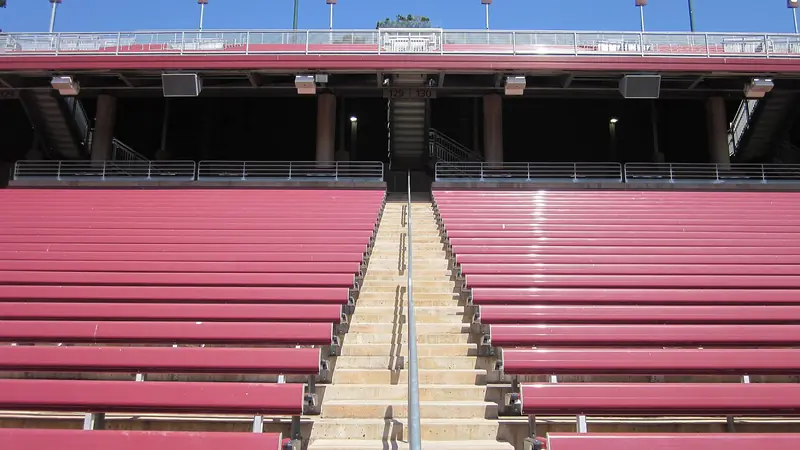
A few years later he turned the first shovel of dirt for Stanford Stadium, on June 1, 1921. Our stadium page covers the building that followed.

A national figure
Wilbur's work reached well past campus. During World War I he led the conservation division of the U.S. Food Administration under Hoover and coined the slogan "Food Will Win the War." He was president of the American Medical Association in 1923 and 1924. In 1923 he was called to the bedside of President Warren Harding in San Francisco and was present when Harding died.
His papers list more roles: chairman of the Institute of Pacific Relations from 1925 to 1929 and a member of the first California State Park Commission. From 1927 to 1932 he chaired the national Committee on the Costs of Medical Care. Its November 1932 report urged spreading medical costs through insurance or taxes. The AMA backed the minority reports instead. In Palo Alto that debate was not abstract. His son Blake Wilbur was a partner in Russel Lee's group practice, the clinic profiled on our Russel Lee page.
Secretary of the Interior
Hoover named Wilbur Secretary of the Interior in 1929. He took office on March 5 and served until March 4, 1933. He stopped granting new oil leases to private parties unless the law required it. He reorganized the Bureau of Indian Affairs. He signed the contract to build the Boulder Canyon dam and renamed it Hoover Dam, a choice that drew criticism. He also chaired the White House Conference on Child Health and Protection from 1929 to 1931.
Back at Stanford, chemist Robert Eckles Swain served as acting president. The student humor magazine called Wilbur the "president-by-mail."
Depression years and after
Wilbur returned in 1933 to a university squeezed by the Depression. He cut faculty salaries by 10 percent, raised tuition and launched the Stanford Fund. He also lifted the cap on women's enrollment that Jane Stanford had set. Our page on Jane Stanford explains that rule. In politics he became a sharp critic of the New Deal and a champion of "rugged individualism."
He also wrote steadily. The Hoover Institution's register of his papers lists Conservation (1931, with William Atherton DuPuy), Stanford Horizons (1936), Hoover Policies (1937, with Arthur M. Hyde), March of Medicine (1938) and Human Hopes (1940). From 1939 until his death he also sat on the national executive board of the Boy Scouts of America.
He stepped down as president in 1943 and served as chancellor until his death. Marguerite died on December 24, 1946. Wilbur died of heart disease at his campus home on June 26, 1949, at 74. He is buried at Alta Mesa Memorial Park in Palo Alto.
Where to find his traces
| Place | Connection |
|---|---|
| Jane Lathrop Stanford Middle School | Opened August 18, 1953 as Ray Lyman Wilbur Junior High; renamed in 1985 |
| Wilbur Hall, Stanford | Dormitory complex named for him |
| The Knoll, Stanford | Built as his residence; now CCRMA |
| Stanford Stadium | He broke ground in 1921 |
| Alta Mesa Memorial Park, Palo Alto | His grave |
Our page on JLS Middle School covers the school that once carried his name.
Frequently asked questions
Who was Ray Lyman Wilbur?
Ray Lyman Wilbur (1875 to 1949) was a physician, Stanford's third president and Secretary of the Interior under Herbert Hoover. He studied at Stanford from 1892, led its medical school from 1911 and served as president from 1916 to 1943. He was chancellor from 1943 until his death.
Was Ray Lyman Wilbur friends with Herbert Hoover?
Yes. They met as Stanford students in the 1890s, when Hoover was promoting a laundry service on campus. They stayed lifelong friends. Hoover made Wilbur his Secretary of the Interior in 1929. Wilbur in turn renamed the Boulder Canyon dam project for Hoover.
Why was Wilbur Junior High in Palo Alto renamed?
Ray Lyman Wilbur Junior High School opened on August 18, 1953. In 1985, after the district's other junior highs had closed, it became Jane Lathrop Stanford Middle School. Our school page describes the change as part of that reorganization.
Where is Ray Lyman Wilbur buried?
He is buried at Alta Mesa Memorial Park in Palo Alto. He died of heart disease at his home on the Stanford campus on June 26, 1949, at 74.
What did Wilbur do for American medicine?
He was president of the American Medical Association in 1923 and 1924. From 1927 to 1932 he chaired the Committee on the Costs of Medical Care, whose November 1932 report urged spreading medical costs through insurance or taxes. The AMA rejected the majority's proposals.