On this page
Frederick Law Olmsted is the most famous name in American landscape design. Central Park, Prospect Park, the U.S. Capitol grounds and dozens of college campuses carry his mark. Stanford is on that list too. Yet the campus next to Palo Alto is as much a record of his defeats as his wins. He lost the argument over where to build. He lost control of the planting. He walked away before the university opened.
Our Stanford architecture guide sums up his plan in a few paragraphs. This page goes further into the man, the quarrel and the parts of his design you can still find on a walk. The main sources are a 2017 Stanford Magazine history called "A Gentleman's Quarrel," Stanford's own landscape history, the National Park Service and the Olmsted archives.
Who Olmsted was by 1886
Olmsted was born in Hartford, Connecticut, in 1822. Before he turned to landscape design he had been a sailor, a farmer and a writer. In 1858 he and Calvert Vaux won the competition to design Central Park. Over the following decades he and his firms worked on close to 6,000 projects, the Olmsted network counts.
California was not new to him. In the 1860s he spent about two years managing the Mariposa mining estate in the Sierra foothills and wrote an early report on Yosemite. He also drew a plan for the College of California in Berkeley. The National Park Service notes that the founders never carried it out. In it he praised a site close to San Francisco but apart from it, saying students needed "a suitable degree of seclusion and a suitable degree of association" with the wider world.
The Stanford commission
After Leland Stanford Jr. died in 1884, his parents decided to build a university on their Palo Alto farm. The National Park Service puts it simply: Stanford wanted the best. In 1886 he invited Olmsted to plan the campus. Stanford Magazine reports that Olmsted asked $10,000 for the first consultation and planning, well above his usual rate. He arrived in the fall of 1886. The Olmsted archives list the work as job No. 01032, Palo Alto.
Olmsted came away impressed by the scale of his client's ambition. "There is not any word half big enough for his ideas of what it is to be," he wrote. Our page on the Stanford family explains where that ambition came from.
The fight over the site
Olmsted's first design put the university in the foothills west of today's campus. He wanted a California campus suited to its dry climate, set into the land instead of laid over it. "The principal buildings of the University could have been placed near the edge of an elevated table land," he wrote later.
Stanford said no. He wanted the flat land near the railroad, where the university could expand without limit. He also wanted a grand axial approach worthy of the Ivy League. The architect Charles Coolidge reported that Stanford "was going to have his buildings the way he wanted them." Olmsted worried the result would be a "mongrel sort of plan."
In 1887 Stanford ordered the Main Quad turned and a Memorial Arch added over its entrance. The architects borrowed the arch design from an unbuilt Civil War memorial in Buffalo, New York.
What the plan laid down
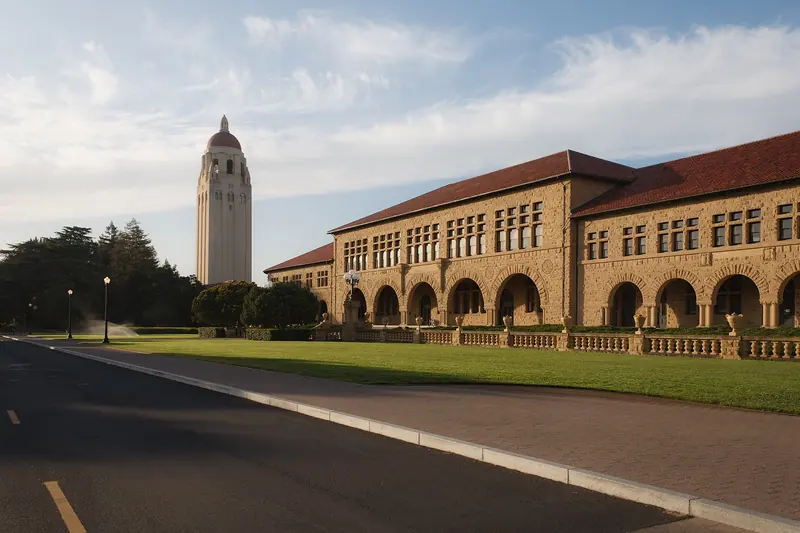
Olmsted still shaped the bones of the campus. The plan set the Main Quad on a long north and south axis, with room for more quads to lock onto it east and west. Palm Drive runs straight north toward the train station. Stanford's university landscape architect, Cathy Blake, told Stanford Magazine that the alignment is "no accident." Stanford's archives note that the firm's 1888 plan is the first to show Palm Drive and the Oval. Our page on the Oval and Palm Drive covers that approach.
He also won one important point. The National Park Service says the Quad was paved and planted with circles of trees and shrubs instead of lawns, an early water-saving choice in a dry climate. Stanford's landscape history adds a smaller win. In 1888 Olmsted moved planned construction to save a large old coast live oak, so the family tomb was built on a new site that year. You can see it today at the Stanford Mausoleum.

The arboretum that stalled
Olmsted imagined a living museum of trees across the estate: natives plus drought-tolerant species from dry regions around the world. Stanford approved an arboretum and forest plan in 1888. That December Olmsted hired Thomas Douglas to oversee the planting. Douglas supervised crews of Chinese gardeners from 1889 to 1892.
By June 1889 Olmsted's nurseryman had more than 200 species of seedlings on site. Olmsted expected about 150,000 seedlings to go into the ground by July. Then Stanford lost interest. He said he was "not going to have the hills covered in trees." He reversed his approval of the foothill forest. Part of that land stayed as native oak woodland instead.
Not all of the older garden work was Olmsted's. Before him, Stanford had hired Rudolph Ulrich from 1881 to 1884. Ulrich laid out the Arizona Garden, today's Arizona Cactus Garden. He also supervised the first planting of the area now called the Arboretum. Our Arboretum guide covers that ground.
The falling-out
Relations soured over control. In 1890 Ariel Lathrop, Jane Stanford's brother and the family's business manager, fired Olmsted's foreman on the job without giving a reason. Olmsted suspended his work on the campus. He and Stanford traded final letters around the time the university opened in 1891.
Olmsted retired in 1895 as his memory failed. He died on August 28, 1903, in Belmont, Massachusetts. Leland Stanford had died ten years earlier. Jane Stanford carried on the building program until her own death in 1905.
What was built and what was not
| Olmsted idea | What happened |
|---|---|
| Campus in the foothills | Rejected; built on the flats |
| Main Quad on a long axis with linked quads | Built, with later quads added over the next century |
| Palm Drive toward the railroad | Built; the palm theme came from others |
| Paved Quad with native planting, no lawns | Built, though cheap asphalt and gravel came first |
| Granite-like paving blocks in the Quad | Not built as he intended |
| Memorial Church placed to the west | Not followed; the church went at the center of the Quad |
| A large arboretum and foothill forest | Begun, then abandoned |
The 1906 earthquake knocked down the Memorial Arch and the church spire. Neither was rebuilt, reportedly because of cost. Our page on the 1906 earthquake covers the damage.
The plan comes back
Olmsted's ideas outlived the quarrel. Stanford Magazine says President Ray Lyman Wilbur followed the plan during the expansion of 1916 to 1943. Later decades drifted. The Physics Tank, home to the physics department from 1957 to 1997, blocked the east and west axis until it was torn down.
Under President Gerhard Casper, from 1992 to 2000, Stanford began returning to the plan. John Hennessy continued the work. New quads now follow the same sight lines and axes. Cathy Blake summed it up: the design "belongs to Olmsted." His preference for drought-tolerant planting also reads well in an age of multiyear droughts.
See the plan on foot
- Walk Palm Drive from El Camino Real to the Oval and look back: the line runs to the railroad.
- In the Main Quad, notice the planted circles in the paving, the one point Olmsted won.
- Walk to the Mausoleum in the Arboretum to see the site he picked to save an oak.
- Stand at Memorial Church, which sits where Stanford, not Olmsted, wanted it.
Frequently asked questions
Did Frederick Law Olmsted design Stanford?
He drew the campus master plan, starting in 1886. Leland Stanford overruled him on the site and on much of the layout, so the result mixes Olmsted's ideas with the founder's. Shepley, Rutan and Coolidge of Boston designed the buildings.
Where did Olmsted want to put Stanford?
His first plan placed the university in the foothills, near the edge of what he called an elevated table land. Leland Stanford rejected it because he wanted the campus on the flat land, where it could grow without limit.
What parts of Olmsted's Stanford plan were built?
The Main Quad on its long axis, Palm Drive running toward the railroad and the paved Quad with planters of trees and shrubs instead of lawns all come from the plan. The foothill campus, the full arboretum and the granite-like paving he wanted were never built.
Why did Olmsted stop working on Stanford?
Relations broke down over money, control and the arboretum. In 1890 Stanford's business manager, Ariel Lathrop, fired Olmsted's job foreman without explanation. Olmsted then suspended his work on the campus.
Did Olmsted plant Palm Drive?
No one credits the palm idea to Olmsted. His firm's 1888 plan is the first to show Palm Drive and the Oval, but Stanford sources credit the palms to others, including a story about David Starr Jordan.