On this page
The 1930s in Palo Alto are often told as a prelude: the decade that ends with two young engineers in a garage. That part is true, but it skips how hard the early years were. The Depression filled the town with men looking for work and a meal. The city answered with a shelter in an old warehouse. At the same time a wealthy widow, a determined doctor and a busy architect were building institutions that still anchor civic life.
The census shows a town that kept growing slowly, from 13,652 residents in 1930 to 16,774 in 1940. This overview moves theme by theme and links to the full pages on each story.
Hard times and the Hotel de Zink
Palo Alto's best-known Depression story is a homeless shelter. According to PaloAltoHistory.org, Mable Glover had heard that restaurants were throwing away leftover food. She and her husband, former sea captain Jesse "Cap" Glover, set up a shelter in an old warehouse on Federal Telegraph Company property, on the site of today's Sheraton hotel near the train station. It opened on November 9, 1931, as the Palo Alto Shelter. The city gave $500, a truck and the space.
The shelter was soon renamed the Hotel de Zink after Police Chief Howard Zink, who backed it. Its stated mission was to "assist worthy men who are in distress." The numbers show the scale of the need. Between October 1932 and March 1933 it housed 9,290 men and served 40,881 meals. Complaints that it served too many out-of-town men and hired non-residents helped close it in April 1934. Accounts suggest meals for work carried on for some years after.
The university felt the slump in its budget. In 1933, with the Depression draining revenue, Stanford's trustees replaced Jane Stanford's cap of 500 women with a ratio that allowed about 40 percent women. Herbert Hoover, meanwhile, lost the 1932 election to Franklin D. Roosevelt and heard the returns from his house on the Stanford campus. Ray Lyman Wilbur, who had been on leave to serve in Hoover's cabinet, returned to the Stanford presidency in 1933.
Lucie Stern's gifts
If one person made 1930s Palo Alto a better place to live, it was Lucie Stern. The widow of Levi Strauss's nephew and partner Louis Stern had settled in town after his death in 1924. In the 1930s she became its leading benefactor. Locals called her Palo Alto's Fairy Godmother.
Her signature gift was the community center at 1305 Middlefield Road. Dates vary by source. The city says Birge Clark's complex was built in 1934. Other accounts date the first buildings to 1932 or 1933. A history of the Hostess House says the city gladly accepted a larger community theater from her in 1933. Wings followed through the decade. The safest summary is that the center grew in stages, with 1934 as the city's own date.
The Palo Alto Children's Theatre began in 1932 under Hazel Glaister Robertson. A city history dates Stern's gift of a dedicated children's theater wing to 1937. In 1939 she offered $17,000 for a library just for children, which opened in 1940 beside the center. The Palo Alto Historical Association also credits her with gifts toward Rinconada Pool and the Junior Museum, which itself began in 1934 in the basement of an elementary school. Our pages on Lucie Stern and the Children's Library cover her legacy.
A clinic, a post office and a new look
Birge Clark stayed busy despite the slump. Two of his best-known buildings opened in 1932. The first was the post office at 380 Hamilton Avenue, the city's main post office for decades and still a branch called Hamilton Station. The second was a clinic at 300 Homer Avenue for Dr. Russel V. A. Lee's group practice.
Lee had founded the Palo Alto Medical Clinic with five other physicians around 1930. He commissioned the Russian-born muralist Victor Arnautoff, a former assistant to Diego Rivera, to paint 17 frescoes at the entrance. Lee was also a national voice on health care. Stanford president Ray Lyman Wilbur, himself a physician, chaired the national Committee on the Costs of Medical Care, whose November 1932 report urged spreading medical costs through insurance or taxes. The building is now the Roth Building, planned as the home of the Palo Alto History Museum. Our Palo Alto Medical Clinic page tells the story.
By the late 1930s Clark was drawing Streamline Moderne as well as Spanish revival, as in his 1936 auto dealership at 790 High Street. Pedro de Lemos added a Spanish style office building at 533 to 539 Ramona Street in 1938. Our Birge Clark page lists his work by address.
Dry town, wet gulch
National Prohibition ended in 1933, but Palo Alto's own rules stayed. The deed clauses and the 1909 state law still barred liquor sales near campus. Frank Crist found a gap. In 1933 he won the right to run a liquor business at the far end of University Avenue near the Bayshore Highway, outside Palo Alto's limits. The cluster of bars that grew there became known as Whiskey Gulch. On November 2, 1934, the California Supreme Court held that the mile-and-a-half distance should be measured in a straight line from the campus limits, voiding one license. Our page on Palo Alto's alcohol ban has the details.
Roads, rails and the bay
Federal money and local fights reshaped how people moved. The interurban cars of the Peninsular Railway made their last Palo Alto runs on September 30 and October 1, 1934. After a train killed two people near Palo Alto High School in 1927 and a local bond failed in 1929, the city built the Embarcadero Road underpass in 1936 with New Deal grade separation funds. Our freeways and expressways page covers that crossing.
Out on the marsh, a noise lawsuit filed in 1934 pushed the airfield off Stanford land. The airport moved to its current Baylands site around 1935. Our airport history follows it from there. The lawn bowling green opened on March 10, 1935. A saltwater swimming pool also went in near Embarcadero Road as part of city engineer John Fletcher Byxbee's bayside plan. That pool is now the duck pond.
The electronics seed
Federal Telegraph left for New Jersey in the early 1930s, but Stanford's engineering school was building something new. Frederick Terman, a Stanford graduate with an MIT doctorate, taught radio engineering and urged his students to start companies nearby. Our Frederick Terman page covers his role.
In 1936 physics department head David Webster agreed to take on Russell and Sigurd Varian. In August 1937 the brothers completed a prototype klystron, a tube that would help put radar into airplanes. See our page on the Varian brothers.
Two of Terman's students came back to Palo Alto in 1938. Dave Packard and his new wife Lucile rented the ground floor of a house at 367 Addison Avenue. Bill Hewlett finished an engineer's degree at Stanford in 1939. On January 1, 1939, the two formalized their partnership in the garage out back with $538 in cash and equipment. A coin toss put Hewlett's name first. Their HP 200A audio oscillator found an early buyer in Walt Disney Studios, which bought eight for work on Fantasia. Our Hewlett and Packard page follows the founders.
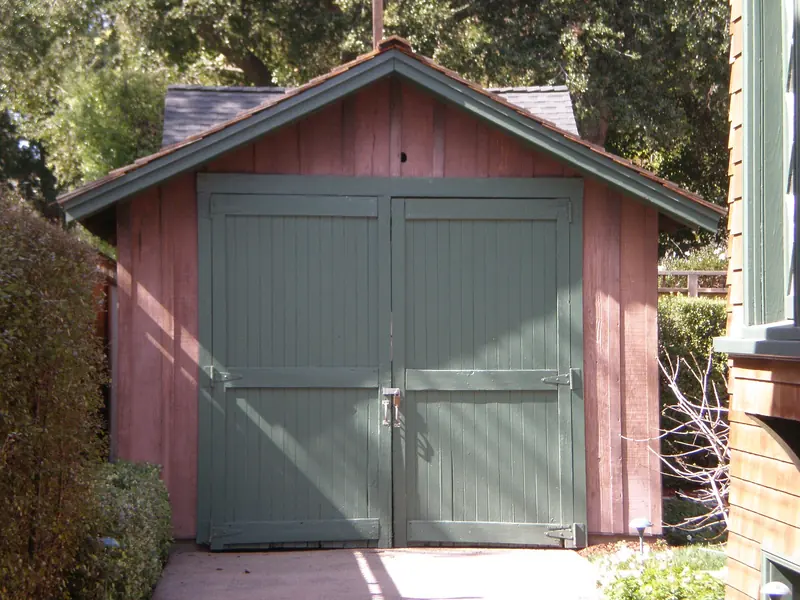

1930s timeline
| Year | Event |
|---|---|
| 1930 | Palo Alto Bicycles opens. Lee's medical group forms around this year. |
| 1931 | The Hotel de Zink shelter opens November 9. |
| 1932 | Clinic and post office open. Children's Theatre founded. Hoover loses. |
| 1933 | Stanford eases its cap on women. Whiskey Gulch begins. |
| 1934 | City date for the Stern center. Shelter closes. Interurban ends. Junior Museum starts. |
| 1935 | Airport moves to the Baylands. Lawn bowling green opens. |
| 1936 | Embarcadero underpass built. Timothy Hopkins dies January 1. |
| 1937 | Varian brothers build the klystron. |
| 1939 | HP partnership January 1. Stern offers the Children's Library. Hoover Tower construction begins. |
The decade closed with Hoover Tower rising on campus and war in Europe. Its dedication in 1941 and the home front that followed are on our page about Palo Alto in World War II.
Frequently asked questions
How did the Great Depression affect Palo Alto?
Jobless men passed through in large numbers. From November 1931 to April 1934 the city backed a shelter called the Hotel de Zink in an old warehouse, which housed 9,290 men and served 40,881 meals between October 1932 and March 1933 alone. Stanford felt the pinch too: with revenue falling, its trustees eased the cap on women students in 1933.
What was the Hotel de Zink?
It was a Depression shelter for jobless men that opened on November 9, 1931, in a warehouse on Federal Telegraph Company land, where the Sheraton hotel stands today. Mable Glover conceived it and ran it with her husband, Jesse Glover. It was named for Police Chief Howard Zink and closed in April 1934.
When was the Lucie Stern Community Center built?
The city says Birge Clark's complex was built in 1934. Other sources date the first buildings to 1932 or 1933, with wings added through the decade. A city history dates Lucie Stern's gift of a children's theater wing to 1937.
When did Hewlett-Packard start?
Bill Hewlett and Dave Packard formalized their partnership on January 1, 1939, in the garage behind 367 Addison Avenue, with $538 in cash and equipment. Their first product was the HP 200A audio oscillator. Walt Disney Studios bought eight for work on Fantasia.
What was Whiskey Gulch?
It was a cluster of bars and liquor stores at the far end of University Avenue across San Francisquito Creek, outside Palo Alto's dry limits. Frank Crist won the right to open a liquor business there in 1933, after Prohibition ended. The site is now University Circle in East Palo Alto.