On this page
Palo Alto in 1920 was still a small college town of 5,900 people with a dry downtown and an Army camp freshly cleared from across the creek. By 1930 it had 13,652 residents, the old town of Mayfield inside its borders and a downtown that looked like a stage set of early California. Much of what visitors photograph on Ramona Street and University Avenue today went up in these ten years.
This page gives the overview theme by theme. The detailed stories of the people and buildings live on their own pages and the links below lead to them.
The end of Mayfield
Mayfield had been a separate town since 1903. Without its saloons it struggled. From 1918 on some residents pushed to join Palo Alto, pointing to money problems, poor roads and weak services. Palo Alto ran its own water, power and gas and had more to offer. A first annexation vote failed in 1924.
The second try worked. Palo Alto voters approved annexing Mayfield on July 2, 1925. Wikipedia, citing local records, gives the count as 1,094 to 441. The Palo Alto History Museum gives a much closer 357 to 288. The difference is unresolved, but both agree on the result. The two towns were consolidated on July 6, 1925. College Terrace came in with the same annexation.
The merger meant renaming. Palo Alto already had a Lincoln Avenue, so Mayfield's main street became California Avenue. Mayfield's Washington Street became Cornell Street, which is why Cornell sits out of order among the College Terrace streets named for colleges. The Mayfield depot kept its old name until 1941. Our Mayfield page tells the whole story of the town that lost its name.
Downtown goes Spanish
In the 1920s Spanish Colonial Revival swept California and Palo Alto took to it with unusual consistency. The main reason was one architect. Birge Clark, the son of Stanford art professor Arthur B. Clark, came home from service as a World War I balloon pilot and opened his Palo Alto office in 1922. By one local account he was one of just two licensed architects between San Jose and San Francisco. He called the style Early California: white stucco, red clay tile roofs, arches, wrought iron and colored tile.
Clark's 1920s downtown work reads like a walking tour:
- University Avenue: numbers 125 and 323 (1925), 415 to 419 (1926) and several 1927 blocks between 423 and 476.
- Ramona Street: 532 to 538 (1926) and 541 to 545 (1927), the core of the later Ramona Street Architectural District.
- Hamilton Avenue: the Medico-Dental Building at 261 to 267, dated 1928 (some sources say 1927).
- Bryant Street: the 1927 police and fire station at 450 Bryant, now the Avenidas senior center.
- The Hotel President at 480 to 498 University Avenue, which opened in 1929 with 125 rooms and a roof garden.
Clark did not work alone. Artist Pedro de Lemos built the Gotham Shop at 520 Ramona Street in 1925 around an old oak he wanted to keep, the first building on that block. He added the Lemos Building in 1929. Our pages on Birge Clark and Pedro de Lemos cover both careers.
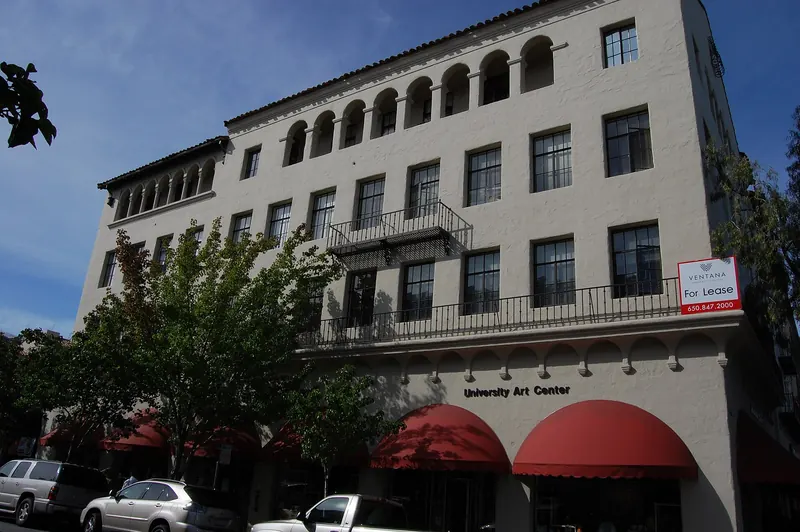

The style reached homes too. The 1926 Dunker House at 420 Maple Street was one of the first two Spanish Colonial Revival houses in town. In 1927 novelists Kathleen and Charles Norris built a large Clark-designed house at 1247 Cowper Street. Our Kathleen Norris page covers the bestselling author's Palo Alto years.
Theaters, hotels and a creamery
Downtown became a place to spend an evening. The Stanford Theatre opened at 221 University Avenue in 1925, designed by Weeks and Day with Persian and Moorish ornament. The Varsity Theatre at 456 University, designed by James and Merritt Reid, opened on September 26, 1927. Just over the line in Menlo Park, the Guild Theatre opened in 1926. Our downtown theaters page follows each of them to today.
The Cardinal Hotel at 235 Hamilton Avenue, by William H. Weeks, dates to 1924. The Palo Alto Creamery has served food on Emerson Street since 1923, which makes it one of the oldest businesses still open in the city. Above the street, an electric arch had lit University Avenue since 1911. It came down in 1925, the same year the local streetcars stopped running on September 27. The Stanford car line followed on October 21, 1929, as cars and paved roads took over. Our streetcars page explains why.
Newcomers and new neighborhoods
Population more than doubled in the decade, partly through the merger and partly through new tracts. The Palo Alto Development Company began laying out Southgate in 1923, next to Palo Alto High School.
Lucie Stern arrived in these years. She was the widow of Louis Stern, a nephew and partner of Levi Strauss. After Louis died in 1924 she settled in Palo Alto. Her great gifts to the city came in the 1930s, but the relationship began here. Our Lucie Stern page tells her story.
Other arrivals shaped the city's institutions. Dr. Russel V. A. Lee began practicing in Palo Alto in 1924, the start of what became the Palo Alto Medical Clinic. Frederick Terman began teaching electrical engineering at Stanford in 1925. In 1926 Lou Henry Hoover helped the local Girl Scouts build a house at 1120 Hopkins Avenue, drawn by Birge Clark.
Who was kept out
The growth was not open to everyone. In 1920 the Palo Alto Chamber of Commerce passed a resolution calling for a segregated district for Asian and Black residents. Henry Dodson, president of the Colored Citizens Club of Palo Alto, answered in public and the plan died. Deed restrictions did the same work quietly. According to PaloAltoHistory.org, most subdivisions recorded in the city between 1925 and 1950 barred anyone not of the white race except as servants. California's alien land laws of 1913 and 1920 and the 1924 federal immigration law hit Asian families hard. Our page on covenants and the fair housing fight covers this history.
Black residents built their own institutions. The University AME Zion Church put up its first building at 819 Ramona Street in 1925. In Mayfield, Thomas Foon Chew's Bayside cannery, at its peak the area's largest employer, ran under his ownership until he sold it to the Sutter Packing Company in 1928. See our Thomas Foon Chew page.
Civic projects and the bay
City engineer John Fletcher Byxbee Jr. looked east to the marsh. At his request the Board of Public Works recommended in 1921 that the city buy its first 40 acres of marshland, the start of the Baylands. Byxbee's plan for an airport, harbor, golf course and pool would take decades to finish. Palo Alto's first airfield, meanwhile, sat beside Stanford Stadium. The city dates it to 1923 while other sources say the late 1920s. Our Baylands history follows the marsh story.
Traffic brought danger too. In October 1927 a train killed two people at the crossing next to Palo Alto High School. A $60,000 bond for an underpass failed in May 1929, just short of the two-thirds it needed. The first May Fete Children's Parade marched in 1924 and is still held each spring.
A president at home
The decade ended with Stanford's most famous graduate in the White House. Herbert and Lou Henry Hoover had finished their house on San Juan Hill in June 1920. In August 1928 Hoover spoke to a huge crowd at Stanford Stadium after his nomination. On election night that November he heard the returns at home and learned he had won. He took office in March 1929 and named Stanford president Ray Lyman Wilbur as his Secretary of the Interior. The stock market crash that October would define his term. Our page on Herbert Hoover in Palo Alto covers his local life.
1920s timeline
| Year | Event |
|---|---|
| 1920 | The Hoover house is finished. Chamber segregation resolution fails. |
| 1921 | The city moves to buy its first 40 acres of marsh. |
| 1922 | Birge Clark opens his office. |
| 1923 | Palo Alto Creamery opens. Southgate is laid out. |
| 1924 | First May Fete parade. First Mayfield annexation vote fails. |
| 1925 | Mayfield joins Palo Alto. Stanford Theatre opens. Local streetcars end. |
| 1926 | Dunker House built. El Palo Alto plaque dedicated November 7. |
| 1927 | Varsity Theatre opens. Police and fire station on Bryant Street. |
| 1928 | Hoover elected president. Chew sells the cannery. |
| 1929 | Hotel President opens. Stanford streetcar line ends. |
The Depression years that followed, with Lucie Stern's gifts and a garage on Addison Avenue, are covered on our page about Palo Alto in the 1930s.
Frequently asked questions
When did Palo Alto annex Mayfield?
A first annexation vote failed in 1924. Palo Alto voters approved annexing Mayfield on July 2, 1925. The two towns were consolidated on July 6, 1925. Published vote counts differ, so check original records if the numbers matter. Mayfield's Lincoln Avenue became California Avenue.
Why does downtown Palo Alto have so many Spanish style buildings?
Most went up in the 1920s and 1930s, when Spanish Colonial Revival was the fashion across California. Architect Birge Clark, who opened his Palo Alto office in 1922, designed dozens of them and gave downtown a consistent look. Artist Pedro de Lemos added the Gotham Shop on Ramona Street in 1925.
Who was Lucie Stern?
Lucie Stern was the widow of Louis Stern, a nephew and partner of Levi Strauss. After her husband died in 1924 she settled in Palo Alto. In the 1930s she paid for the Lucie Stern Community Center and the Children's Library, both designed by Birge Clark.
Was Herbert Hoover in Palo Alto when he was elected president?
He was at home on the Stanford campus, just outside Palo Alto's city limits. In August 1928 he spoke to a large crowd at Stanford Stadium after his nomination. On election night that November he heard the returns in the house Lou Henry Hoover had designed on San Juan Hill.
What old Palo Alto businesses date from the 1920s?
The Palo Alto Creamery has served diner food on Emerson Street since 1923. The Stanford Theatre on University Avenue opened in 1925 and the Varsity Theatre building followed in 1927. The Cardinal Hotel at 235 Hamilton Avenue dates to 1924.