On this page
Palo Alto likes to think of itself as a progressive place. Its housing history is more complicated. From the 1920s to the late 1940s many new neighborhoods were sold with deed covenants that kept out anyone who was not white. Federal lending rules reinforced them. Real estate agents steered Black families across the county line. At the same time, a small group of residents, ministers and one well known builder pushed the other way, years before the law required it.
This page tells both halves of that story with documented sources. It builds on our pages about Eichler homes and Palo Alto's Japanese American community, which cover parts of it in more detail.
What the covenants said
A racial covenant was a clause written into a deed or a subdivision's rules. It bound every future owner. The typical Palo Alto version, quoted by PaloAltoHistory.org, read: "No person not wholly of the white Caucasian race shall use or occupy such property unless such person or persons are employed as servants of the occupants." The site reports that most subdivisions recorded in the city between 1925 and 1950 included this clause.
Some were more specific. When the Southgate neighborhood was subdivided in 1923, all its properties carried restrictions that no one of African, Japanese, Chinese or Mongolian descent could use or occupy the houses, according to Ward Winslow's centennial history of the city, as reported by Palo Alto Online.
The rules shaped real lives. Palo Alto Online told the story of Jerry Harrison, a Black man who came from North Carolina in 1922 and worked as a railroad porter and shoe shiner. He and his wife saved enough to buy a small house in Crescent Park. Because the seller would not deal with him directly, a Jewish friend bought the property and transferred it to him.
The 1920 segregation proposal
Covenants were the quiet tool. There was also an open one. In 1920 the Palo Alto Chamber of Commerce passed a resolution calling for a "segregated district" for Asian and Black residents. The Palo Alto Times, the Native Sons of the Golden West, the American Legion and the carpenters union backed it. Henry Dodson, president of the Colored Citizens Club of Palo Alto, spoke against it in public and the plan died. Racial zoning was never written into city law. Private deeds did the work instead.
How federal lending reinforced it
From the 1930s, federal mortgage programs rated neighborhoods for risk. Areas with Black residents were usually marked as hazardous, a practice later called redlining. Underwriting manuals warned lenders against "inharmonious racial groups" and encouraged covenants. A family that could not buy in a covenanted area also could not get a loan in a redlined one.
The rules stopped integrated projects before they started. In 1940 the writer Wallace Stegner joined about 150 families in the Peninsula Housing Association to build a cooperative community near Stanford. The Federal Housing Administration refused to approve financing because the group included Black families and the project collapsed, according to a 2026 report in the Mountain View Voice.
The Fair Play Council and the Lawrence Tract
In 1948 the U.S. Supreme Court ruled in Shelley v. Kraemer that courts could not enforce racial covenants. That made them unenforceable but did not open the market. Local volunteers tried to show another way.
The Palo Alto Fair Play Council was organized by activists including Gerda Isenberg and Josephine Duveneck, whose family also founded Hidden Villa. It began by helping Japanese Americans find homes and jobs after the wartime incarceration. Sources also call it the Fair Play Committee. Its biggest project was the Lawrence Tract in today's Midtown:
- The land. About 6 acres along Lawrence Lane, Greer Road and Colorado Avenue. Ten members put in $250 each. Paul Lawrence, a Black former Stanford student and Howard University professor, delivered the money to the realtor.
- The start. Construction began on February 23, 1950, on modest three bedroom redwood houses costing about $9,000.
- The residents. At opening the tract had nine Black families, six Japanese American families, one Chinese American family and seven white families.
- The goal. In the council's words, "to show that different races could get along and live together."
Neighbors were not all convinced. A 1952 Fair Play Council survey found that only 68 Palo Altans polled would rent to a person of good character regardless of race, while 198 would rent to white tenants only.
Eichler and the churches
Joseph Eichler's company sold to buyers regardless of race or religion at a time when most builders would not. In 1958 he resigned from his industry's builders association when it would not back that stand. Sources name the group as the National Association of Home Builders or a regional affiliate. The same year more than 1,000 Palo Altans signed a petition for "open and unsegregated housing" backed by 12 area churches.
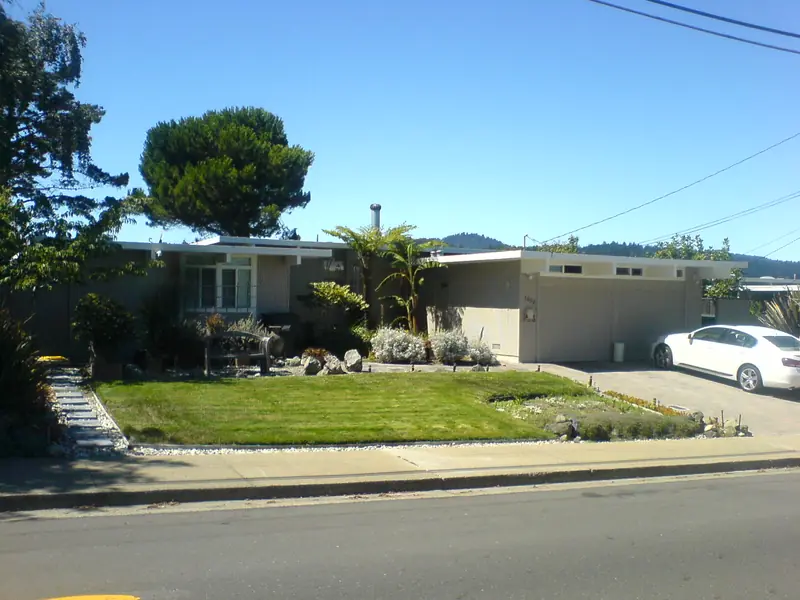
Eichler's tracts did open doors for Black and Asian buyers in south Palo Alto. They did not end segregation in the wider market. Our Eichler page covers the tracts.

Blockbusting in East Palo Alto
Across San Francisquito Creek, unincorporated East Palo Alto became one of the few places where Black families could buy homes. Real estate agents made sure of it. In blockbusting, an agent would warn white owners that Black families were moving in, buy their homes cheaply in the panic and resell them at a markup. Accounts date the start of this in East Palo Alto to the mid 1950s. PaloAltoHistory.org says many parts of East Palo Alto and the Belle Haven area of Menlo Park saw rapid white flight after a few Black families arrived.
The local press captured the attitude. In 1956 the president of Palo Alto's Board of Realtors told the Palo Alto Times, "If you do sell to Negroes, everyone else is down your throat." Within about a decade East Palo Alto had become the center of the Midpeninsula's Black community. Our East Palo Alto page follows the city from there to its incorporation in 1983.
The laws change
| Year | Law or ruling | What it did |
|---|---|---|
| 1948 | Shelley v. Kraemer | Courts may not enforce racial covenants. |
| 1959 | Unruh Civil Rights Act (California) | Barred discrimination by business establishments. |
| 1963 | Rumford Fair Housing Act (California) | Banned discrimination in much of the housing market. |
| 1964 | Proposition 14 | Voters repealed Rumford by amending the state constitution. |
| 1967 | Reitman v. Mulkey | The U.S. Supreme Court upheld the ruling that struck down Proposition 14. |
| 1968 | Fair Housing Act (federal) | Banned discrimination in the sale, rental and financing of housing. |
Midpeninsula Citizens for Fair Housing
Proposition 14 passed easily statewide in November 1964. Out of the losing campaign against it came a new group. A volunteer writing in the early 1970s said Midpeninsula Citizens for Fair Housing "evolved in 1965" from citizens who had fought the proposition. It started with education, sending speakers to schools, factories and churches. After 1968 it added legal help and testing.
Testing was simple and powerful. A Black renter and a closely matched white renter would ask about the same apartment. If the white tester was offered the unit the Black tester was told was gone, that was evidence. A 1971 survey found signs of discrimination at 58 percent of the large Palo Alto apartment complexes tested. The volunteer's account says the city then held meetings with landlords through its Human Relations Commission and agreed to act as a co-plaintiff in discrimination cases. The group later disbanded.
Good to know
- Old covenant language still turns up in title reports. It has no legal force.
- California's AB 1466, passed in 2021, requires county recorders to identify and redact unlawful covenants. Owners can also record a restrictive covenant modification through the county recorder.
- Questions about renting today are covered in our renting guide.
The legacy
Palo Alto's Black population has stayed small for a century, about 2 percent by PaloAltoHistory.org's count, while East Palo Alto became the center of the Midpeninsula's Black community by the 1960s and later a largely Latino city. That pattern was not an accident of the market. It followed from covenants, lending rules and sales tactics that were legal for decades. The voluntary school transfer program created in the 1980s and today's debates over affordable housing are both, in part, responses to it. Our African American history page follows the people and institutions behind this story.
Frequently asked questions
Did Palo Alto have racial covenants?
Yes. PaloAltoHistory.org reports that most subdivisions recorded in the city between 1925 and 1950 barred anyone not wholly of the white race from occupying the property except as servants. When Southgate was subdivided in 1923 its deeds excluded people of African, Japanese or Chinese descent, according to the city's centennial history.
Are racial covenants still legal?
No. The U.S. Supreme Court ruled in Shelley v. Kraemer in 1948 that courts could not enforce them. State and federal fair housing laws later banned housing discrimination outright. Old covenant language can still appear in recorded deeds and California law now lets owners have it formally struck.
What was the Lawrence Tract?
It was a small subdivision on Lawrence Lane, Greer Road and Colorado Avenue in Palo Alto, planned as an interracial neighborhood. The Palo Alto Fair Play Council helped buy the land and construction began on February 23, 1950. When it opened it was home to Black, Japanese American, Chinese American and white families.
What was blockbusting in East Palo Alto?
Blockbusting was a sales tactic in which agents stirred fears that Black families were moving into a white neighborhood, bought homes cheaply from panicked owners and resold them at a profit. Historians describe it as a major reason East Palo Alto and Belle Haven in Menlo Park became majority Black in the 1950s and 1960s.
What was Midpeninsula Citizens for Fair Housing?
It was a volunteer group formed in 1965 by people who had campaigned against Proposition 14. It ran education programs, paired Black and white testers to check apartment listings and helped people file complaints. Its 1971 survey found evidence of discrimination at 58 percent of the large Palo Alto apartment complexes tested. The group no longer exists.