On this page
World War II never came to Palo Alto in the form of bombs. It came in ration books, empty tire racks, blackout drills and soldiers in Stanford classrooms. It came in a sprawling Army hospital just over the county line. It also came in the form of a federal order that removed 144 of the city's own residents. By 1945 the town had been reshaped in ways that set up the boom that followed.
This page covers the home front from Pearl Harbor to V-J Day. It draws on PaloAltoHistory.org, Stanford Magazine, the Hoover Institution's archives and local Menlo Park histories. The story of the Japanese American community has its own full page, so it is summarized briefly here.
On the eve of war
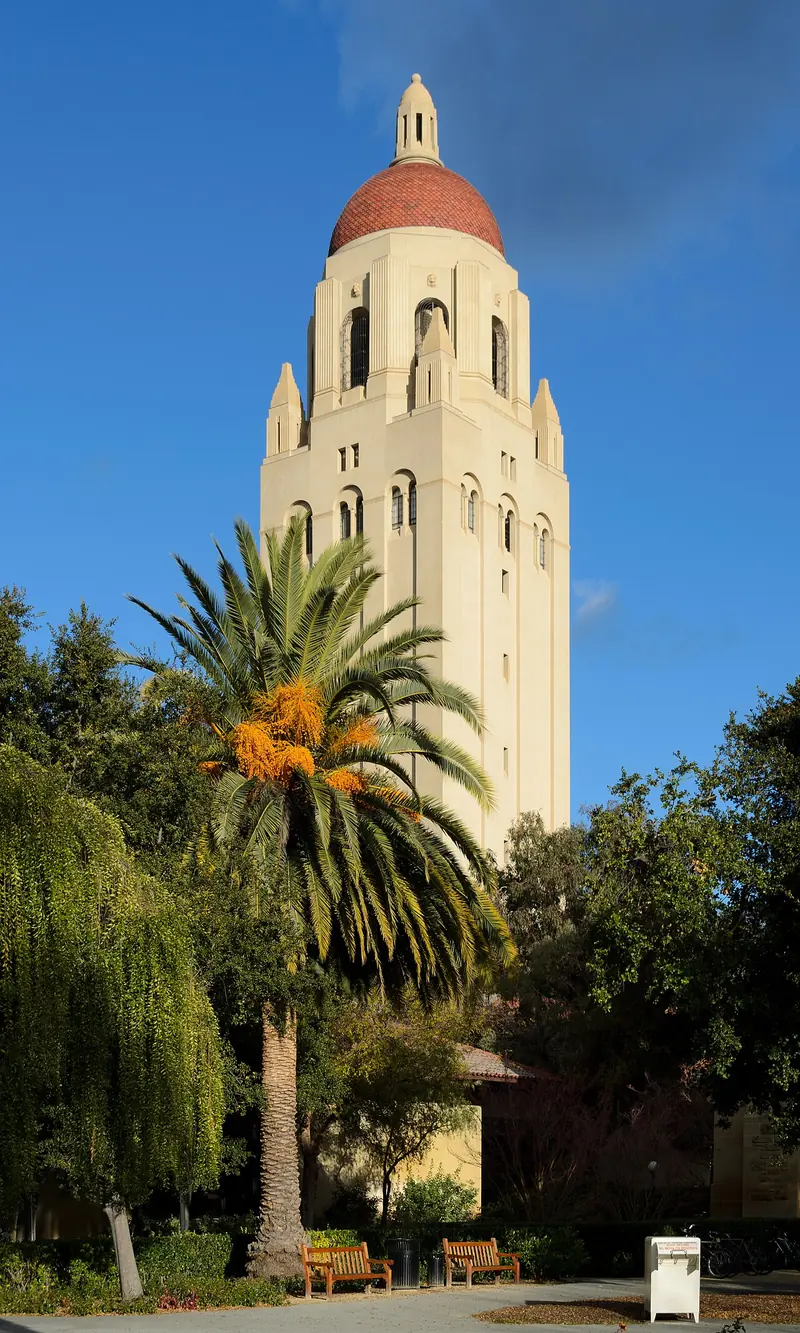
In 1940 Palo Alto was a college town of 16,774 people. Stanford had just finished Hoover Tower, completed in 1941 for the university's 50th anniversary. Two years earlier, Bill Hewlett and Dave Packard had formalized their partnership in the Addison Avenue garage. At Stanford the Varian brothers had built a prototype klystron in 1937, a tube that would help put radar into airplanes.
The war soon pulled Stanford's best engineers away. Frederick Terman left to run the Radio Research Laboratory at Harvard, which built radar countermeasures with a staff of about 800. Our Terman page covers how that experience shaped the research park he built after the war.

December 1941
The fall of 1941 was calm at Stanford, one alumna recalled for Stanford Magazine. Then came December 7. The next morning, Professor Yamato Ichihashi's Japanese history class of about 30 students swelled to 100 as people came to hear him. Two days after the attack, the president of the Palo Alto Japanese American Association published a statement of loyalty in the Palo Alto Times. Seven of the association's men were already serving in the Army.
It did not protect them. President Roosevelt signed Executive Order 9066 on February 19, 1942. On May 26, 1942, 144 Palo Alto residents of Japanese ancestry boarded buses for the Santa Anita Assembly Center near Pasadena. Ichihashi and his wife were removed the same day. Most families later went to the Heart Mountain camp in Wyoming. Paly graduate Fred Yamamoto, one of the soldiers from the community, was killed in France and awarded the Silver Star.
Rationing and making do
Volunteers at the Palo Alto Ration Board handed out limits on sugar, meat, butter, coffee, gasoline, tires and even typewriters, PaloAltoHistory.org reports. Tires were the hardest to get. In all of February 1942 the entire city was allowed just 18 car tires. Drivers were asked to keep to a "victory speed" of 35 mph to save rubber.
The bicycle made a comeback. The Palo Alto Times told readers that "the automobile replaced the horse and now the bicycle has replaced the automobile." Racks along University Avenue filled with bikes. Laundry and shoe repairs took weeks because shops were short of help.
- Victory gardens. Hundreds grew in Palo Alto backyards. In October 1943 Jordan Junior High students reported that their school garden had produced a ton of food.
- Salvage. Families saved kitchen fat for explosives. Children collected scrap metal, rubber and foil from gum wrappers.
- Bonds. Posters urged residents to buy war bonds and stamps. Stanford's first War Stamp Day raised $595, enough for one Army jeep.
- Civil defense. Air raid drills sent Stanford freshmen to the basement of Roble Hall.
Stanford goes to war
Stanford mobilized quickly. By commencement in 1942 it had added a summer quarter so students could graduate faster and admitted freshmen to summer courses for the first time. The Red Cross held blood drives twice a month. Students and faculty walked to class to save gas and tires. Women students harvested cherries, hops and peaches in the Santa Clara Valley to replace farm workers who had gone to war, Stanford Magazine reports.
By 1943 most male students were overseas and many faculty were gone. Their places were taken by soldiers. The Army Specialized Training Program sent soldier-students to campus in 1943 and 1944 for accelerated college courses. Stanford's archives hold the program's records and photographs. Stanford alumnae later remembered them as most of the wartime dating pool.
A second Army program had a longer view. The Civil Affairs Training School ran at Stanford from late 1943 until the middle of 1945. According to the Hoover Institution's finding aid for its records, it trained personnel to run occupied areas in Europe and Asia, with courses on their languages, history, culture and especially their economies.
The war also opened doors for Stanford women. Janet McClanahan Morris became the first woman to serve as student body president. Our Stanford history page places these years in the university's longer story.
Dibble General Hospital
The war's biggest local building project was in Menlo Park. Expecting waves of wounded soldiers from the Pacific, the Army bought the former estate of railroad partner Mark Hopkins in 1943. It built a large military hospital there, first named Palo Alto General Hospital and soon renamed Dibble General Hospital for Col. John Dibble, who had been killed in a plane crash in 1943.
Dibble specialized in plastic surgery, care for blinded soldiers, neuropsychiatry and orthopedics. At its peak it had 2,400 beds, about two thirds of Menlo Park's population at the time, according to a Redwood City Pulse history. About 700 civilians worked there. The hospital closed in 1946.
Menlo Park already had a veterans hospital on the old Camp Fremont grounds, opened in 1923. After the war the VA added temporary buildings there in 1946 and 1947 as returning veterans filled its wards.
Women at work
With so many men away, women took jobs that had been closed to them. A 1944 Palo Alto Times piece, quoted by PaloAltoHistory.org, noted that women had "manned" taxis, buses, the cannery, gas stations, the banks and the post office. In 1943 the paper reported that nearly 40 Palo Alto women trained in Stanford courses in drafting, chemical analysis and industrial accounting were heading to Bay Area war plants. Hundreds of volunteers rolled bandages for the Palo Alto Red Cross. One resident, identified only as Mrs. Walter Rodgers, opened her home to service members as a Hospitality House that logged more than 50,000 guests by 1944.
V-J Day
A little after 4 p.m. on August 14, 1945, word spread through town that Japan had surrendered. A city siren malfunctioned and wailed for a quarter of an hour. Firecrackers went off on University Avenue. Cars full of soldier-students from Stanford rolled downtown honking. The Stanford Band marched down University Avenue to the Stanford Theatre and played "The Star-Spangled Banner." Palo Alto High School alone had lost 73 graduates in the war.
After the war
Peace brought a flood. Stanford's undergraduate enrollment jumped from a little over 3,700 in 1945 to 8,200 in 1947. The registration line in fall 1946 stretched from History Corner to Geology Corner, one alumna recalled. Stanford took over much of the old Dibble site as Stanford Village, with about 300 apartments for married students and 1,500 dorm beds. Menlo Park bought 29 acres of the hospital grounds for its civic center. The new Stanford Research Institute also moved into part of the former hospital. See our SRI International page.
Palo Alto's population grew from 16,774 in 1940 to 25,475 in 1950 and then doubled in the 1950s. Veterans with GI Bill benefits, defense research money and Terman's return to Stanford all fed the boom. Our postwar growth page picks up the story from 1945.
Frequently asked questions
What was Dibble General Hospital?
It was a U.S. Army hospital built in Menlo Park in 1943 on the former Mark Hopkins estate. First called Palo Alto General Hospital, it was renamed for Col. John Dibble, who died in a plane crash in 1943. It specialized in plastic surgery, care of blinded soldiers, neuropsychiatry and orthopedics and had up to 2,400 beds before closing in 1946.
What was rationed in Palo Alto during World War II?
Volunteers at the Palo Alto Ration Board limited sugar, meat, butter, coffee, gasoline and tires, even typewriters. Tire rationing was so strict that the whole city was allowed just 18 car tires in February 1942. Bicycles filled the racks on University Avenue.
Did the Army train soldiers at Stanford in World War II?
Yes. Soldier-students in the Army Specialized Training Program studied on campus in 1943 and 1944. The Civil Affairs Training School ran at Stanford from late 1943 to mid 1945, training personnel to administer occupied areas in Europe and Asia.
What happened to Palo Alto's Japanese Americans in World War II?
Under Executive Order 9066, 144 local residents of Japanese ancestry were sent by bus to the Santa Anita Assembly Center on May 26, 1942. Most were later moved to the Heart Mountain camp in Wyoming. Our page on the Japanese American community tells the full story.
What became of Dibble General Hospital after the war?
Stanford took over much of the site as Stanford Village, with about 300 apartments for married students and 1,500 dorm beds. Menlo Park bought 29 acres for its civic center. The Stanford Research Institute also moved into part of the former hospital.