On this page
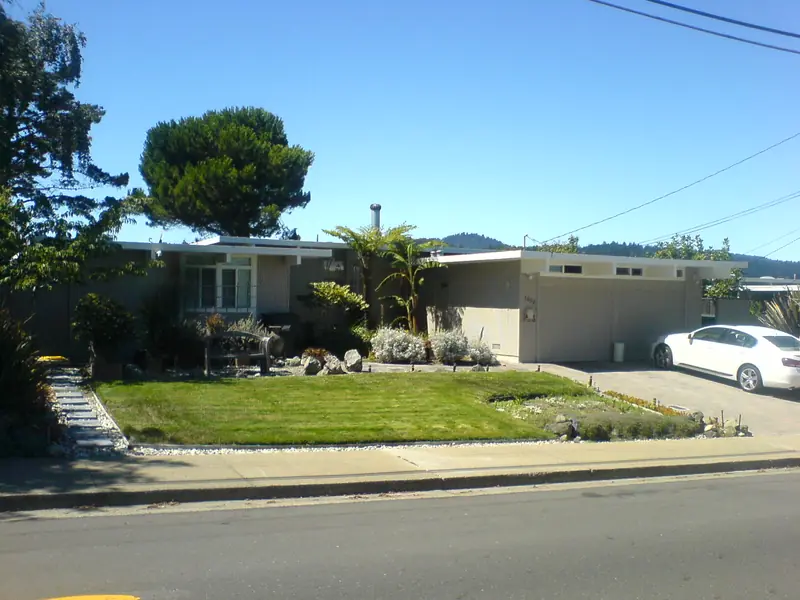
About 2,700 houses in Palo Alto carry Joseph Eichler's name. People who live in them talk about radiant floors, atriums and walls of glass. They rarely talk about the man, who was a former butter and egg wholesaler from Manhattan with a short fuse and a long list of convictions. He never drew a plan himself. What he did was hire good architects, back them against his own builders and refuse to sell homes by race.
Our page on Eichler homes in Palo Alto covers the tracts, the designs and the city's preservation rules. This page is about the builder. It draws on Wikipedia, a three-part Eichler Network profile and the Eichler Network's research on the homes the family lived in.
A Manhattan childhood
Joseph Leopold Eichler was born in New York City on June 25, 1900. His father was Austrian and his mother German. They ran a small toy store near Sutton Place in midtown Manhattan. City directories place the family on East 57th and East 58th streets in the 1920s. He grew up in a traditional Jewish household that revered Franklin Roosevelt, the Eichler Network says.
He earned a business degree from New York University and started out on Wall Street. Nothing in that early life pointed toward building houses.
Butter, eggs and a scandal
In 1925 he married Lillian Moncharsh, the daughter of Polish Jewish immigrants. Most sources, including the Eichler Network and the University of Washington's architect database, spell her name Lillian, though Lilian also appears. Her family ran Nye and Nissen, a wholesale butter and egg company in San Francisco. Joe went to work for it. They had two sons, Richard in 1928 and Edward, known as Ned, in 1930.
When the family moved west is less clear. Wikipedia and the Eichler Network's history of his homes put the move in the mid-1920s, with years in San Francisco apartments in the Marina and Cow Hollow and then a house in San Mateo in the 1930s. The Eichler Network's profile instead says the family came west in 1940, when he became treasurer of the business.
The business ended badly. Wikipedia says Nye and Nissen had closed by the mid-1940s after regulators found it selling "outdated and incorrectly graded" eggs. His brother-in-law went to jail for six months to a year. Joe needed a new line of work.
Living in a Frank Lloyd Wright house
The turn came through a rental. During World War II the Eichlers rented the Sidney Bazett House in Hillsborough, a small Usonian house by Frank Lloyd Wright. The owner was an Air Force pilot stationed overseas. Accounts disagree on the dates: Wikipedia says 1943, the Eichler Network profile says 1942 and its research on his homes says 1944 and 1945. All agree that living with Wright's open plan, warm wood and glass changed what Eichler thought a house could be.
From ordinary tracts to Anshen
Eichler started building in 1946 with conventional tract homes. Then he hired Robert Anshen, a University of Pennsylvania trained architect, to design a house for his own family. Ned Eichler later recalled Anshen's challenge to his father: "Joe, how can someone like you, who loves real architecture, build this crap?"
Eichler listened. In 1949 Anshen designed a 50-house subdivision in Sunnyvale with three prototype plans. Wikipedia names it Sunnymount Gardens. It sold out in two weeks, the Eichler Network says. The national press called it a bold new kind of tract house. Palo Alto's first Eichler tract, University Gardens, went up in 1949 and 1950 with 63 lots, according to the city's tract list. Postwar Palo Alto was growing fast, with engineers and young families arriving for Stanford and the new electronics firms. Our page on postwar growth explains the boom that gave Eichler his market. Between 1949 and 1966 Eichler Homes built more than 11,000 houses in California, most of them in the Bay Area.
The company's best features came from his architects, but he defended them. His builders complained that the atrium plan was too complex. Eichler kept it anyway. In time the crews learned to build it.

The man and his temper
People who worked for Eichler described him as tough, honest and often arrogant. "He always had a frown on his face, grumbling at people," one employee told the Eichler Network. He and his publicity partner, Jim San Jule, a former union organizer and OSS agent, reportedly worked 12 to 14 hours a day, six or seven days a week.
Palo Alto saw that temper up close. At one city council hearing over a minor dispute, Eichler lost his cool and insulted the council members. San Jule remembered "this tremendously arrogant, angry speech about the superiority of his designs." Afterward San Jule talked him out of appearing before city councils. He never did again. San Jule left the company in 1955.
A stand on race
Eichler's best-remembered conviction was about who could buy his houses. In an era of racial covenants and redlining, Eichler Homes sold to buyers regardless of race or religion. In 1958 he resigned from the National Association of Home Builders after it refused to back a nondiscrimination policy. The Eichler Network notes that the stand cost him criticism from others in the industry but earned the loyalty of his largely liberal staff. Our page on the fair housing fight in Palo Alto sets it in local context.
Going public and the fall
In 1961 Eichler Homes went public. Eichler disliked answering to stockholders. The push for steady sales also clashed with his habit of changing designs. Ned, by then a financial adviser to his father, urged him to take fewer risks. He did not.
In the mid-1960s the company moved into the city with townhouses and towers: projects in the Western Addition and Visitacion Valley, the Summit on Russian Hill and row houses on Diamond Heights. These stretched its finances. Eichler Homes filed for bankruptcy in 1967, according to Wikipedia. The Eichler Network describes it as a sale for far less than the company had been worth a year or two earlier.
Eichler kept building through smaller firms, among them J.L. Eichler and Associates. None matched the earlier work. He died in 1974 in San Mateo County at 74. Wikipedia gives the date as July 1. A University of Washington architecture database gives July 25, so treat the exact day as uncertain.
Where the Eichlers lived
The builder moved often. The Eichler Network counts at least 14 homes the family lived in across California. They included San Francisco apartments, a Spanish-tinged house in San Mateo, the Wright house in Hillsborough, a custom Eichler in Hillsborough and, for a time, one of his ordinary tract homes in Los Altos. All are private. We do not list addresses.
Legacy
Ned Eichler went on to write The Merchant Builders (1982), a history of postwar homebuilding that includes his father's company. Palo Alto's tracts now hold the largest concentration of Eichlers anywhere. Greenmeadow and Green Gables are National Register districts. The city adopted voluntary Eichler design guidelines in 2018.
If you want to understand the man through his houses, ride a bike through Fairmeadow and Greenmeadow, then read our mid-century modern guide. Buyers will find the practical side in our Eichler buying guide.
Frequently asked questions
Was Joseph Eichler an architect?
No. He studied business at New York University and worked in his in-laws' wholesale food company before he started building houses. He hired architects to design his homes, among them Robert Anshen, A. Quincy Jones and Claude Oakland.
What inspired Joseph Eichler to build modern homes?
During World War II he rented the Bazett House in Hillsborough, a small house designed by Frank Lloyd Wright. Living in its open, glass-walled rooms changed his ideas about what a family home could be. Accounts date his stay between 1942 and 1945.
Where did Joseph Eichler build his first homes?
His first modern tract was a 50-house subdivision in Sunnyvale designed by Robert Anshen in 1949, which Wikipedia names Sunnymount Gardens. It sold out in two weeks, according to the Eichler Network. University Gardens, his first Palo Alto tract, followed in 1949 and 1950.
Did Joseph Eichler live in an Eichler?
Yes, at times. The Eichler Network counts at least 14 homes the family lived in across California, including a custom Eichler in Hillsborough and one of his regular tract houses in Los Altos. All of these are private homes.
What happened to Eichler Homes?
The company went public in 1961, then took on costly projects in San Francisco. It filed for bankruptcy in 1967, according to Wikipedia. Eichler kept building on a smaller scale with successor firms until his death in 1974.