On this page
Most visitors to Palo Alto never find Esther Clark Park and many residents have never been. That suits its fans. The preserve is a small piece of open grass and oak woodland in the lower foothills, surrounded by homes on large lots. The city describes it as an undeveloped nature reserve with no amenities. It recommends the place for quiet meditation or watching the sun set. Both are good reasons to go.
This page explains where the park is, how to get in without annoying the neighbors, what you will find once you are there and how it came to be. It also suggests how to fold a visit into a longer day in the foothills.
What Esther Clark Park is
Esther Clark Park covers about 21 acres. It is part of Palo Alto's open space system along with much larger preserves such as Pearson-Arastradero and Foothills Nature Preserve. On city web pages it is listed both as a park and as an open space preserve. Either way it is managed for nature, not for recreation.
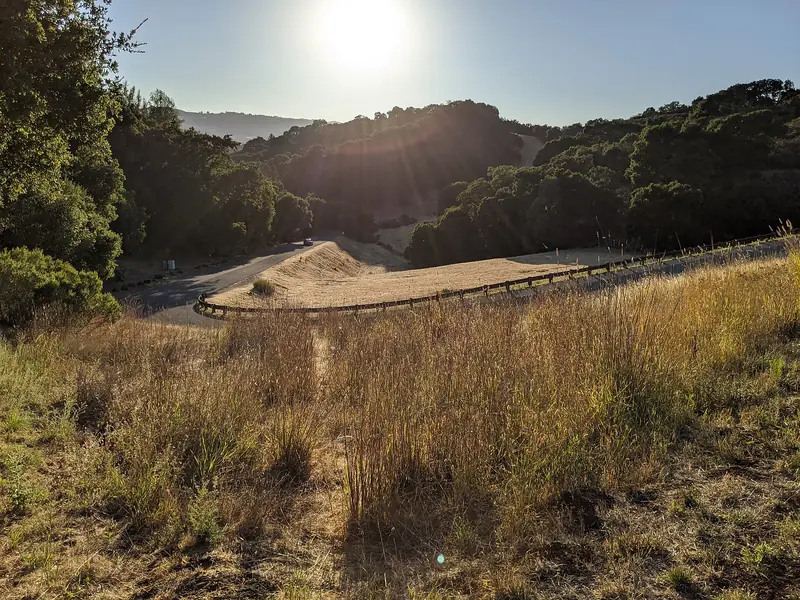
The landscape is the classic lower foothill mix. Open grassland covers the slopes. Valley and live oaks stand alone or in small groves. The grass is green from the first winter rains until about May. Then it turns gold and stays that way through the dry season. Wildflowers appear in the grass in spring and deer browse at the edges at dawn and dusk.
What you will not find is just as important. There are no restrooms, no drinking water, no picnic tables, no playground and no parking lot. There is no visitor center and no trail map board. That makes it one of the least developed public places in the city.
Where it is
The park sits on the southwest side of Palo Alto, off Arastradero Road. A neighborhood profile in the Palo Alto Weekly described the land as surrounded by Old Adobe Road, Old Trace Road and Manuela Avenue. The streets around it are quiet and narrow, lined with homes on lots of an acre or more. If you know the area, it is a short way from Gunn High School and the Arastradero corridor.
The park has no official street address. Mapping apps usually find it under its name. If yours does not, set it to Old Adobe Road in Palo Alto and look for the open grass on the hillside.
Coming from elsewhere in town, the easiest approach is by bike. From Barron Park the car-free Bol Park bike path runs south toward Gunn High School and Arastradero Road. From there it is a short ride to the park's edge. Our biking guide covers the route and other low-traffic streets.
Getting in and parking
There is no lot. Visitors use the surrounding residential streets. Parking is limited, shoulders are narrow and several driveways are hard to see. Park only where it is clearly legal, never block a gate or mailbox and keep voices down early and late. The park works because its neighbors tolerate visitors. Please do not test that.
The city refers to more than one park entrance. They are simple openings at the edge of the grass rather than formal trailheads. Stay on public land. Some of the surrounding homes have open yards that can look like part of the park when they are not.

Paths and what to do
There are no named or mapped trails in the way that Arastradero has them. Informal paths cross the grass and link the entrances. A full circuit takes well under half an hour at a slow pace. The ground is uneven and can be slick after rain or when the dry grass is flattened in late summer, so wear shoes with some grip.
People come here to do very little. That is fine:
- Watch the sunset. The city itself suggests it. The open slope looks out over the lower hills and valley.
- Walk a dog on a leash. It is a calmer option than the busy trails at Arastradero on a weekend.
- Sit under an oak. Bring a book or nothing at all.
- Look for wildlife. Deer, hawks and songbirds are the most likely sightings. Coyotes are around too.
If you want a real workout, combine a visit with a longer hike elsewhere. The steep loops at Arastradero are a few minutes away and the paved hill climbs at the Dish are about 15 minutes by car.
The story behind the name
Dr. Esther Clark was a Stanford graduate who also studied at Stanford's medical school. She was one of the founding members of the Palo Alto Medical Clinic, the group practice that grew into one of the best-known medical institutions on the Peninsula. She also founded the Children's Health Council, a Palo Alto nonprofit that serves children and teens.
Clark owned this hillside. When she sold it to the City of Palo Alto, she did so on the condition that it remain open space. That condition is why the land is still grass and oaks while the lots around it have filled with homes. The city points readers to the Palo Alto Historical Association for a fuller account of her life.
The park fits a larger pattern. From the 1960s onward Palo Alto worked to keep its foothills open, through land purchases, zoning limits and a 1965 charter amendment that requires a public vote before dedicated parkland can be sold. Esther Clark Park is the smallest piece of that effort and one of the most personal.
Rules
The same open space rules apply here as in the larger preserves. From the city's Esther Clark Park page:
- Dogs must be leashed and under physical control at all times.
- Helmets are required for anyone riding a bike.
- No fires, barbecues or smoking.
- No hunting or camping.
- No collecting plants or animals and no feeding wildlife.
- No remote-control devices, including drones and model planes.
The city's general rule for open space sets the maximum leash length at six feet. The city page does not list separate hours. Treat it as a daytime place and leave by dusk out of respect for the people who live next door.
Fire safety work
Dry grass next to homes is a fire risk that the city manages. In the fall of 2024 Palo Alto removed 38 eucalyptus trees from the park as a fuel reduction project, working with its urban forestry staff and the fire department. Eucalyptus is not native and its oily bark and leaf litter burn hot. You may notice open patches where those trees stood. Smoking is banned for good reason.
How it compares with the other preserves
| Preserve | Size | Facilities | Best for |
|---|---|---|---|
| Esther Clark Park | About 21 acres | None | A quiet sit or short stroll |
| Pearson-Arastradero | 622 acres | Parking lot, gateway building | Easy loops, bikes, dogs |
| Foothills Nature Preserve | About 1,400 acres | Lake, picnic areas, interpretive center | Longer hikes in the hills |
| Baylands | 1,940 acres | Nature center, boardwalk | Birding and flat walks |
Good to know
- Bring water. There is none in the park.
- Ticks and poison oak live in the grass and under the oaks. Stay on worn paths.
- Go on a weekday evening in spring for green grass, soft light and almost no one else.
- For the bigger picture, see our outdoors guide.
Frequently asked questions
Where is Esther Clark Park in Palo Alto?
It sits in the lower foothills off Arastradero Road on the southwest side of the city. The land is bounded by Old Adobe Road, Old Trace Road and Manuela Avenue. There is no street address or visitor center, so set your map to Old Adobe Road.
Is there parking at Esther Clark Park?
There is no parking lot. Visitors use the residential streets around the edge, where parking is limited and the roads are narrow. Walking or biking in is the easiest option and the kindest to the neighbors.
Can I bring my dog to Esther Clark Park?
Yes, on a leash. The city requires dogs to be leashed and under physical control at all times. In city open space the leash can be no longer than six feet.
Who was Esther Clark?
Dr. Esther Clark was a Stanford graduate and Stanford Medical School alumna. She was a founding member of the Palo Alto Medical Clinic and founded the Children's Health Council. She sold this land to the city on the condition that it stay open space.
Does Esther Clark Park have restrooms or trails?
There are no restrooms, water fountains or other amenities. Informal paths cross the grass. It is a place for a short walk or a quiet sit rather than a long hike.