On this page
Palo Alto's early history is usually told through men: Leland Stanford, Timothy Hopkins, David Starr Jordan, Hewlett and Packard. Look closer and women are everywhere in the record. They ran ranchos and farms before the town existed. They founded its first library, fought for its first sewer bond and won the vote two years after electing one of their own. They paid for the buildings that still anchor civic life. Later they led the fights that saved the foothills and the bay.
This page gives an overview in time order. Several women already have full pages on this site, so we link to those rather than repeat them.
Before the town
Two women owned land here long before Stanford. Juana Briones, a healer and San Francisco pioneer, bought Rancho La Purísima Concepción in 1844 and lived on it for decades. Her story, including the 2011 demolition of her house, is on our Juana Briones page.
Sarah Wallis acquired Mayfield Farm in 1856, on land that later became Barron Park. In 1870 she led California's first statewide suffrage organization. That made a farm on the edge of Mayfield one of the starting points of the state's long campaign for the vote.
Jane Stanford and the 500 rule
Jane Lathrop Stanford was a co-founder of the university, not just a donor's wife. After Leland Stanford died in 1893, she kept the school alive through years of probate fights on a monthly allowance. In 1899 she gave the university more than $10 million in stocks, bonds and property. Our Stanford family page tells her life story.
The same 1899 meeting produced her most controversial decision. Women had made up about 28 percent of students in 1891 and about 40 percent by 1899. Mrs. Stanford worried the university would become a women's college. Using her powers over the founding grant, she ruled that female enrollment would "at no time ever exceed five hundred." Susan B. Anthony, who had corresponded with her for years, wrote that the limit "sends a chill over me."
The cap lasted 34 years. The university kept long waiting lists and turned away women who had outperformed admitted men. By 1930 women were about 11 percent of students. In 1933, with the Depression draining revenue, the trustees replaced the cap with the ratio of 1899, which allowed about 40 percent women. In 1973 Stanford asked a county court to remove sex-based limits from its governing documents altogether. The details come from a Stanford Magazine history of the rule.

The Woman's Club of Palo Alto
On June 20, 1894, the year the town incorporated, 24 women met at the old Presbyterian Church and organized the Palo Alto Woman's Club. Mary Grafton Campbell, a doctor, became its first president. In 1897 she told members that men formed clubs for relaxation and recreation while women formed them "for concerted work."
The club's early record reads like a list of city firsts:
- Schools. Member Anna Zschokke helped found the first elementary school in 1893. Around 1897 she paid for a new three-room building on Forest Avenue near Cowper Street for the first high school. The corner of Channing Avenue and Webster Street held the 1894 grammar school and later the 1900 public high school.
- Jobs. The Friendly Wood Yard, started in 1894, gave work to unemployed transients.
- Sewers. Members asked the city trustees in 1895 and again in 1899 to put a sewer bond before voters.
- The library. A reading room opened in 1896 and a lending library in 1898. Julia Gilbert led the effort to hand it to the city on October 1, 1902, with more than 2,300 volumes.
- Trees. A village improvement committee planted and watered street trees and organized clean-up days.
In 1916 the club finished its Tudor and Craftsman style hall at 475 Homer Avenue, designed by Charles Edward Hodges, at a cost of $10,590. About 500 people came to the housewarming. The building joined the National Register of Historic Places in 2014. In the following decades the club hosted early Girl Scout meetings, lobbied for the city's first policewoman and saw the premiere performance of West Bay Opera on its stage.
Suffrage and the first officeholders
Palo Alto women did not wait for the vote to enter politics. In 1909 the Woman's Club nominated Mrs. C. L. Place for the Board of School Trustees and she won. The club says she was the first Palo Alto woman elected to any office.
In 1911 California's male voters approved women's suffrage, a cause the club had fought for. Members then taught each other about local and state issues and how to organize. In 1919 the club endorsed the first two women elected to the Palo Alto City Council. All of this came before the 19th Amendment in 1920.
Benefactors, doctors and writers
Lucie Stern
The widow Lucie Stern paid for some of Palo Alto's most loved buildings in the 1930s, including the Lucie Stern Community Center and the Children's Library, which opened in 1940. Birge Clark designed them. Our Lucie Stern page has the full story.
Dr. Esther Clark
The pediatrician Esther Clark, Birge Clark's sister, was a founding partner of the Palo Alto Medical Clinic and one of the first women doctors on the Peninsula. She later founded the Children's Health Council. A small foothill park, the Esther Clark Preserve, carries her name. Our Palo Alto Medical Clinic page covers her practice.
Kathleen Norris
Kathleen Norris was one of the most widely read and highest paid women writers in America from 1911 into the 1950s. She wrote 93 novels, starting with Mother in 1911. She and her husband, the novelist Charles Norris, built a house in Palo Alto and spent summers at their ranch near Saratoga. Birge Clark designed the Norris House at 1247 Cowper Street in the late 1920s. It joined the National Register on July 24, 1980. See our Spanish Colonial Revival guide for the house.
Lou Henry Hoover and Hazel Glaister Robertson
Lou Henry graduated from Stanford in 1898 as the first Stanford woman to earn a geology degree. She later became first lady. Her campus house is a National Historic Landmark. See the Lou Henry Hoover House. In 1932 Hazel Glaister Robertson founded the Palo Alto Children's Theatre, which still stages shows for young actors.
The war years
World War II pulled women into new roles. A 1944 Palo Alto Times piece, quoted by PaloAltoHistory.org, noted that women had taken over driving taxis and buses and working at the cannery, gas stations, banks and the post office. At Stanford, Janet McClanahan Morris became the first woman student body president. Stanford women worked as nurse's aides, rolled bandages and harvested Santa Clara Valley crops, Stanford Magazine reports.
The women who saved the hills and the bay
After the war, women led many of the city's defining civic fights:
- Josephine Duveneck and Gerda Isenberg organized the Palo Alto Fair Play Council, which built the interracial Lawrence Tract in 1950.
- Lucy Evans, a teacher known as Baylands Lucy, campaigned for the marsh. The nature center was renamed for her in 1978.
- Harriet Mundy circulated a petition that helped stop a large commercial plan for the Baylands.
- Enid Pearson, on the council from 1965 to 1975, championed the rule that parkland cannot be built on without a public vote. The Pearson-Arastradero Preserve is named for her.
- Emily Renzel served 12 years on the council and defended the Baylands for decades.
Our Baylands history tells their story in detail. Joan Baez, who refused to leave her Palo Alto High classroom during an air raid drill, belongs to the next chapter. See Palo Alto in the 1960s.
Where to see this history
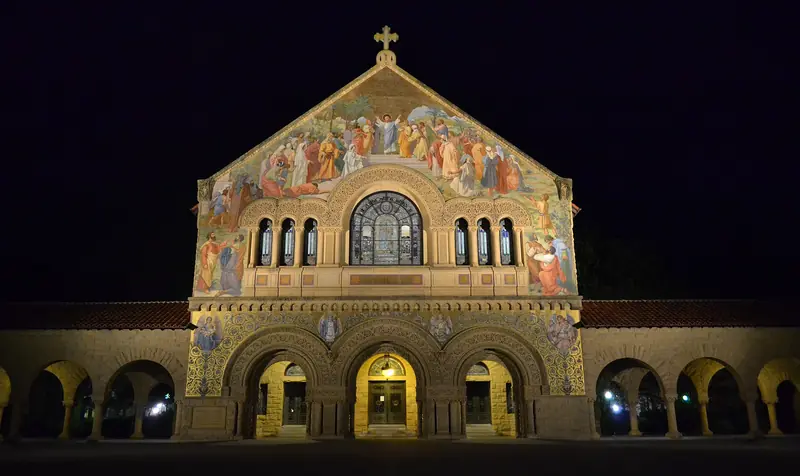
A short downtown walk covers several sites. Start at the Woman's Club hall at 475 Homer Avenue, then walk a block to the Roth Building, the former medical clinic where Esther Clark practiced. Continue to the Norris House on Cowper Street, viewed from the sidewalk since it is private. On another day, visit Memorial Church at Stanford and the Lucie Stern Community Center on Middlefield Road.
Frequently asked questions
When was the Woman's Club of Palo Alto founded?
On June 20, 1894, when 24 women met at the town's old Presbyterian Church. Mary Grafton Campbell, a doctor, was the first president. The club built its hall at 475 Homer Avenue in 1916 and the building joined the National Register of Historic Places in 2014.
Why did Stanford limit women to 500 students?
In 1899 Jane Stanford amended the founding grant so that women would never exceed 500 students at one time. She feared the growing share of women would turn Stanford into a women's college. Trustees replaced the cap in 1933 with the 1899 ratio of about 40 percent women. Stanford had all sex-based limits removed in 1973.
When could women vote in Palo Alto?
California men approved women's suffrage in a statewide vote in 1911, nine years before the 19th Amendment. The Woman's Club of Palo Alto had campaigned for it. Two years earlier the club had helped elect Mrs. C. L. Place to the school board, the first Palo Alto woman elected to any office.
Who founded Palo Alto's first library?
The Woman's Club did. Members opened a reading room in 1896 and a lending library in 1898. On October 1, 1902, they handed it to the city trustees with more than 2,300 volumes, at a cost to the club of $3,387.
Did Kathleen Norris live in Palo Alto?
Yes. The novelist, one of the best paid women writers in the country, built a house in Palo Alto with her husband Charles Norris. Birge Clark designed it at 1247 Cowper Street in the late 1920s and it joined the National Register in 1980.