On this page
Most Palo Alto residents know Timothy Hopkins as a name: on a strip of oaks along San Francisquito Creek, on a marine lab in Pacific Grove and in every account of the town's founding. Fewer know the man. He started life as the son of poor Irish immigrants in Maine. He was raised in the household of one of the richest men in California. He lost most of that fortune in a court fight and still found the money to give away land, a laboratory and a library.
Our page on the founding of Palo Alto covers how he laid out University Park in 1887. This page follows his own life from Augusta to Menlo Park and the long list of things he left behind. Sources include Wikipedia's biography, Stanford's history of its seaside lab and a 2019 Stanford Historical Society talk by Palo Alto historian Steve Staiger titled "Tales of Timothy Hopkins: City Father and University Godfather."
From Timothy Nolan to Timothy Hopkins
He was born Timothy Nolan on March 2, 1859, in Augusta, Maine. His parents, Patrick and Catherine Nolan, were Irish immigrants. In 1862 his father went ahead to California, planning to send for the family. He drowned before they arrived.
His mother later moved west. In 1869 she remarried. She took Timothy's older brother, Thomas, with her and left Timothy with the family of Mark Hopkins, a Sacramento hardware merchant who had become one of the four main investors behind the Central Pacific Railroad. Mark Hopkins and his wife, Mary, had no children of their own.
Mark Hopkins died in 1878 without a will. The young Timothy, still in his teens, took on much of the work of managing the estate. Mary Hopkins legally adopted him in 1879. He went on to serve as treasurer of the Southern Pacific, the railroad that grew out of the Central Pacific.
Sherwood Hall and a Menlo Park life
In 1882 Timothy married Mary Kellogg Crittenden, a niece of Mary Hopkins. The couple received a 280-acre estate in Menlo Park, formerly the Thurlow estate, which they called Sherwood Hall. It was their home for the rest of his life. Their only child, Lydia, was born in 1887.
That address put Hopkins next door to the Stanfords' Palo Alto farm and close to the people planning the new university. It also explains why so much of his giving went to the Midpeninsula. After his death the estate passed to Stanford. Today the land holds the Menlo Park Civic Center and SRI International. Our Menlo Park guide covers the town around it.
The youngest trustee
Hopkins was a close friend of Leland and Jane Stanford. When they set up the board for their new university in 1885, they named him to it. He was 26, the youngest trustee on the original board. Our page on the Stanford family covers the founding grant that created that board.
He stayed on it until his death in 1936, a span of about 50 years. From 1908 to 1914 he was board president. In those years he worked alongside presidents David Starr Jordan and John Casper Branner. The Stanford Historical Society describes him as one of the university's most devoted and generous supporters.
Laying out University Park
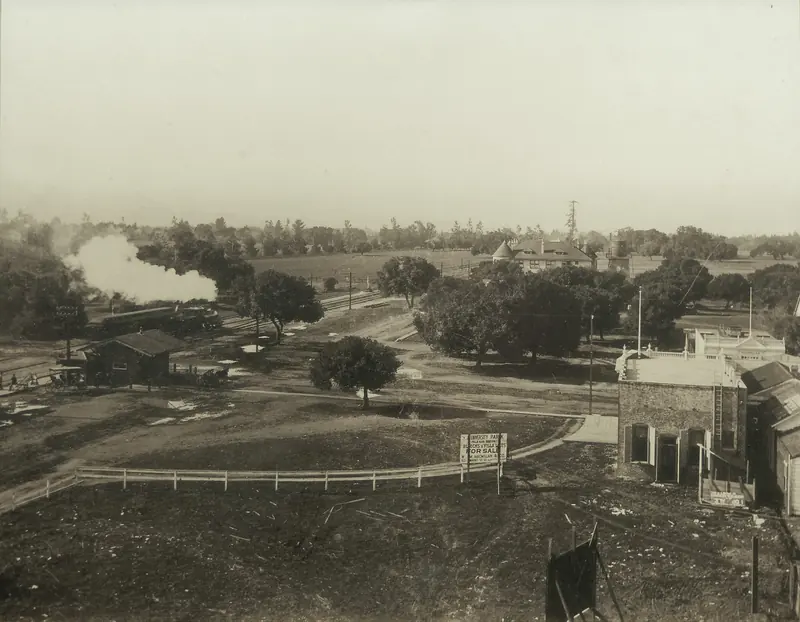
In 1887 Hopkins bought farmland north of the railroad from the Seale family and platted a town. Sources give its size as anywhere from about 697 to 740 acres. He called it University Park. University Avenue ran from the tracks straight toward the campus. The name Palo Alto came later, in 1892.
The deeds he wrote for those lots carried a liquor clause: sell alcohol and the property could revert to Hopkins. The rule shaped downtown for 80 years until a judge struck it down in 1970. Our page on Palo Alto's dry years tells that story in full.
A fortune contested
Hopkins's place in the Hopkins fortune did not last. In 1887 Mary Hopkins married Edward Francis Searles, the interior decorator who had worked on her houses. She was much older than her new husband. When she died in 1891, her will left her fortune to Searles and cut Timothy out.
Timothy challenged the will. Searles eventually won. Even so, Timothy came away with several million dollars, according to Wikipedia's account. That money funded much of what he gave away over the next four decades.
The seaside laboratory
Stanford's first president was a fish biologist. Jordan wanted a lab on the ocean almost as soon as the university opened. Professors Charles Gilbert and Oliver Peebles Jenkins scouted the coast in the fall of 1891 and chose Point Aulon in Pacific Grove, a treeless bluff at what is now Lovers Point.
Hopkins made it happen. He was a partner in the Pacific Improvement Company, the railroad partners' land company that owned much of the Monterey Peninsula. Stanford's own history of the lab says that through his influence the company enlarged the land on offer and gave it outright instead of leasing it. The 1891 to 1892 university register credited the lab to "the liberality of Mr. Timothy Hopkins, of San Francisco" and noted that it was named for him "against his protest."
The Hopkins Seaside Laboratory opened in 1892. In 1917 it moved to a larger point nearby and became Hopkins Marine Station. California created the Hopkins Marine Life Refuge offshore in 1931. A Pacific fish carries his name too: the squarespot rockfish, Sebastes hopkinsi. Our page on Hopkins Marine Station covers its research and what visitors can see.
Other gifts
The seaside lab was only one of his projects. The record shows several more:
- Children's care. He and his wife helped found the Stanford Home for Convalescent Children, a forerunner of today's Lucile Packard Children's Hospital.
- Creekside land. Wikipedia and our park guide say the couple gave Palo Alto about 1.5 miles of land along San Francisquito Creek in 1907. A creek marker instead says he left the strip to the city at his death. Either way it became Hopkins Creekside Park.
- Railroad papers. Stanford's special collections hold the Timothy Hopkins Transportation Collection. Its best-known part is about 2,500 letters and documents, mostly from Collis Huntington to Mark Hopkins, Leland Stanford and others, which the finding aid calls the most significant source on the Central Pacific.
The railroad letters matter to Palo Alto because the Central Pacific fortune paid for the university and the town. Our railroad history explains how the line shaped the Peninsula.

Death and legacy
Hopkins died of pneumonia on January 1, 1936, at Stanford Hospital, which was then in San Francisco. He was 76. He was buried at Cypress Lawn Memorial Park on January 3. Stanford president Ray Lyman Wilbur and former U.S. president Herbert Hoover were among the honorary pallbearers.
His will gave his widow lifetime use of Sherwood Hall. She died in 1941 and most of the estate went to Stanford. Lydia, their daughter, lived until 1965.
His name is easy to overlook because he stayed in the background. He did not run the railroad and he did not lead the university. He financed, signed, platted and served on boards. That steady work left more marks on the map than almost anyone else's.
Where to find Timothy Hopkins today
| Place | Connection | Open to visit? |
|---|---|---|
| Downtown street grid | His 1887 University Park plan | Yes |
| Hopkins Creekside Park, Palo Alto Avenue | Creek land given by the Hopkins family | Yes, as a city park |
| Hopkins Marine Station, Pacific Grove | Grew out of the lab he funded in 1892 | Grounds mostly closed; see our station page |
| Menlo Park Civic Center and SRI | Site of his Sherwood Hall estate | Civic Center grounds are public |
| Stanford special collections | Timothy Hopkins Transportation Collection | By arrangement with the library |
A good way to see his town is on foot. Start at the creek park, walk down University Avenue to the station and picture the grid of lots as it looked on an 1887 survey map.
Frequently asked questions
Who was Timothy Hopkins?
Timothy Hopkins (1859 to 1936) was the adopted son of railroad investor Mark Hopkins. He laid out University Park, the town site that grew into Palo Alto, in 1887. He was also a Stanford trustee for about 50 years and the donor behind the seaside laboratory that became Hopkins Marine Station.
Was Timothy Hopkins related to Mark Hopkins?
Not by birth. He was born Timothy Nolan in Augusta, Maine, to Irish immigrant parents. After his mother remarried in 1869 he stayed with the Hopkins household. Mark Hopkins's widow, Mary, legally adopted him in 1879.
Why is Hopkins Marine Station named after him?
He paid for Stanford's first seaside laboratory in Pacific Grove, which opened in 1892. The university's early register says it was named for him against his protest. The lab moved to its current point and became Hopkins Marine Station in 1917.
Where did Timothy Hopkins live?
He lived at Sherwood Hall, a 280-acre estate in Menlo Park that he and his wife received when they married in 1882. After his widow died in 1941 most of the estate went to Stanford. The land is now home to the Menlo Park Civic Center and SRI International.
When did Timothy Hopkins die?
He died of pneumonia on January 1, 1936, at Stanford Hospital, which was then in San Francisco. He was 76. He was buried at Cypress Lawn Memorial Park on January 3, with Ray Lyman Wilbur and Herbert Hoover among the honorary pallbearers.