On this page
The 1960s gave Palo Alto its counterculture legends. The 1970s were quieter and in many ways more consequential. The postwar building boom ended. Residents fought to save the foothills and the bay shore and mostly won. Downtown got its first legal bar in decades. A lab on the edge of town built the computer that the whole industry would copy. By the end of the decade the city had closed a high school, voters statewide had passed Proposition 13 and a young Steve Jobs had seen the future at Xerox.
This page follows those threads in order. For the decade before, see Palo Alto in the 1960s. For the growth years that set it all up, see postwar growth, 1945 to 1970.
1970: a new decade starts fast
Several turning points landed in a single year. Xerox opened the Palo Alto Research Center in Stanford Research Park. Stanford formally separated from the Stanford Research Institute on March 31, 1970, after campus protest over war research. A new 10 story City Hall by Edward Durell Stone and Associates was completed on Hamilton Avenue. A judge also ruled that the old Hopkins liquor clauses in downtown deeds could not be enforced, which ended the dry era in practice. Our page on the alcohol ban tells that story. Downtown marked its first legal public drink in May 1971.
The protest era had not quite ended. On April 29, 1970, an anti-ROTC sit-in at Stanford's Old Union turned into a clash with police. In January 1972 Stanford fired the English professor H. Bruce Franklin, a leader of the radical group Venceremos, on charges that he incited students. The case drew national attention. Franklin later taught at Rutgers.
The softer side of the counterculture lived on in new institutions. The Palo Alto Community Cultural Center, today's Palo Alto Art Center, opened in the old City Hall on Newell Road on May 1, 1971, after residents lobbied for an arts venue. The Midpeninsula Free University, the do-it-yourself school of the late 1960s, disbanded in July 1971.
Xerox PARC and the Alto
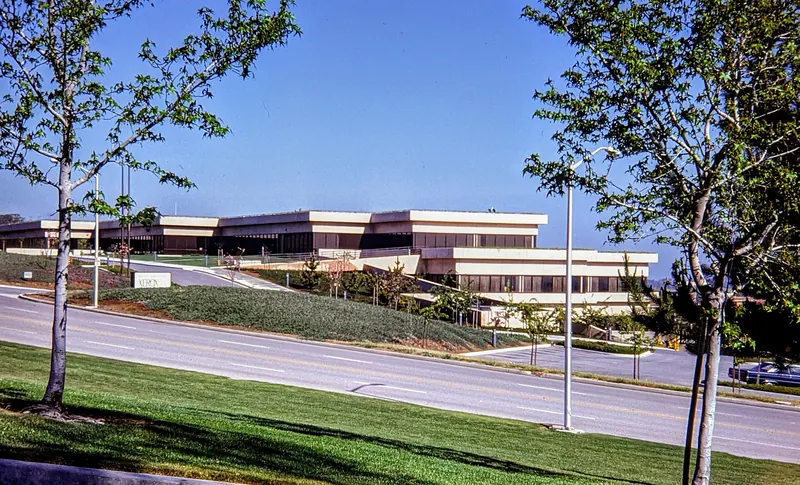
Xerox set up PARC to invent the office of the future. Its researchers came close. On March 1, 1973, the lab introduced the Alto, a computer with a bit-mapped screen, a mouse, overlapping windows and a network link. PARC teams also developed Ethernet and the laser printer in the same years. The Alto was never sold as a mass product. It still set the pattern for the personal computers that followed.
PARC is a good example of how the 1960s fed the 1970s. Larry Tesler, who had been a member of the Midpeninsula Free University, joined PARC and worked on its user interface ideas. The lab also hired from SRI's Augmentation Research Center in Menlo Park, where Douglas Engelbart's team had invented the mouse. Our Xerox PARC page covers the lab in full.

Saving the foothills
The biggest local fight of the decade was over the hills. In the 1960s Palo Alto had annexed thousands of acres west of Foothill Expressway. Developers planned houses there. Residents and council members, including Enid Pearson, pushed back.
The city chose zoning. Court records show a development moratorium in July 1971, a new open space zoning district adopted on June 5, 1972 and an ordinance applying it to private foothill land on August 14, 1972. One owner, Arastra Limited Partnership, held about 515 acres below Foothills Park. It sued. In 1975 a federal judge found that the zoning was designed to stop development rather than regulate it. He ruled that the owner had to be paid fair market value. Much of that hillside is now public land. The Pearson-Arastradero Preserve carries Pearson's name.
The same instinct worked at a regional scale. In 1972 voters in northwestern Santa Clara County approved Measure R, which created the Midpeninsula Regional Open Space District. In 1974 the district bought the ranch that became Monte Bello Preserve. Open space became a public institution rather than a lucky leftover.
The Baylands are protected
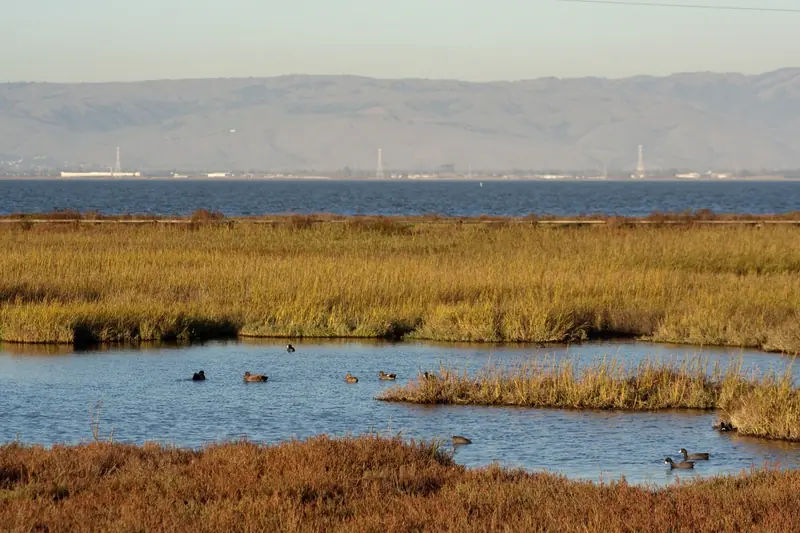
The bay shore had its own campaign. Earlier, a citizen petition led by Harriet Mundy had helped the council turn down a large commercial proposal for the Baylands. In 1972 Congress passed Rep. Don Edwards's bill creating a national wildlife refuge in the South Bay. Lucy Evans, the teacher known as Baylands Lucy, died in 1978 and the nature center was rededicated to her that December. In 1979 Palo Alto annexed a large area of bayside marsh, which put it under city control. The yacht harbor still operated but its days were numbered. Our Baylands history has the full account.

Homebrew, Apple and the Palo Alto connection
Apple was not founded in Palo Alto. Its early work happened in the Jobs family garage in Los Altos. The surrounding scene, though, was centered just north of town. The facts that are well documented:
- March 5, 1975: The Homebrew Computer Club holds its first meeting in Gordon French's garage in Menlo Park. Steve Wozniak credits that meeting as the inspiration for the Apple I.
- 1975 to 1978: The club meets in an auditorium at the Stanford Linear Accelerator Center on Stanford land. Jobs and Wozniak demonstrate the Apple I at a meeting there.
- 1978: Hovey-Kelley Design, the firm that became IDEO, opens in Palo Alto. It went on to design the mouse for Apple's Lisa, a model later used on the Macintosh. See our IDEO page.
- December 1979: Jobs and an Apple team see demonstrations at Xerox PARC in exchange for a chance for Xerox to buy Apple stock.
Venture capital took shape at the same time. Kleiner Perkins was founded in 1972 and the office complex at 3000 Sand Hill Road began going up in phases in 1971. Our venture capital history picks up the thread.
Town life and annexation
The city filled in its last gaps. Barron Park, an unincorporated pocket around El Camino Real and Arastradero Road, joined Palo Alto in 1975 after decades of debate. Our Barron Park guide covers the neighborhood. In 1975 the city also hired its first artist in residence with a federal CETA jobs grant. Several of the trompe l'oeil murals from that program still surprise people downtown.
Stanford changed too. In 1972 its teams stopped being the Indians and became the Cardinals. In 1973 the university asked a county court to remove sex-based limits from its governing documents, which ended the old ratio between men and women. Several historic buildings joined the National Register, including the Squire House in 1972 and the Hostess House in 1976.
Proposition 13 and the Cubberley closure
School enrollment had peaked at 15,576 in 1967 and kept falling. Terman Junior High closed in 1978. That June, California voters passed Proposition 13, which cut property taxes and capped future increases. Palo Alto's well funded schools suddenly faced a deficit. By 1979 the district was about $2 million in the red, according to PaloAltoHistory.org.
On February 6, 1979, the school board voted 3 to 2 to close Cubberley High School at the end of the year. Supporters collected more than 6,000 signatures and won a lower court ruling for a referendum. An appeals court overturned it on May 30, 1979. About 950 Cubberley students moved to Gunn or Paly that fall. Our Cubberley High School page tells the whole story.
The same year the city adopted its Historic Inventory, a list of buildings worth protecting. It was a fitting close. A decade that began with new institutions ended with a city deciding what to keep.
1970s timeline
| Year | Event |
|---|---|
| 1970 | Xerox PARC opens. City Hall is completed. Stanford and SRI separate. |
| 1971 | Community Cultural Center opens May 1. First legal downtown drink in May. Free University disbands in July. |
| 1972 | Foothill open space zoning. Midpen created by Measure R. Kleiner Perkins founded. South Bay refuge authorized. |
| 1973 | The Alto is introduced March 1. Stanford ends its admissions ratio. |
| 1975 | Barron Park annexed. Arastra ruling. Homebrew Computer Club starts. |
| 1978 | Proposition 13 passes. Hovey-Kelley Design opens. Nature center renamed for Lucy Evans. |
| 1979 | Cubberley closes. Historic Inventory adopted. Bay marsh annexed. Jobs visits PARC. |
The decade's census tells the bottom line. Palo Alto had 56,040 residents in 1970 and 55,225 in 1980. It was the city's first census decline since at least 1940. For what came next, read about the dot-com era.
Frequently asked questions
What happened in Palo Alto in the 1970s?
Xerox opened PARC in 1970 and introduced the Alto computer in 1973. The city zoned its foothills as open space in 1972, annexed Barron Park in 1975 and annexed a large area of bay marsh in 1979. After Proposition 13 the school district closed Cubberley High School in 1979.
Was Apple founded in Palo Alto?
No. Apple was founded in 1976 by Steve Jobs and Steve Wozniak, with its early work done in the Jobs family garage in Los Altos. The Palo Alto area still played a part. Wozniak credits the Homebrew Computer Club, which met at SLAC on Stanford land, as his inspiration for the Apple I. Jobs saw the Alto at Xerox PARC in December 1979.
Why did Palo Alto's population stop growing in the 1970s?
The city had largely run out of flat land and residents turned against hillside subdivisions and filling the bay. Open space zoning in 1972 and later land purchases took the foothills off the table. The census counted 56,040 people in 1970 and 55,225 in 1980.
When was the Xerox Alto made?
Xerox PARC introduced the Alto on March 1, 1973. It had a bit-mapped screen, a mouse, windows and a network connection. It was never sold as a mass product but it shaped the Macintosh and later personal computers.