On this page
Palo Alto's street signs read like a reading list. Emerson, Bryant, Waverley, Kipling, Tennyson and Lowell are all on the map, along with a row of colleges, a Spanish word for a landing and a mill that has been gone for well over a century. Some of these names have a clear paper trail. Others have been repeated so often that the story is easy to mistake for a record.
This page sorts out what is documented. It draws on the Menlo Park Historical Association's street research, which cites a local reference titled The Streets of Palo Alto, along with Palo Alto Online, Wikipedia and our own history pages. Where a namesake is likely but unconfirmed, we say so. For the story of the town plan itself, start with our page on the founding of Palo Alto.
The 1887 grid and its literary names
Timothy Hopkins laid out University Park in 1887 on farmland north of the new Stanford campus. The town took the name Palo Alto in 1892. Hopkins drew a simple grid with University Avenue as its spine, running from the railroad toward the bay. Most of the streets on that grid still carry the names he or his surveyors gave them.
A large share of those names belong to writers. Palo Alto Online, reporting on a street naming debate in 2010, described Palo Alto as a city with streets named after tree species and Victorian writers. The pattern is plain on a map. What is missing is a document in which Hopkins explains each choice. Local histories and residents read the names as tributes to particular authors and the matches are hard to miss, but treat the namesakes below as the likely ones rather than the proven ones.
| Street | Likely namesake | How solid |
|---|---|---|
| Ramona Street | Ramona, the 1884 novel by Helen Hunt Jackson | Stated by the Wikipedia article on the Ramona Street district |
| Emerson Street | Ralph Waldo Emerson | Widely assumed |
| Bryant Street | William Cullen Bryant | Widely assumed |
| Waverley Street | Walter Scott's Waverley novels | Widely assumed |
| Cowper Street | English poet William Cowper | Widely assumed |
| Lytton Avenue | Novelist Edward Bulwer-Lytton | Widely assumed |
| Hawthorne Avenue | Nathaniel Hawthorne | Widely assumed |
| Channing Avenue | William Ellery Channing | Widely assumed |
| Addison Avenue | Essayist Joseph Addison | Widely assumed |
| Kingsley Avenue | Novelist Charles Kingsley | Widely assumed |
| Kipling Street | Rudyard Kipling | Widely assumed |
The theme runs south of the original grid too. Byron Street and the avenues named Tennyson, Lowell, Coleridge and Melville carry it into Professorville and Old Palo Alto, the blocks where Stanford's early faculty built their houses. Homer Avenue fits the pattern as well, though as with the others no founding document confirms it. Our Professorville guide covers the houses on those streets.
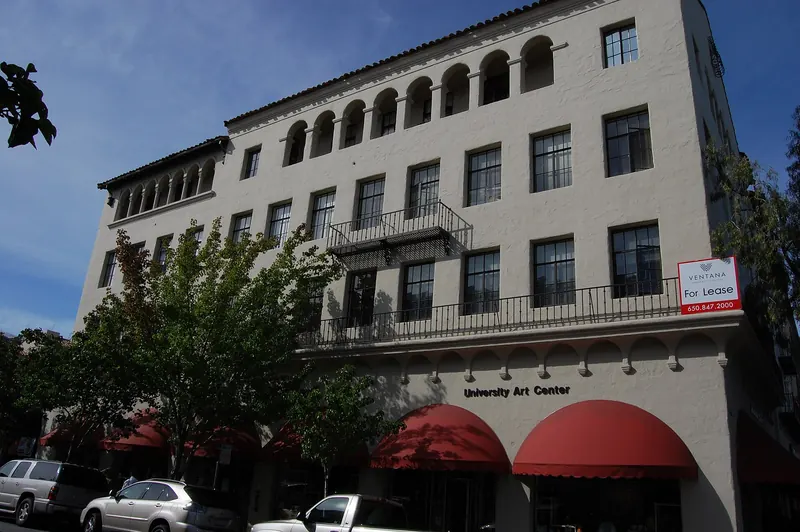

University Avenue and Palm Drive
The most important name on the grid is also the plainest. University Avenue was laid out to link the railroad station with the entrance of the new university. On the far side of the tracks the same straight line continues as Palm Drive. When Stanford opened in 1891, that campus road was also called University Avenue, so a visitor could follow one name from the depot to the Main Quad. The palms and the name Palm Drive came later. Our page on the Oval and Palm Drive tells that story and our University Avenue history follows the town side.
The old roads: Alma, Middlefield, Page Mill and Embarcadero
A few of Palo Alto's main roads are older than the town or were named for things that had nothing to do with literature.
Alma Street
The Menlo Park Historical Association, citing The Streets of Palo Alto, says Timothy Hopkins named Alma Street for a family friend. It started as a path along the railroad tracks and the name is older than the platting of the town. The same source suggests Alma Street in Menlo Park, which bordered the Hopkins family estate north of the creek, shares that history. The friend's full name does not appear in the account we found.
Middlefield Road
Middlefield Road began as part of the old route between San Francisco and San Jose. The Menlo Park Historical Association says a fence built in late 1851 along the road through today's Atherton and Menlo Park became known by 1853 as the Middle Field fence. After the county road, now El Camino Real, opened in 1852, the name passed to the road. The state legislature designated it officially in 1878.
Page Mill Road
Page Mill Road began as the road from Mayfield over the mountains toward Pescadero. It was named for the Page sawmill on the far side of the ridge, near today's Portola Redwoods State Park. The road no longer reaches the mill site, which led one resident to complain in 2010 that the name had lost its point. It stuck anyway.
Embarcadero Road
Embarcadero is Spanish for a landing place. The road runs east to the bayfront, where a landing at the edge of the marsh once served as a transfer point for goods and passengers bound for San Francisco by water. The fit is obvious, though we did not find a record of who named the road or when.
El Camino Real
El Camino Real, the royal road, was the county road of the 1850s and the route of the mission era before that. Its name and its long history get a full page in our El Camino Real history.
Mayfield, College Terrace and the renames of 1925
When Palo Alto annexed the town of Mayfield in 1925, the merged city suddenly had duplicate street names. The fixes are still on the map.
- California Avenue. Mayfield's main street was Lincoln Avenue. Palo Alto already had one, so the Mayfield street became California Avenue. Our California Avenue guide covers the district today.
- Cornell Street. In College Terrace, Washington Street was renamed Cornell Street the same year.
College Terrace has the most orderly names in the city. Alexander Gordon subdivided it in 1887 and named the cross streets after colleges and universities in alphabetical order, so a walk through the neighborhood passes Amherst, Bowdoin, Columbia, Dartmouth, Harvard, Princeton, Wellesley, Williams and Yale. Cornell sits out of sequence because of the 1925 rename. Gordon had first called his tract Palo Alto and gave up that name at Stanford's request, a story told on our College Terrace page.
Old Mayfield also kept a set of tree names. A 1969 city marker for the Herring Box School stands at Birch Street and Sherman Avenue and the nearby Ventura neighborhood has blocks named Ash, Olive and Pepper.
Streets named for people and families
Many of the city's later streets honor landowners, builders or their families. A few with documented origins:
- Miranda Avenue recalls Juana Briones de Miranda, the Californio landowner whose rancho covered the area. See our Juana Briones page.
- Newell Road keeps the name of William Newell, whose farmland became much of Crescent Park.
- Seale Avenue recalls the Seale brothers, Henry and Thomas, whose share of Rancho Rinconada del Arroyo de San Francisquito became the land for University Park.
- Garland Drive, subdivided in 1945, was named for John and Temperance Garland, according to a Palo Alto Weekly neighborhood profile.
- The Palo Alto Orchards streets off Arastradero Road were named by developers James McKellar and Matthew Kelly for themselves and their wives, Suzanne and Lorabelle, as reported by Palo Alto Online.
Some names are plain description. The Triple El neighborhood takes its name from its three streets, Elsinore Drive, Elsinore Court and El Cajon Way.
Stanford's street names
Stanford land has its own naming history. Many campus roads carry Spanish names that recall the mission and colonial era, such as Lasuen and Galvez. In 2018 the university renamed Serra Mall, the main east to west walkway past the Main Quad and Hoover Tower, as Jane Stanford Way, part of a broader review of names tied to Junípero Serra. Hoover Tower's official address is now 550 Jane Stanford Way. Older guidebooks and maps still show the former name.
How new streets get named
Palo Alto is almost fully built, so new streets are rare and usually short. Under the practice described in 2010, the City Council receives proposed names from the Palo Alto Historical Association and votes on them.
That process made news in December 2010. Planning staff and the historical association recommended Packard Court for a cul-de-sac in a new four-lot subdivision near the 700 block of Matadero in Barron Park, where Packard himself had once lived. The council balked. Council member Larry Klein said he was offended to apply David Packard's name to about the smallest street in town. The council voted unanimously to send street and park naming practices to its Policy and Services Committee for review. Palo Alto still has no street named for Packard.
Reading the names on foot
You can see most of these layers in an hour on foot or a short bike ride:
- Start at the Palo Alto Caltrain station and walk up University Avenue, the spine of the 1887 grid.
- Turn onto Ramona, Bryant and Waverley to read the writers' names.
- Continue south through Professorville on Kingsley and Melville avenues into Old Palo Alto.
- Ride to California Avenue, then cross El Camino Real into College Terrace and follow the colleges from Amherst to Yale.
For the stories behind district names such as Professorville, Crescent Park and Barron Park, see our companion page on neighborhood names.
Frequently asked questions
Why are so many Palo Alto streets named after writers?
When Timothy Hopkins laid out University Park in 1887, many of its streets took literary names such as Emerson, Bryant, Waverley and Ramona. Palo Alto Online summed up the city in 2010 as having streets named after tree species and Victorian writers. No document we found records Hopkins explaining each choice, so the individual namesakes are a matter of strong likelihood rather than proof.
Who was Alma Street named after?
The Menlo Park Historical Association, citing a local reference called The Streets of Palo Alto, says Timothy Hopkins named Alma Street for a family friend. It began as a path beside the railroad tracks. The friend's full name is not given in that source.
Why is it called Middlefield Road?
According to the Menlo Park Historical Association, a fence built in the early 1850s along the road through today's Atherton and Menlo Park was known by 1853 as the Middle Field fence and the road took the name. The state legislature made the road official in 1878.
Why are College Terrace streets named after colleges?
Alexander Gordon subdivided College Terrace in 1887 and named its cross streets after colleges and universities in alphabetical order. Cornell Street breaks the pattern because it was renamed from Washington Street in 1925, when Palo Alto annexed Mayfield and had to remove duplicate names.
Is there a street named after David Packard in Palo Alto?
No. In December 2010 the City Council declined to name a small new cul-de-sac in Barron Park Packard Court, with one council member saying the street was far too small for the man. The council asked a committee to review how streets and parks are named.