On this page
Varian and Hewlett-Packard get most of the credit for building Stanford Research Park. Watkins-Johnson deserves a place in the same story. It was founded in Palo Alto in December 1957 by a Stanford professor and an engineer from Hughes Aircraft. It moved into the park the next summer and stayed for about four decades. At its peak it employed around 3,000 people making microwave tubes, electronic warfare gear and chipmaking equipment.
Few people outside the defense electronics world remember the name now. This profile covers its Palo Alto addresses, what it built and how it came apart in the late 1990s. For the wider setting, see our guide to Stanford Research Park.
A professor and a tube engineer
Dean A. Watkins led traveling wave tube research at Stanford's Electronics Research Laboratory. A traveling wave tube, or TWT, amplifies microwave signals. It was vital for radar, electronic warfare and later satellite communications. Watkins also invented a tunable microwave oscillator he called the Helitron.
H. Richard Johnson ran the microwave tube department at Hughes Aircraft in Southern California. The two had met at Hughes before Watkins left for Stanford. According to Johnson's memorial tribute from the National Academy of Engineering, Watkins proposed starting a TWT company over lunch at a Stanford conference in August 1957. The company was incorporated on December 6, 1957, with Watkins as president and Johnson as vice president.
Watkins kept his Stanford appointment and worked part time at first. He later stepped down to adjunct professor when Stanford tightened its limits on outside consulting.
Early venture money
The startup money came from an unusual source: the Kern County Land Company, a big agricultural landholder. Tommy Davis, then at Kern County Land, made the investment. Stanford's Frederick Terman helped negotiate it. Johnson's tribute says Watkins reportedly raised $1 million. In his "Secret History of Silicon Valley" series, Steve Blank calls Watkins-Johnson one of the first venture capital funded companies in the valley. Terman and Davis later sat on its board together. Davis went on to co-found Davis & Rock with Arthur Rock. Our history of venture capital traces that thread.
The board had other famous names. William Hewlett and Terman were early directors. David Packard acted as a mentor. Our Hewlett-Packard profile covers their own company down the road.
535 Ramona Street
The company's first home was a two-room office of about 400 square feet at 535 Ramona Street in downtown Palo Alto. Ramona Street is the city's best known block of Spanish Colonial Revival buildings. The stretch between University and Hamilton avenues is now permanently closed to cars. Our downtown architecture walk passes it.
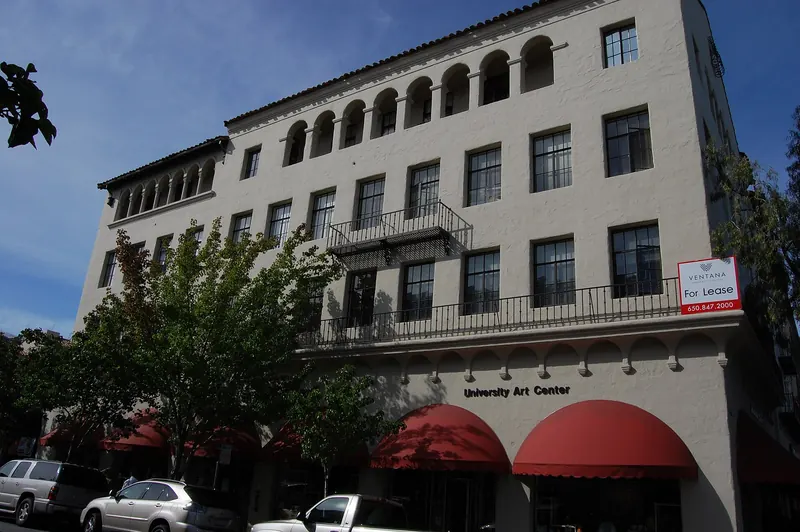

3333 Hillview Avenue
The downtown office did not last long. In August 1958 the company moved into a new 13,000 square foot building at 3333 Hillview Avenue in Stanford Industrial Park, now Stanford Research Park. Johnson later recalled that the building felt cavernous for the roughly ten employees who moved in.
Johnson's memorial tribute calls the company the first tenant in the new research park. That does not match other records, which give that honor to Varian Associates in 1953. Watkins-Johnson was certainly one of the early tenants. Our Varian profile covers the park's first arrival.
Hillview Avenue became the company's base for the rest of its life. Business reference profiles from the mid 1990s still list its headquarters at 3333 Hillview Avenue, Palo Alto, CA 94304.
Growth through the 1960s and 1970s
The company made money from its first year, earning about $80,000 on nearly $500,000 in sales. Its tubes went mainly into military systems. Growth came from new products and a series of purchases:
- 1963. Bought Stewart Engineering of Santa Cruz, a maker of backward wave oscillators.
- 1967. Bought Communication Electronics Inc. of Rockville, Maryland, which made receivers. Sales that year reached about $31 million with $3.2 million in profit.
- June 1968. Listed on the New York Stock Exchange.
- 1970. Bought RELCOM of Mountain View, which made mixers and other components.
- 1978. Opened a plant in San Jose.
By 1969 the company had more than 1,250 workers at plants in Palo Alto, the Santa Cruz area and Rockville. By the late 1970s it had about 3,000 employees, four manufacturing sites and sales approaching $130 million. It also branched into furnaces and other equipment for semiconductor factories, which would matter later.
From defense to chip equipment
W. Keith Kennedy, who had joined in 1968, became president in 1988. Watkins and Johnson moved up to chairman and vice chairman. That year revenue was $280 million and about 90 percent came from defense. When military budgets fell after the Cold War, the company cut its workforce from 3,200 to 2,400 and closed a plant in North Carolina in 1991.
The semiconductor equipment business carried it for a while. By 1995 those sales had grown to about $220 million, roughly 60 percent of the total. Telecom and wireless parts made up about 10 percent. In 1994 the company reported $332.6 million in sales and 2,220 employees.
Good to know
- The company's plant in Scotts Valley, near Santa Cruz, was found to have soil and groundwater contamination in 1984. It was added to the federal Superfund list in 1990.
- We found no source describing contamination at the Hillview Avenue site, so we make no claim about it.
The breakup
In the second half of the 1990s the company sold itself off in pieces:
| Date | Unit sold | Buyer |
|---|---|---|
| April 1995 | Microwave surveillance systems | Condor Systems |
| October 1997 | Military devices and subsystems | Stellex Industries |
| July 1999 | Semiconductor Equipment Group | Silicon Valley Group |
| August 1999 | Telecommunications Group | Marconi North America |
| October 1999 | Wireless Products Group | Fox Paine and Company |
The wireless group carried on as WJ Communications. Fox Paine took it public on Nasdaq in August 2000. TriQuint Semiconductor bought WJ Communications in March 2008, which ended the corporate line.
The site today
We could not confirm which company occupies 3333 Hillview Avenue in 2026 or whether the original 1958 building still stands, so we do not say. The address sits on the same stretch of Hillview Avenue as the TIBCO campus, the former Syntex and VMware land and SAP's Palo Alto campus. All are private offices, best seen from a bike or car.
A simple route covers both company addresses. Start downtown on Ramona Street, which is now a pedestrian block between University and Hamilton avenues. Then ride south on the Bryant Street bike boulevard and cross into the research park via California Avenue and Hanover Street to reach Hillview Avenue. The ride is roughly 3 miles each way. Our biking guide has more routes.
The company also has an afterlife online. A volunteer Watkins-Johnson history site and an archive of the company's technical notes preserve its catalogs and papers. For more of the companies that built the park, browse our companies guide or follow the famous tech addresses tour.
Frequently asked questions
Where was Watkins-Johnson in Palo Alto?
The company started in a two-room, 400 square foot office at 535 Ramona Street downtown. In August 1958 it moved to a 13,000 square foot building at 3333 Hillview Avenue in what is now Stanford Research Park. Company profiles from the mid 1990s still list 3333 Hillview Avenue as its headquarters.
What did Watkins-Johnson make?
It began with traveling wave tubes and backward wave tubes, microwave amplifiers and oscillators used mostly in defense electronics. Later it made solid state microwave parts, electronic warfare systems, receivers, antennas and equipment for making semiconductors.
Who founded Watkins-Johnson?
The founder and first president was Dean A. Watkins, a Stanford electrical engineering professor who led traveling wave tube research there. His partner was H. Richard Johnson, who headed the microwave tube lab at Hughes Aircraft. Early board members included William Hewlett and Frederick Terman.
How was Watkins-Johnson funded?
The first money came from the Kern County Land Company in 1957, in a deal negotiated with help from Stanford's Frederick Terman. Johnson's memorial tribute says Watkins reportedly raised $1 million. Entrepreneur and author Steve Blank calls it one of the first venture funded companies in the valley.
What happened to Watkins-Johnson?
In the late 1990s the company sold its businesses one by one: defense units in 1995 and 1997, then its semiconductor equipment, telecom and wireless groups in 1999. The wireless group became WJ Communications, which went public in 2000 and was bought by TriQuint Semiconductor in 2008.