On this page
Most visitors to Palo Alto never notice Stanford Research Park. There is no gate, no sign that shouts and no tourist center. Low buildings sit under oaks along Page Mill Road, Hanover Street and Hillview Avenue. Yet this stretch of leased university land has housed some of the most important technology companies of the past 75 years. In 2026 it is busier than it has been in decades.
This guide covers how the park started, which companies are there now, how the land deal works and how to get around it. For the wider picture, start with our Palo Alto startups hub.
How it started in 1951
After World War II Stanford was land rich and cash poor. Leland and Jane Stanford's founding grant kept the university from selling its land. Frederick Terman, the dean of engineering who later became provost, saw another way. Stanford could lease land on long terms to research companies, earn steady income and keep its graduates close to home.
In 1951 Stanford and the City of Palo Alto created the Stanford Industrial Park. Wikipedia notes that the first allocation was 209 acres. The city annexed about 700 acres of Stanford land in all, which brought tax revenue to the city, Santa Clara County and the Palo Alto Unified School District. The park took its current name in the 1970s.
Varian, HP and Lockheed
Varian Associates became the first tenant in 1953. The company had developed the klystron microwave tube, technology the park credits as a foundation for satellite communications and particle accelerators. Hewlett-Packard followed and made 1501 Page Mill Road its headquarters in 1960. HP Inc. is still headquartered at that address. Lockheed's space and missile business also set up research labs in the park in its early years. The park credits Lockheed Martin with developing critical components for the International Space Station. Lockheed Martin is still a tenant.
The tenant count grew from about 40 in 1960 to about 100 by 1985. Read the full company stories on our pages about Varian and Hewlett-Packard.
Famous past tenants
Several of the park's most famous residents have moved on, but their work shaped the industry.
- Xerox PARC. Xerox's Palo Alto Research Center developed personal workstations, Ethernet and laser printing. It sits on Coyote Hill Road in the hills of the park. Xerox donated it to SRI International in 2023. See our Xerox PARC page.
- NeXT. Steve Jobs's company worked in the park after he left Apple in the 1980s.
- Facebook. The company moved its headquarters from downtown to 1601 California Avenue in 2009 and stayed until it left for Menlo Park in 2011. Our Facebook in Palo Alto page tells that story.
- Varian Medical Systems. The medical spinoff of Varian Associates developed radiation oncology equipment in the park. Siemens Healthineers announced the purchase in 2020 and completed it in April 2021.
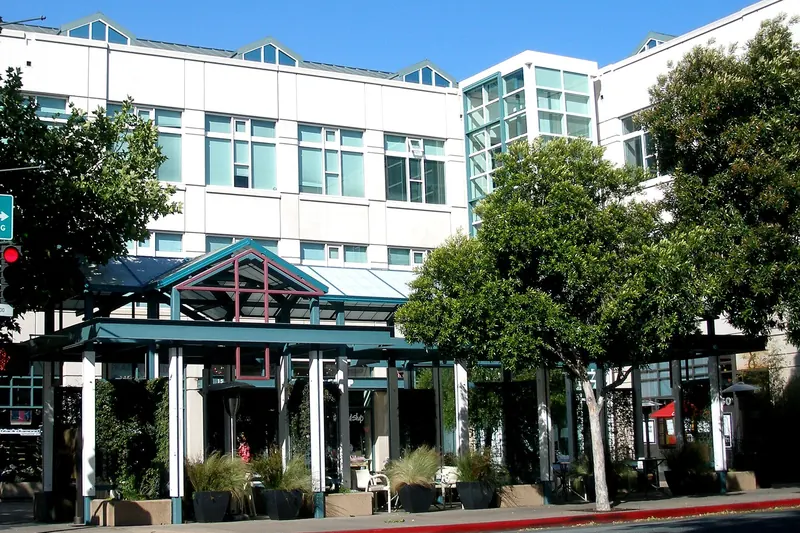

Who is there today
The park says it holds more than 150 companies in roughly 10 million square feet of office and lab space. Wikipedia counted about 23,000 workers in January 2018. Tenants we could confirm in 2026 include:
| Tenant | What is there |
|---|---|
| HP Inc. | Headquarters at 1501 Page Mill Road |
| Tesla | Global engineering headquarters at 3000 Hanover Street, the former Hewlett Packard Enterprise campus. Wikipedia lists Tesla as the park's largest tenant as of late 2025. |
| Broadcom | Headquarters on the former VMware campus on Hillview Avenue |
| General Motors | Leased nearly 340,000 square feet at 3411 Hillview Avenue in mid 2026 |
| SAP | Large campus, including an SAP Experience Center |
| Lockheed Martin | Research and technology facilities |
| Ford | Listed by the park as a neighbor of The Hub |
| Rivian | Offices, including the former Varian site |
| 1X Technologies | Humanoid robot maker, headquarters opened in summer 2025 |
| Arc Institute | Nonprofit biomedical research institute, in the park since 2023 |
| Guardant Health | Cancer diagnostics company |
| StartX | Stanford's nonprofit accelerator |
Smaller companies come and go faster. Industry news in the past year reported an AI company, BrightAI, leasing all 26,891 square feet of 1001 Page Mill Road, with Uniphore expanding in the same building. The pattern is clear. Robotics, electric vehicles, AI and life sciences are driving demand.
The life science district
A growing share of the park is lab space. The park markets a Life Science District focused on bioengineering, precision medicine, medical devices and digital health. It says it has 92,000 square feet of life science accelerator lab space. The largest piece is Page Mill Labs at 950 Page Mill Road, which offers 77,300 square feet of flexible wet labs for startups, many founded by Stanford faculty. The Stanford University School of Medicine also has space near The Hub. Our guide to research labs near Palo Alto covers SLAC, SRI and the other big labs nearby.
How the land deal works
Stanford owns the land and companies lease it, usually on long ground leases. In 1991 Stanford created Stanford Management Company to manage its investments and real estate, including the park. Companies often build or renovate their own buildings on leased ground. Because the land sits inside Palo Alto, tenants follow city zoning and permit rules and pay city taxes. A 2016 economic study credited the park with about $775 million in economic activity for Palo Alto and about $2.4 billion for Santa Clara County.
The arrangement has drawn its share of local debate over traffic and housing. In 2016 Stanford and a dozen large employers formed a transportation management association to cut solo car trips. An affordable housing community with 180 units opened in the park in 2017.
The Hub and StartX
The closest thing the park has to a town square is The Hub, at the corner of Porter Drive, Hillview Avenue and Hanover Street. Its address is 3215 Porter Drive. Coupa Café runs a coffee shop there that serves breakfast, lunch and dinner. The park lists its hours as 7:30 a.m. to 7 p.m. on weekdays. Mike's Bikes runs a bike repair shop for the more than 1,000 people the park says bike in each day. The Hub also hosts noontime Lunch and Learn talks and an evening speaker series for people who work in the park.
StartX is headquartered in the park and plans to anchor The Link, a new hub built with Stanford Research Park that StartX says will open in early 2027. Read about it in our accelerators guide.
Getting there and around
The park sits southwest of El Camino Real, about two miles from the main Stanford campus. Page Mill Road is the spine. It connects Interstate 280 at the top of the hill with El Camino Real and, beyond, the Oregon Expressway and Highway 101.
- Caltrain. California Avenue station is the nearest stop for most of the park. Palo Alto station at University Avenue is the bigger hub. See our getting around guide for fares.
- Shuttles and buses. The park says eight bus and shuttle routes serve it, including Stanford's free Marguerite shuttle from the University Avenue station. Marguerite main lines run on weekdays only.
- SRPGO. The park's commute program offers trip planning, commuter rewards and VTA's guaranteed ride home program for people who work in the park.
- Bike. The Matadero Creek Trail gives 1.5 miles of off-street riding and walking. Our biking guide covers routes across town.
- Car. Parking is controlled by each tenant. Visitors should ask their host where to park.
Flying in for meetings? The park is roughly halfway between SFO and San Jose airports. Compare hotels near Stanford Research Park, including options along El Camino Real and near California Avenue.
Visiting tips
Good to know
- The park is not a tourist site. Buildings are private and most need a badge. Do not walk into lobbies or garages without an invitation.
- You can drive or bike past 1501 Page Mill Road, 3000 Hanover Street and Coyote Hill Road to see the scale of the place.
- For lunch after a meeting, the shops and restaurants of California Avenue are a few minutes away.
- The park celebrated its 75th year in 2026. Check the Stanford Research Park website for news and events.
Frequently asked questions
When was Stanford Research Park founded?
Stanford and the City of Palo Alto created it in 1951 under the name Stanford Industrial Park. The idea came from Frederick Terman, Stanford's dean of engineering and later provost. It took the name Stanford Research Park in the 1970s and marked its 75th year in 2026.
What companies are in Stanford Research Park?
Tenants include HP Inc., Tesla, Broadcom, SAP, Lockheed Martin, Ford, Rivian, Guardant Health, 1X Technologies and the Arc Institute, plus the StartX accelerator. General Motors signed a lease on Hillview Avenue in 2026. The park says it holds more than 150 companies in total.
Can the public visit Stanford Research Park?
You can drive, bike or walk the public streets, but the buildings are private offices with badge access. Do not enter lobbies or parking structures without an invitation. The Hub on Porter Drive is a gathering space for people who work in the park.
How big is Stanford Research Park?
The park covers about 700 acres and roughly 10 million square feet of office and lab space. It stretches from near El Camino Real past Foothill Expressway toward Arastradero Road, with Page Mill Road running through it.
How do you get to Stanford Research Park by public transit?
Take Caltrain to Palo Alto or California Avenue station, then a Stanford Marguerite shuttle, a VTA bus or a bike. The park's commute program, SRPGO, has a trip planner and lists the bus and shuttle routes that serve it.