On this page
Millbrae is a small city on the north Peninsula, wedged between San Bruno, Burlingame and San Francisco International Airport. About 23,000 people live here. For most Palo Alto travelers it is just a name on a train sign, the place where you switch from Caltrain to BART on the way to the airport or the East Bay.
The town itself deserves a little more attention. Its downtown along Broadway and El Camino Real is one of the best places on the Peninsula for Chinese food, its old train depot has a volunteer museum and its hotels sit a few minutes from the SFO terminals. This guide explains the station, the town and why you might stop on purpose.
Where Millbrae is and how far
Millbrae is in northern San Mateo County. The airport lies to the northeast, San Bruno to the northwest and Burlingame to the southeast. San Andreas Lake and the hills of the San Francisco watershed form its western edge. El Camino Real runs north to south through the middle of town and Highway 101 runs along the bay side.
From downtown Palo Alto it is about 21 miles. Outside rush hour the drive takes 25 to 30 minutes on Highway 101 or a bit longer on Interstate 280, which runs just west of town.
The Millbrae station
Millbrae Transit Center opened on June 22, 2003, as part of BART's extension to SFO. It is the only station where BART and Caltrain meet. BART lists the address as 200 North Rollins Road, on the east side of the tracks. SamTrans buses and employer shuttles also stop here.
Caltrain
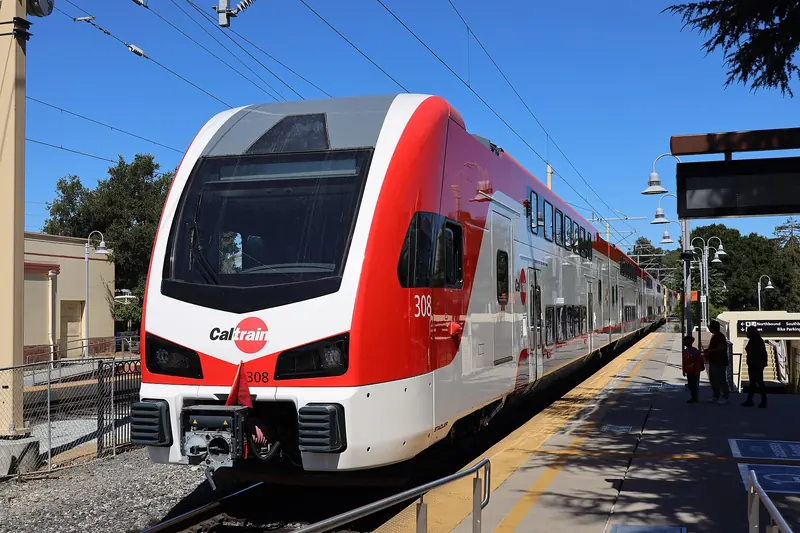
Caltrain places Millbrae in zone 2 and Palo Alto in zone 3, so the ride is a two-zone fare: $6.25 in October 2026 and $6.50 from January 1, 2027. On the late October 2026 weekday timetable, an express from Palo Alto took about 21 minutes and a local about 29. Every train shown on that timetable stopped at Millbrae. Our guides to the Palo Alto station and riding Caltrain cover tickets and Clipper.
BART
BART's station page lists two lines at Millbrae: Richmond to Millbrae and SFO and Antioch to SFO and Millbrae. On weekdays during the day, trains leave about every 20 minutes and run first to the airport, then through San Francisco and under the bay. In the evening the pattern changes. Check the BART station page and its trip planner before you travel at night. BART charges its own fare, separate from Caltrain.
Making the transfer
The two systems share a fare concourse upstairs. Northbound Caltrain and BART share one island platform with faregates between them, so in that direction you can change trains a few steps apart. Southbound Caltrain uses a separate side platform. BART and Caltrain publish a joint transfer timetable to help you pick connecting trains. The 2,200-space garage sits on the east side of the station. Our page on coming from the East Bay explains the BART route in detail.
Gateway at Millbrae and the future
The old surface lots east of the station were replaced by Gateway at Millbrae, finished in 2023, with about 400 homes, a 164-room hotel and office space. SamTrans and Caltrain both announced moves of their headquarters into its office building. Millbrae is also the only planned California High-Speed Rail stop between San Francisco and San Jose, though no service date has been set.
A short history
The Ramaytush Ohlone lived along San Bruno Creek before the Spanish arrived. The Portolà expedition camped near San Andreas Lake in November 1769. The land later became part of Rancho Buri Buri. In the 1860s the banker Darius Ogden Mills bought a large piece of the rancho for a country estate. The name Millbrae joins Mills with the Scottish word brae, a hillside.
Mills gave land to the new San Francisco and San Jose Railroad in exchange for a station. The first depot opened in 1864 and was renamed Millbrae the next year. Fires destroyed two depots before Southern Pacific built the current two-story building in 1907. The town grew slowly, then quickly. In the 1940s a hilltop was shaved down to provide fill for the growing airport. Residents incorporated on January 14, 1948. The Mills mansion burned in June 1954 and the estate was broken up for housing.
Green Hills Country Club, designed by Alister MacKenzie and built in 1929, still forms a green belt through the middle of the city. It is a private club.
The historic depot
When Southern Pacific planned to tear down the 1907 depot in 1976, local residents formed the Millbrae Historical Society to save it. The building was added to the National Register of Historic Places on September 1, 1978. In 1980 it was moved about 200 feet to make way for a wider Millbrae Avenue. It stands just south of the modern station.
After trains moved to the new transit center, the historical society reached an agreement with Caltrain and opened the Millbrae Train Museum in the depot in October 2004. A 1941 Pullman car named Civic Center was later placed beside it. Volunteers run the museum on a limited schedule and we could not confirm current hours, so look from outside unless you have checked first. It is one of seven Caltrain depots on the National Register.

Food in Millbrae
Millbrae's restaurants are the main reason to linger. Downtown runs along Broadway and El Camino Real, a few blocks west of the station. The blocks are dense with Chinese restaurants, especially Cantonese seafood and dim sum houses, along with Chinese bakeries, noodle shops, hot pot, Japanese and Korean places, Vietnamese pho and boba tea. Weekend dim sum brings lines at the bigger restaurants, so arrive early or expect a wait.
Because restaurants open and close often, we name none here. A good approach is to walk the length of Broadway and read the menus in the windows. For comparisons closer to home, see our guide to Chinese food in Palo Alto.
Staying near SFO
Millbrae is one of the closest towns to the airport. Hotels line El Camino Real and the bay side of town. The Gateway at Millbrae hotel sits beside the station. Staying here makes sense for a dawn flight or a late arrival: you can ride BART one stop to the terminals in the morning, then take Caltrain to Palo Alto later in the day. Compare rates with Millbrae and SFO-area hotels and ask whether yours runs an airport shuttle. If you would rather be met at arrivals, book an airport transfer in advance.
Our SFO guide covers every option between the airport and Palo Alto. Facing a long layover? Our SFO layover plan uses this same BART and Caltrain connection.
Other things to do
- Art and Wine Festival: Millbrae closes Broadway for a large street festival every Labor Day weekend, with art booths, music and food. The 2026 edition was billed as the 55th. Caltrain has promoted riding the train to it.
- The Spur Trail: a city path that the city is redesigning under a new Spur Trail Master Plan.
- Plane spotting: the bay side of town looks across the approach paths into SFO.
- The reservoirs: San Andreas Lake and the San Francisco watershed lie just west of town along Skyline Boulevard, with views over the water.
- A trip onward: from Millbrae, BART runs to San Francisco, Oakland and Berkeley.
Why a Palo Alto visitor might go
- Dim sum and Cantonese food. Millbrae is one of the Peninsula's best Chinese food towns and it is right on Caltrain.
- An easy airport base. Hotels one stop from SFO beat a long early drive.
- The gateway to BART. It is the transfer point for Oakland, Berkeley and the rest of the East Bay.
- Railroad history. The 1907 depot is one of the best preserved on the line.
Good to know
- BART and Caltrain charge separate fares. Clipper and contactless cards work on both.
- Our East Bay page notes a BART garage fee of $3.40 a day in October 2026, if you drive to Millbrae to catch the train.
- Downtown parking is tight at dinner and on weekends. The city is studying a downtown parking management plan.
- Weekend dim sum lines peak around late morning.
Frequently asked questions
How do I get from Palo Alto to Millbrae?
Caltrain is the simplest way. Millbrae is a two-zone fare from Palo Alto, $6.25 in October 2026 and $6.50 from January 1, 2027. On the late October 2026 weekday timetable an express took about 21 minutes and a local about 29. By car it is about 21 miles on Highway 101, roughly 25 to 30 minutes outside rush hour.
Do all Caltrain trains stop at Millbrae?
Millbrae is one of Caltrain's main stops and the trains on the late October 2026 weekday timetable stopped there, including the express runs. Patterns can change with new timetables, so check the current schedule before you count on a specific train.
How often does BART run from Millbrae?
On weekdays during the day, BART's station page showed trains leaving Millbrae about every 20 minutes. They run first to SFO and then on through San Francisco toward Richmond. Evening and weekend patterns differ, so use BART's trip planner for your time.
Is Millbrae close to SFO?
Yes. The airport sits just northeast of the city and is one BART stop from Millbrae station. Several hotels line El Camino Real and the bay side of town, which makes Millbrae a practical base for an early flight.
What is Millbrae known for?
Millbrae is best known for its transit hub, where BART and Caltrain connect. It is also known for a downtown packed with Chinese restaurants and bakeries. It also has a 1907 Southern Pacific depot on the National Register and an Art and Wine Festival every Labor Day weekend.