On this page
Hillsborough is unlike any other town on the Peninsula. It has about 11,400 residents, 6.2 square miles of oak-covered hills and not a single store. The town's zoning allows no commercial uses, no apartments and no lots smaller than half an acre. The only non-residential places are schools, town buildings, a golf course, a country club and a few small parks.
That makes it an odd place to visit. For most of the year there is little reason to go. The exception is Carolands, a 1916 chateau built by a Chicago railroad heiress. It is a National Register landmark and its foundation runs free tours by reservation. This guide covers where Hillsborough is, its history, how to book Carolands and how to visit the area with respect for the people who live there.
Where Hillsborough is and how far
Hillsborough sits in San Mateo County on the hills west of Burlingame and San Mateo. Interstate 280 forms its western edge, with the Crystal Springs reservoirs beyond. To the east the land flattens toward El Camino Real. Three creeks, San Mateo, Cherry Canyon and Sanchez, drain its wooded slopes.
From downtown Palo Alto it is about 20 miles. Outside rush hour the drive takes 25 to 30 minutes. Interstate 280 is the more pleasant route and has several exits into the town. Highway 101 works too, with a short climb west through Burlingame or San Mateo.
Getting there
- Car: the only practical way to reach Carolands. Streets wind and change names without warning, so set your navigation before you leave the freeway.
- Caltrain: the nearest stations are Burlingame and San Mateo, both two zones from Palo Alto ($6.25 in October 2026, $6.50 from January 1, 2027). From either, Hillsborough is a short rideshare uphill. Our Caltrain guide explains fares.
- Bus: SamTrans runs along El Camino Real at the town's eastern edge but not up into the hills.
- On foot or bike: most streets have no sidewalks and blind curves. Walk only where there is room and wear something visible.
How Hillsborough came to be
The land was part of Rancho San Mateo, granted in 1846 to the Californio ranchero Cayetano Arenas. That same year it was bought by William Davis Merry Howard, son of a shipping magnate from Hillsborough, New Hampshire, which gave the future town its name. Howard settled his family here and wealthy San Franciscans soon followed, building country houses in the hills above the railroad.
After the 1906 earthquake, more of them moved south for good. Hillsborough residents voted to incorporate on May 5, 1910. Many of the largest estates went up in the following decades, often designed by leading architects of the day. Later in the century many estates were subdivided into smaller lots, though "small" here still means half an acre or more.
Like many Peninsula towns, Hillsborough kept people out by race for decades. Wikipedia records that it was an exclusive community for wealthy white residents until 1963, when Jack and Betty Ken, children of Chinese immigrants, bought land in town and became the first non-white property owners. Our page on covenants and the fair housing fight tells the Palo Alto side of the same story.
Carolands Chateau
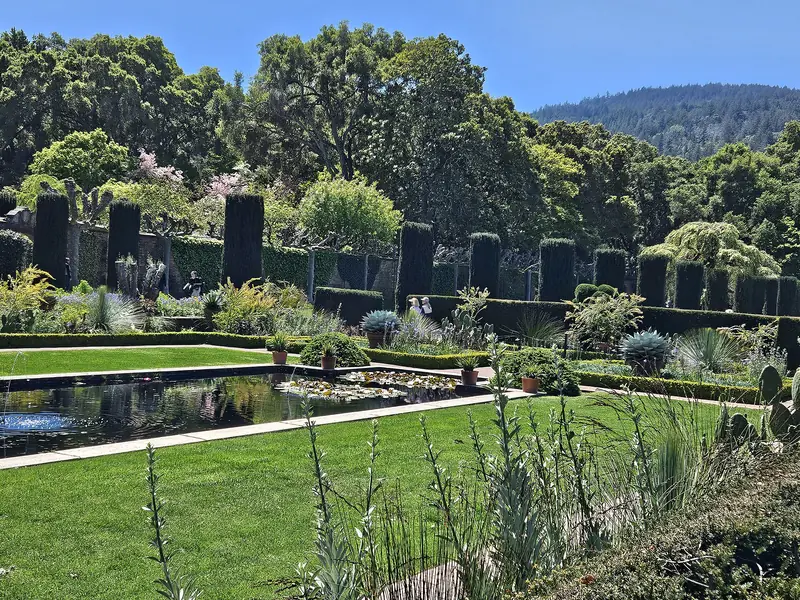
Carolands is one of the last great houses of the Gilded Age. Harriett Pullman Carolan, daughter of George Pullman of Pullman railroad car fame, married Francis Carolan of San Francisco in 1892. In 1912 she bought 554 acres on the highest ground in the area, chosen for its views of the bay. She hired the Parisian architect Ernest Sanson, then in his seventies, to design a house inspired by 17th century French classicism. San Francisco's Willis Polk managed construction and the landscape architect Achille Duchêne designed formal gardens in the manner of Versailles. Only a small part of the garden plan was ever built.
The finished house had 98 rooms, including three 18th century period rooms bought in Paris. The Carolans moved in during the fall of 1916, but they separated the next year and the house was closed by 1918. It changed hands several times and stood empty for long stretches. In 1950 Countess Lillian Remillard Dandini bought it and saved it from demolition, opening it often for charity events until her death in 1973. The state listed it as California Historical Landmark No. 886 and it joined the National Register of Historic Places in 1975.
Decades of decline followed until a 1991 designer showhouse drew 68,000 visitors and renewed interest. Charles and Ann Johnson bought and restored the house beginning in 1998 and later gave it to the Carolands Foundation, which now runs it.
Booking a tour
The Carolands Foundation tour page sets out the rules:
- Tours are free and curator-led, on Wednesdays at 1 p.m., by reservation only.
- Each reservation covers one or two guests. Dates are released a month or two ahead and fill fast.
- Guests must be 16 or older, except on student tours. Each guest may visit once a year.
- Allow about two and a half hours. Tours include up to 100 steps and plenty of standing.
- Arrive at 12:45 p.m. with a printed confirmation and photo ID. Park inside the gates, as the foundation asks, out of respect for neighbors.
- No photography inside the chateau. Casual photos of the grounds for personal use are fine.
- Wear flat shoes to protect the floors. Backpacks, food and pets are not allowed, except service animals.
Guests who need wheelchair access should contact the foundation in advance. If you cannot make your date, cancel at least 48 hours ahead, or the visit counts as your one for the year.

Visiting the town respectfully
Outside Carolands, Hillsborough is simply a residential town. Homes are private, most sit behind trees and gates and the town has no viewpoints, visitor center or public tours. A few practical points:
- Streets are narrow, steep and winding, with few shoulders. Drive slowly and do not stop in the road to look at houses.
- Do not park at driveways or photograph private homes. Several large historic properties are now private schools and are not open to casual visitors.
- The town's parks are small neighborhood spaces, not destinations.
- Deer, raccoons and coyotes are common. Wikipedia also notes mountain lions in the surrounding green belts. Drive carefully at dusk.
For a sense of how the estate era shaped the Peninsula, compare Hillsborough with Woodside and Atherton, which also restrict commercial uses. Then browse the historic houses on our historic homes page.
Walks and views nearby
The best walking near Hillsborough lies just west of Interstate 280, around the Crystal Springs reservoirs. San Mateo County Parks manages the Crystal Springs Regional Trail along the water, including the paved Sawyer Camp section, which is popular with walkers, runners and families on bikes. The reservoirs themselves are closed to the public as part of the San Francisco water system, but the trail has long views over them. Our hiking guide lists more routes closer to Palo Alto.
Food and places to stay
Because Hillsborough has no businesses, plan to eat in a neighboring town. Burlingame Avenue and Broadway in Burlingame are about five minutes away by car and have dozens of restaurants and cafes. Downtown San Mateo, just to the southeast, has a large choice too. For a full day, pair a Carolands tour with lunch on Burlingame Avenue.
There are no hotels in Hillsborough. The bayfront hotels in Burlingame and the business hotels in San Mateo are the closest. You can compare Burlingame and San Mateo hotels if you want to make a weekend of it.
Why a Palo Alto visitor might go
- Carolands. A free curator-led tour of a restored Gilded Age chateau is rare anywhere in California.
- Architecture. If you enjoyed Filoli, Carolands shows the French side of the same era.
- A Peninsula pairing. A Wednesday tour fits neatly with lunch in Burlingame and a walk along the reservoirs.
Good to know
- Carolands reservations open in batches a month or two out. Check the foundation's tour page often.
- No one is admitted to the Carolands grounds without a printed confirmation and photo ID.
- The chateau can be cold in winter and warm in summer. Dress in layers.
- Hillsborough has no public restrooms or cafes, so plan stops in Burlingame or San Mateo.
Frequently asked questions
Can you tour Carolands Chateau?
Yes. The Carolands Foundation offers free curator-led tours of the chateau and gardens on Wednesdays at 1 p.m. by reservation only. Each reservation covers one or two people, guests must be at least 16 and each person may visit once a year. Dates are released a month or two ahead and fill quickly.
How long is the Carolands tour?
The foundation asks guests to allow about two and a half hours. Tours include up to 100 steps and a lot of standing. Check-in is at 12:45 p.m. and you need a printed confirmation and photo ID to enter the grounds.
Are there shops or restaurants in Hillsborough?
No. Hillsborough has no commercial zoning, so there are no stores, restaurants or hotels in town. Burlingame Avenue and downtown San Mateo, each a few minutes away by car, have plenty of both.
Who built Carolands?
Harriett Pullman Carolan, daughter of the railroad car maker George Pullman, built it after buying land in Hillsborough in 1912. The Parisian architect Ernest Sanson designed the house, Willis Polk managed construction and Achille Duchêne laid out the gardens. She and her husband moved in during the fall of 1916.
Can I drive around Hillsborough to see the mansions?
The streets are public, but they are narrow and winding, most have no sidewalks and there is little place to stop. Homes are private and most sit behind trees and gates. Please do not stop at driveways or photograph private homes. Carolands is the one estate open to visitors.