On this page
VMware is a Palo Alto company from start to finish. It was founded here in 1998 by a group of Stanford computer scientists, grew into one of the largest software firms in the world and built a hillside campus in Stanford Research Park. In November 2023 the chipmaker Broadcom bought it and moved its own headquarters onto the campus. Most of the buildings have since been sold and re-leased.
VMware's main idea, the virtual machine, is invisible to most people. It lets one physical computer act as many separate computers. That simple trick reshaped corporate data centers and helped make cloud computing practical.
Founding and the Stanford connection
VMware was founded on February 10, 1998, in Palo Alto. Its technical roots were in Disco, a research project at Stanford led by computer science professor Mendel Rosenblum. Disco explored how to run multiple operating systems on one machine using a thin layer of software called a virtual machine monitor.
Rosenblum co-founded the company with his wife, Diane Greene, who became chief executive. Two of his Stanford graduate students, Edouard Bugnion and Scott Devine, were also co-founders, along with a fifth co-founder whose first name is reported inconsistently as Edward or Ellen Wang. Greene brought business experience. The others brought the research. Our Stanford visitor guide covers the campus where the work began.
From Workstation to the data center
The first product, VMware Workstation, came out in May 1999. It let developers and testers run several operating systems at once on a single desktop PC. That was useful but niche.
The bigger opportunity was in servers. Companies were running one application per physical server, which left most machines idle most of the time. VMware's server products let a business pack many virtual servers onto fewer physical machines and move them around as needed. Large companies bought in. VMware became standard equipment in corporate data centers during the 2000s.
Why virtualization mattered
Before virtualization, adding a new business application usually meant buying a new server. Data centers filled with machines that sat mostly idle. VMware's software let companies consolidate those workloads onto fewer machines, which saved space, power and money. It also made it easier to back up a whole server, move it to different hardware or start a copy in minutes.
Those same ideas underpin cloud computing. Public cloud providers rent out slices of large machines to many customers at once. Virtual machines are one of the main ways they do it. VMware did not build the big public clouds, but it trained a generation of corporate IT staff to think of servers as software. That shift is a large part of why a Stanford research project became a company worth tens of billions of dollars.
A complicated ownership history
VMware changed owners several times while staying in Palo Alto.
- EMC, 2004. The storage company EMC agreed to buy VMware in December 2003 and closed the deal on January 9, 2004. VMware kept running as a separate unit.
- Public listing, 2007. On August 14, 2007, EMC sold about 15 percent of VMware in an initial public offering. The shares rose sharply on the first day of trading.
- Dell, 2016. Dell bought EMC, which made it VMware's majority owner.
- Independence, 2021. Dell spun off its VMware stake, completing the separation on November 1, 2021.
- Broadcom, 2023. Broadcom announced a deal on May 26, 2022, valued at about $69 billion in cash and stock. It closed on November 22, 2023.
The Hillview Avenue campus
As VMware grew, it built up a large campus at 3401 Hillview Avenue in Stanford Research Park. Like every tenant in the park, it sits on land leased from Stanford, which cannot sell the property under its founding grant. Our page on Stanford Research Park explains that arrangement.
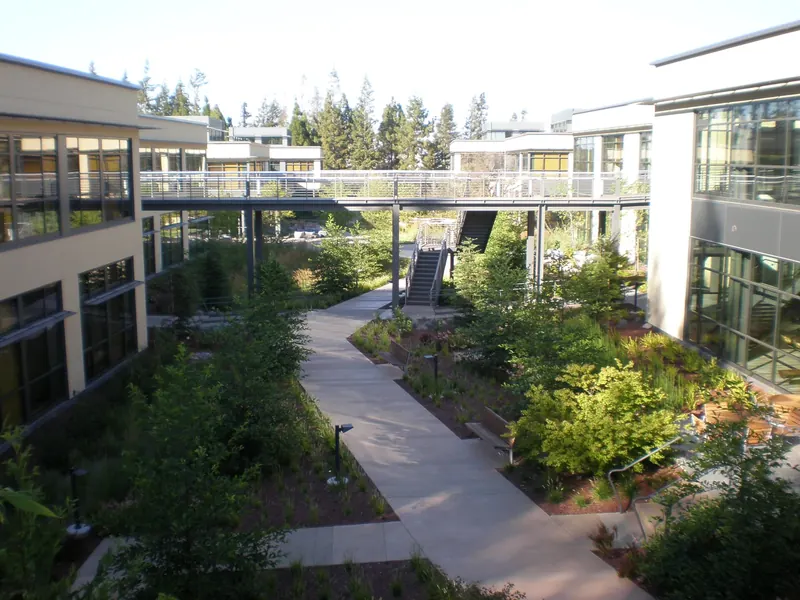
By the time Broadcom took over, the campus covered nearly 70 acres, about a tenth of the whole research park. Real estate reports describe it as roughly 1.6 million square feet of buildings, with full cafeterias, fitness centers and three parking garages. Landscaped courtyards sit between the buildings.

Broadcom moves in
Within days of closing the deal, Broadcom moved its corporate headquarters from 1320 Ridder Park Drive in North San Jose to the former VMware campus. Its fiscal 2025 annual report lists the address as 3421 Hillview Avenue. It also ended VMware's flexible work policy and cut jobs, as news outlets reported at the time.
Broadcom did not need the whole campus. In January 2024 it put 13 buildings on nearly 70 acres up for sale while planning to keep about 600,000 square feet of offices for itself. Two of the buildings for sale were leased to Toyota. The rest were to be delivered empty.
Harvest Properties and TPG Real Estate bought the 13 buildings in 2025. Reports describe their holding as about 1.1 million square feet at 3411 Hillview Avenue. The new owners began upgrading the buildings with new amenities, including an outdoor amphitheater.
What is on the campus today
The old VMware campus now has several occupants. Broadcom's headquarters sits on the campus, listed in its filings as 3421 Hillview Avenue. On the Harvest and TPG side, Rivian already leased space by 2026. In mid 2026 General Motors leased about 340,000 square feet at 3411 Hillview Avenue, with room for up to 1,500 workers, according to The Real Deal. GM plans to bring together hundreds of Bay Area employees there.
VMware itself lives on as a brand and business unit inside Broadcom. Its software is still sold under the VMware name. As a standalone company with its own Palo Alto headquarters, it is gone.
Good to know
- The campus is private. There is no visitor center, museum or public courtyard access.
- Hillview Avenue runs through the research park close to Foothill Expressway. A bike or car is the easiest way to pass by.
- Do not enter parking garages to look around. Security is active on all parts of the campus.
VMware timeline
| Date | Event |
|---|---|
| February 10, 1998 | VMware founded in Palo Alto. |
| May 1999 | VMware Workstation released. |
| January 9, 2004 | EMC completes its purchase. |
| August 14, 2007 | Public listing. |
| November 1, 2021 | Dell spinoff complete. |
| November 22, 2023 | Broadcom completes its purchase and moves its HQ to Hillview Avenue. |
| 2025 | Harvest Properties and TPG Real Estate buy 13 campus buildings. |
| 2026 | General Motors leases about 340,000 square feet. |
VMware's place in Palo Alto history
VMware followed the classic Stanford path: university research, a company formed a few miles away and a long lease in Stanford Research Park. That path started with Varian and Hewlett-Packard in the 1950s. Our Hewlett-Packard profile covers the first big example.
Its campus also shows how the park recycles space. Built for one software company, it now houses a chipmaker and several automakers. That turnover is normal here and is part of why the park keeps attracting new tenants. For the full list of companies with a Palo Alto chapter, see our companies guide and the Silicon Valley history.
Frequently asked questions
Where was VMware headquartered?
VMware was founded in Palo Alto in 1998 and was headquartered on a large campus at 3401 Hillview Avenue in Stanford Research Park. Broadcom moved its own headquarters to that address after buying VMware in November 2023.
Who founded VMware?
VMware was founded by Stanford computer science professor Mendel Rosenblum, his wife Diane Greene, his graduate students Edouard Bugnion and Scott Devine, plus a fifth co-founder usually named as Edward Wang. Greene served as chief executive.
When did Broadcom buy VMware?
Broadcom announced the deal on May 26, 2022. It completed it on November 22, 2023. The cash and stock transaction was valued at about $69 billion.
What happened to the VMware campus?
Broadcom kept about 600,000 square feet of office space for its headquarters and sold 13 other buildings to Harvest Properties and TPG Real Estate. The new owners have leased space to tenants including General Motors, which took about 340,000 square feet in 2026.
Does VMware still exist?
Yes, as a business unit and brand inside Broadcom. Its virtualization and cloud software is still sold under the VMware name, but it is no longer an independent public company.