On this page
Most companies in this series started in Palo Alto. Jive Software came here on purpose. It was founded in 2001 and spent its early years in Iowa, New York and Portland, Oregon. In 2010 it moved its headquarters to a downtown Palo Alto office on Lytton Avenue. The new chief executive was blunt about why. Silicon Valley was where the engineers were.
Jive went public from Palo Alto in 2011, grew to more than 600 employees and then shrank its local footprint in 2017 just before it was sold. Its story shows how downtown Palo Alto works as a base for growth companies, not only for garage startups. For the neighborhood, see our guide to downtown Palo Alto.
What Jive made
Jive sold collaboration software for businesses. Its main product let a company run an internal social network, with profiles, discussions, documents and blogs, plus online communities for customers. The idea was sometimes called social business software. Jive also created Openfire, an open source chat server.
By 2010 Jive said it had more than 15 million users across its customers. Named clients included Nike, Intel, Lufthansa and VMware, whose own headquarters was a few miles away in Stanford Research Park. Our VMware profile covers that company.
Iowa, New York and Portland
Matt Tucker and Bill Lynch founded Jive in 2001 in Iowa. The company relocated to New York later that year. In 2004 it moved its headquarters to Portland, Oregon, which became its main engineering center. At the end of 2009 Jive reported an 85 percent jump in revenue and raised $12 million in a Series B round from Sequoia Capital. Our Sequoia Capital profile covers the firm, based on Sand Hill Road.
The 2010 move to Palo Alto
Jive opened its first Palo Alto office in 2009 with four employees, in space on Emerson Street. By May 2010 that office had grown to about 50 people. On May 18, 2010, the company announced two changes:
- Tony Zingale, interim chief executive since February 2010, became permanent CEO. He had previously run Mercury Interactive, which Hewlett-Packard bought in 2006.
- Jive's headquarters would move from Portland to Palo Alto. It had signed a lease for 20,000 square feet at 325 Lytton Avenue and planned to move in later in 2010.
Zingale told reporters, "Our reason for being in the Valley is really clear: this is where the talent resides." He said Jive expected to compete with Facebook and Google for engineering talent. The company planned to quadruple its Palo Alto workforce to about 200 within 18 months. Facebook was then headquartered in Stanford Research Park. Our Facebook profile covers its Palo Alto years.
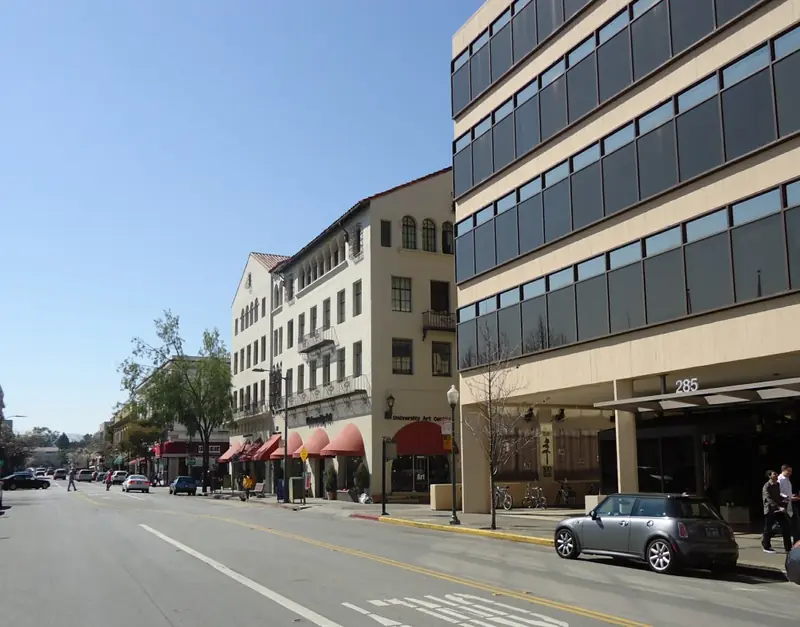

325 Lytton Avenue
Lytton Avenue runs parallel to University Avenue one block north, a short walk from the Caltrain station. Its office buildings sit close to downtown's cafes, restaurants and investment firms. Our page on University Avenue's tech history covers the many companies that have worked within a few blocks.
Jive's 2016 annual report lists its principal executive offices at 325 Lytton Avenue, Suite 200, Palo Alto, CA 94301. Portland stayed important. A 2013 report quoted Jive's chief financial officer, Bryan LeBlanc, saying it was easier to hire engineers in Portland than in the Bay Area. The company kept a large sales, marketing and product team there.
Going public
Jive filed for a $100 million IPO in 2011. On December 12, 2011, its shares began trading on Nasdaq. The offering raised $161.3 million, about $60 million more than planned.
Jive kept buying smaller companies. In November 2012 it bought Producteev, a task management app. It also bought Meetings.io, a chat and video tool. In May 2013 it added CLARA and StreamOnce. Its workforce reached 658 people by 2014.
Slower growth
On November 4, 2014, Zingale announced his retirement as CEO. Elisa Steele, already president, was named chief executive on February 10, 2015. By 2015 customer and revenue growth had slowed and the company's market value had fallen to about $400 million. The analyst firm Real Story Group suggested Jive might be a sign of a wider shift in the market for business collaboration software. In February 2017 Jive said the fourth quarter of 2016 was its first with operating profit under standard accounting rules.
At the end of 2016 Jive had 595 full-time employees. The 2016 annual report shows the company preparing to leave downtown. In October 2016 it amended its Palo Alto lease to allow an early exit in March 2017. It also leased about 12,500 square feet in Campbell, in the South Bay. It planned to move its architecture and security teams there in the first quarter of 2017.
Where Jive's people worked
The same report breaks down the 595 employees by function. Research and development was the largest group, followed by sales and marketing:
| Function | Employees, December 31, 2016 |
|---|---|
| Research and development | 173 |
| Sales and marketing | 156 |
| General and administrative | 93 |
| Support | 73 |
| Professional services | 56 |
| Hosting | 44 |
The report also shows how the work was spread out. Portland held architecture and security staff along with the network operations center and deployment teams. Another deployment team worked in the United Kingdom. Palo Alto held the corporate headquarters.
The Aurea sale
On May 1, 2017, Jive agreed to join Aurea, a group of software companies, for $462 million in cash. The deal closed on June 12, 2017. Jive left the stock market. Some investors saw the price as a good exit. Others called it a fire sale. Aurea took over Jive's products and customers.
Jive's downtown neighbors
Jive was one of many growth companies that used downtown Palo Alto as a headquarters in the 2000s and 2010s. Palantir grew up downtown from 2003 until its headquarters moved to Denver in 2020. Facebook had its downtown office at 471 Emerson Street from 2005 before moving to Stanford Research Park in 2009. The design firm IDEO long kept its headquarters at 100 Forest Avenue. Our Palantir profile covers the company that shared the downtown streets with Jive for the longest stretch.
Timeline
| Date | Event |
|---|---|
| 2001 | Jive founded in Iowa; moves to New York. |
| 2004 | Headquarters moves to Portland, Oregon. |
| 2009 | First Palo Alto office opens on Emerson Street. |
| May 18, 2010 | Headquarters move to 325 Lytton Avenue announced. |
| December 12, 2011 | IPO on Nasdaq. |
| February 10, 2015 | Elisa Steele named CEO. |
| March 2017 | Early exit from the Palo Alto lease; Campbell office opens. |
| June 12, 2017 | Aurea completes its purchase. |
Lytton Avenue today
We could not confirm who occupies 325 Lytton Avenue in 2026. Downtown office space turns over quickly. If you are looking for space of your own, our guide to coworking and office space covers the options. For more companies with a Palo Alto chapter, see our companies guide and the famous tech addresses tour.
Frequently asked questions
Where was Jive Software headquartered?
From 2010 until early 2017 Jive's headquarters was at 325 Lytton Avenue in downtown Palo Alto. Its 10-K for 2016 lists 325 Lytton Avenue, Suite 200. Before 2010 the company was headquartered in Portland, Oregon, where it kept a large office.
Why did Jive move to Palo Alto?
Chief executive Tony Zingale said in 2010 that the reason was talent. He expected Jive to compete with Facebook and Google for engineers. The move also put the company near the Silicon Valley investors and customers it needed before its planned IPO.
When did Jive go public?
Jive's IPO took place on December 12, 2011, on Nasdaq. It raised $161.3 million, about $60 million more than the company had first planned.
What happened to Jive Software?
In May 2017 Jive agreed to be bought by Aurea, a software group, for $462 million in cash. The deal closed on June 12, 2017, after which Jive's products became part of Aurea.
Did Jive leave Palo Alto?
Jive amended its Palo Alto lease in October 2016 so it could leave early in March 2017. It leased about 12,500 square feet in Campbell and moved architecture and security teams there in early 2017. We could not confirm whether any Jive office remained in Palo Alto after the Aurea deal.