On this page
Hewlett-Packard was always an engineering company first. Its founders came out of Stanford's electrical engineering program and its early products were tools for other engineers. By the mid 1960s, though, HP had grown into a set of product divisions that each worked on their own next model. Bill Hewlett and Dave Packard wanted a place where researchers could look further ahead. On March 3, 1966, they founded HP Laboratories, known almost everywhere as HP Labs.
HP Labs has been based in Palo Alto ever since. It gave HP some of its most important products, from the first scientific pocket calculator to thermal inkjet printing. It also shrank sharply after 2000 and split in two in 2015. This profile covers its Palo Alto home, its main achievements and what remains today. For the company itself, start with our Hewlett-Packard profile.
Why HP built a central lab
Before 1966 most HP research happened inside product divisions, close to the engineers who would turn it into instruments. That worked well for steady improvements. It worked less well for ideas that cut across divisions or that might take years to pay off. Wikipedia sums up the founders' goal as an organization "not bound by day-to-day business concerns."
Other American companies had famous central labs, such as Bell Labs at AT&T and IBM Research. Xerox would open its own Palo Alto Research Center a few minutes away in 1970. Our Xerox PARC profile tells that story. HP Labs differed in one way that mattered: it sat on the same campus as the people who would sell what it invented.
Barney Oliver
HP Labs' first director was Bernard M. Oliver, known as Barney. He had become HP's director of research in 1952 and its vice president for research and development in 1957, with a seat on the board. He ran HP Labs from its founding until 1981. Oliver was also known outside HP for his interest in the search for extraterrestrial intelligence.
The directors who followed him show how the lab's role changed over time:
| Years | Director |
|---|---|
| 1966 to 1981 | Barney Oliver |
| 1981 to 1984 | John Doyle |
| 1984 to 1986 and 1991 to 1999 | Joel Birnbaum |
| 1999 to 2007 | Dick Lampman (after a brief term by Ed Karrer) |
| 2007 to 2012 | Prith Banerjee |
| 2012 to 2016 | Martin Fink |
| 2016 to 2021 | Shane Wall |
The Page Mill Road home
HP moved its headquarters to 1501 Page Mill Road in Stanford Research Park in 1960. HP Labs made its Palo Alto home on the same campus. Its technical reports have long carried the address HP Laboratories, 1501 Page Mill Road, Palo Alto. HP Inc. is still headquartered at the same address.
The site sits on Stanford land leased through the research park. Our Stanford Research Park guide explains how those leases work. The campus is a short drive from Stanford's engineering school.
HP Labs added sites abroad over time. A lab in Bristol, England, opened in 1983 and is still one of its two main locations. Others in Haifa, Tokyo, Beijing, Bangalore, Singapore, St. Petersburg, Princeton and Cambridge, Massachusetts, later closed. Palo Alto stayed the headquarters throughout.
What came out of the lab
A 50th anniversary review published by IT Business and Wikipedia credit HP Labs with work on several landmark products. The dates below are product launch years.
- LEDs and LED displays, from 1966. The lab's semiconductor group, first led by Mohamed Atalla, worked on practical light emitting diodes. HP introduced its first commercial LED display in 1968 and an intelligent numeric display in February 1969.
- The HP 9100A, 1968. A programmable desktop calculator, one of the first of its kind.
- The HP-35, 1972. The first pocket scientific calculator, small enough to carry in a shirt pocket.
- Thermal inkjet, 1984. Developed in the lab in the 1970s, it reached market in the ThinkJet printer and became the basis of HP's huge printer business.
- RISC processors, 1986. HP made reduced instruction set chips central to its computers.
- EPIC, early 1990s. The lab's explicitly parallel instruction computing concept led to Intel's Itanium architecture.
Other research included power transistors in 1977, molecular logic gates with UCLA in 1999 and later work on the memristor led by R. Stanley Williams. Alan Kay, best known for his work at Xerox PARC on graphical interfaces, also spent time at HP Labs.
Good to know
- HP's instrument business, which HP Labs once served, became Agilent Technologies in 1999.
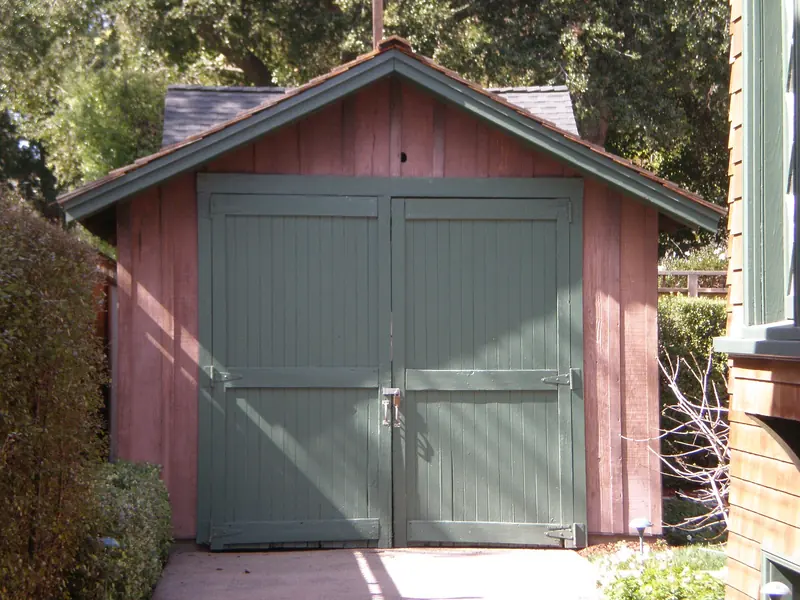
- The garage where HP began is at 367 Addison Avenue. It is the only HP site with a visitor-friendly view, from the sidewalk. See our HP Garage guide.

Shrinking and refocusing
The lab's size and reach fell after 2000. In August 2007 HP executives cut its research portfolio from about 150 projects to about 30. By 2018 Wikipedia counted just over 200 researchers at HP Labs, compared with about 500 at earlier peaks.
The biggest change came with the company split. On November 1, 2015, Hewlett-Packard divided in two. HP Inc. kept PCs and printers. Hewlett Packard Enterprise took servers, storage and services. The lab divided too. HP Labs stayed with HP Inc. at 1501 Page Mill Road. A new Hewlett Packard Labs went with HPE, with Martin Fink as its director. Our Hewlett Packard Enterprise profile covers HPE's later move to Texas. Wikipedia now describes HPE's lab, renamed HPE Labs, as located in Houston.
HP Labs today
Today's HP Labs works on the products HP Inc. sells: laptops, desktops, printers, ink and 3D printing. Recent research areas listed by Wikipedia include:
- 3D printing, including HP's Multi Jet Fusion and metal printing work
- Microfluidics for packaging, life sciences and sensing
- Device and printer security, much of it from the Bristol lab
- Digital printing presses for HP Indigo
It is a much smaller group than in its heyday, but it still carries the name and address Hewlett and Packard gave it in 1966.
A lab among labs
HP Labs was never the only corporate research center in the neighborhood. Lockheed opened its Palo Alto research lab beside Stanford in 1956, a decade before HP Labs. Xerox PARC arrived on Coyote Hill Road in 1970, a short drive up the hill. SRI International, founded by Stanford in 1946, works out of Menlo Park. Researchers moved between these labs, Stanford and nearby startups throughout the following decades. That mix of corporate and university research is a large part of why the research park became what it is. Our Lockheed Martin Advanced Technology Center profile covers the oldest of the group.
Seeing the site
There are no tours, exhibits or public spaces at HP Labs. The Page Mill Road campus is easy to see from the road on a bike or car loop through the research park. Pair it with the former Agilent headquarters at 395 Page Mill Road and the HP Garage downtown. Our famous tech addresses tour strings them together. For more company histories, see the companies guide.
Frequently asked questions
Where is HP Labs?
HP Labs is headquartered in Palo Alto. Its technical reports have long given the address as 1501 Page Mill Road in Stanford Research Park, which is also HP Inc.'s headquarters. HP Labs also has a major site in Bristol, England.
When was HP Labs founded?
Bill Hewlett and Dave Packard established HP Labs on March 3, 1966. They wanted a central research group that was not tied to the day-to-day demands of HP's product divisions. Barney Oliver, HP's longtime research chief, became its first director.
What did HP Labs invent?
HP credits its labs with the 9100A programmable desktop calculator of 1968, the HP-35 pocket scientific calculator of 1972 and the thermal inkjet technology behind the 1984 ThinkJet printer. Labs researchers also built early LED displays and worked on RISC and EPIC processor designs.
What is the difference between HP Labs and Hewlett Packard Labs?
When Hewlett-Packard split on November 1, 2015, the research group split too. HP Labs stayed with HP Inc. in Palo Alto. Hewlett Packard Labs went with Hewlett Packard Enterprise and is now called HPE Labs, based in Houston according to Wikipedia.
Can you visit HP Labs?
No. HP Labs is inside HP Inc.'s private corporate campus and has no public tours or exhibits. You can see the Page Mill Road buildings from the street. The HP Garage at 367 Addison Avenue is the HP site built for visitors, viewed from the sidewalk.