On this page
Wunderlich Park starts at a stable. Turn off Woodside Road west of the village and the first thing you see is a long, handsome estate barn with a horse ring beside it. Past the barn, trails climb through bay and oak, then into redwood canyons and up to a meadow with a view across the bay. Keep going and you reach Skyline Boulevard, about 2,000 feet up.
San Mateo County runs the park. It is wilder and less developed than Huddart Park a few miles north, with fewer facilities and no group picnic areas. That makes it a good choice for a quieter walk. Our Woodside and Atherton guide introduces the area. This page covers the trails, the restored Folger Stable and the park's history.
The basics
- Address: 4040 Woodside Road, Woodside. The park office is listed at (650) 851-1210.
- Size: 942 acres of mixed forest and meadow, according to the county.
- Hours: Open every day, including holidays, from 8 a.m. The county lists closing at 6 p.m. from October 12 to November 1, 2026 and at 5 p.m. from November 2, 2026 through February 2027. Check the county's hours page for spring and summer.
- Fees: Wunderlich is not on the county's list of parks that charge a vehicle entry fee.
- Facilities: Water and restrooms at the parking area. Picnic tables for drop-in use. No reservable day-use sites.
How the park is laid out
The county describes four zones stacked up the slope:
- The stable area at the bottom, with boarding stables, riding facilities and a horse ring that were once the Folger ranch complex.
- An open meadow about halfway up, known as The Meadows. It is the park's only real grassland.
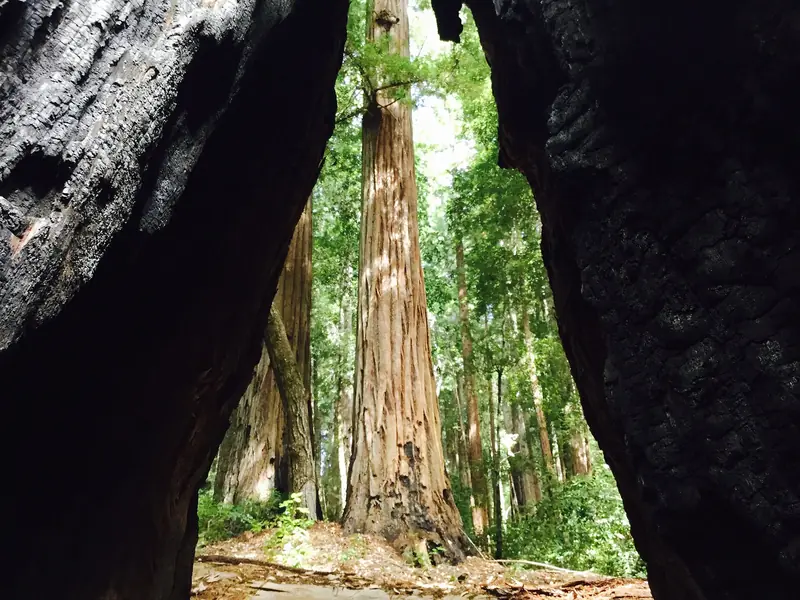
- Canyons with a running stream, springs and dense second-growth redwood groves.
- An upper meadow at roughly 2,000 feet, with views in every direction.
Trails link all four. Benches at five "destination points" give you natural places to rest and turn around: Alambique Flat, The Crossroads, Redwood Flat, The Meadows and a vista point on the Meadow Trail.
Trails
The county's trail page describes each trail. In summary:
| Trail | Type | Highlights |
|---|---|---|
| Alambique Trail | Unpaved service road | The only trail that reaches Skyline and back on its own. Passes Alambique Flat, The Crossroads and the park's largest known redwood. |
| Bear Gulch Trail | Single track | Starts near the stables. Passes Redwood Flat and The Meadows. Many junctions for building loops. |
| Loop Trail | Lower service road | A 12-foot-wide dirt road that ends where it meets the Alambique Trail. |
| Madrone Trail | Single track | Forms a 2.6-mile loop in the lower park with the Bear Gulch or Meadow trails. |
| Redwood Trail | Single track | Through redwood forest. Adds 0.6 miles to the Madrone loop for 3.2 miles. |
| Meadow Trail | Single track | Crosses The Meadows, with benches and a vista point over the south half of the bay. |
| Oak Trail | Single track | The shortest trail, through oak woodland. You need about 1.5 miles of other trails to reach it. |
| Skyline Trail | Single track | Part of the Bay Area Ridge Trail. Tops out at Skyline Boulevard opposite Midpen's El Corte de Madera Creek preserve. |
Suggested walks
- Short and shady: The Madrone loop of 2.6 miles, adding the Redwood Trail for 3.2 miles if you want more big trees.
- The view: Climb Bear Gulch Trail to The Meadows and return by the Meadow and Alambique trails. On a clear day the meadow looks out over the southern bay.
- The big day: Take the Alambique Trail all the way to Skyline and back. Look for the park's largest known redwood on the way to Alambique Flat. Its gnarled limbs and blown-out top made it poor lumber, which is why it was never cut.
Horses use most trails. Step aside on the downhill side and say hello as riders pass. Our hiking guide compares Wunderlich with other hikes near Palo Alto.
The Folger Stable and Carriage Room museum
The Folger Stable is the heart of the lower park. According to the San Mateo County Historical Association, architect Arthur Brown Jr. designed buildings for James Folger II's estate. Brown later designed San Francisco City Hall. The county describes the estate as the family's warm country getaway from San Francisco's cold summers. The stable housed its horses and carriages.
The county restored the stable and the buildings around it. They reopened to the public in 2010. Today the old carriage room inside the main stable is a small museum on local history, including the logging, farming and great estate eras. The county lists it as open on Saturdays and Sundays from noon to 3 p.m. Private group tours can be arranged through the Friends of Huddart and Wunderlich Parks by calling (650) 851-2660. The historical association runs hands-on school programs there for third and fourth graders, from saddling a model horse to pressing apple cider.
The stable still boards horses. The county has contracted Excel Equestrian as the stable operator, with 24-hour care for boarded horses. The county's published boarding fees in October 2026 were $1,000 to $1,100 per horse per month, depending on the barn. For another historic stable closer to Palo Alto, see our guide to Stanford's Red Barn.

History
The county's history page tells a long story in a few lines.
- Before 1769: Ohlone people, called Costanoans by the Spanish, lived in the area.
- November 6, 1769: The Portolá expedition camped in the Woodside valley.
- August 4, 1840: Governor Alvarado granted Rancho Cañada de Raymundo, which included the park, to John Coppinger.
- 1846: Charles Brown received a deed to 2,880 acres of timbered slopes from Coppinger.
- 1872: Simon Jones bought 1,500 acres and named it Hazel Wood Farm. Chinese workers cleared brush and built rock retaining walls. Jones planted grapes and fruit trees and ran it as a working ranch.
- October 12, 1902: Jones's son Everett sold the property to James A. Folger II of the Folger coffee company.
- 1904: Folger built a hydroelectric system powered by Alambique Creek, which the county calls the first in this part of California.
- November 1956: Contractor Martin Wunderlich bought the property from the Folgers.
- 1974: Wunderlich deeded 942 acres to San Mateo County for parkland and open space.
Under the Folgers the land changed from lumber and farming to leisure. Old skid roads became riding and carriage trails. Weekend campouts along Alambique Creek were common. Some of the Jones-era buildings and plantings survive. The park marked its 50th anniversary in spring 2024 with farrier demonstrations, pony rides, bluegrass and docent-led tours of the Carriage Room.
Forest and wildlife
Redwoods with sword fern and redwood sorrel fill the gullies. Most of the park is mixed evergreen forest of tanbark oak, madrone, California bay, coast live oak and Douglas fir. Hot, dry slopes carry chaparral. Valley oaks and black oaks grow near the bottom. Deer are common. Bobcats, coyotes and gray foxes are seen less often.
The county finished forest health work on more than 180 acres in April 2022, thinning small trees along boundaries, fire roads and residential roads. In an earlier project, crews removed eucalyptus and acacia from 16 acres and planted 1,800 oak acorns and buckeye seeds. Volunteers return each year to pull invasive French broom. The county lists a broom pull on Saturday, November 28, 2026, the Saturday after Thanksgiving.
Rules
- No dogs or other pets.
- Bicycles and motor vehicles only on paved roads and in parking areas.
- Stay on designated trails. Do not pick plants or mushrooms.
- Fires only in barbecue pits. Beer and wine only, no hard liquor.
- No smoking, drones or feeding wildlife.
Getting there from Palo Alto
Take Interstate 280 north to the Woodside Road exit, drive west through Woodside village and continue on Woodside Road toward Skyline until you reach the park entrance. Allow about 25 minutes. There is no transit to the park. If you are visiting without a car, you can compare rental cars for the day. Combine a morning hike with lunch in Woodside village or an afternoon at Filoli. For more big trees, see our redwood forests guide.
Good to know
- The Carriage Room museum is open weekend afternoons only.
- Winter closing time is 5 p.m. The Skyline round trip takes most of a day, so start early.
- Expect horses on the trails and near the stable. Keep children close around the barns.
- Bring water. The county lists water only at the parking area.
Frequently asked questions
Is there an entry fee at Wunderlich Park?
San Mateo County does not list Wunderlich among the seven county parks that charge a vehicle entry fee. Parking is in the lot near the stable. Check the county's park page for changes before you go.
Are dogs allowed at Wunderlich Park?
No. The county's rules for Wunderlich say dogs and other pets are not allowed. Bicycles are allowed only on paved roads and in parking areas. Horses are welcome on many trails.
When is the Folger Stable Carriage Room museum open?
The county lists the Carriage Room museum as open to the public on Saturdays and Sundays from noon to 3 p.m. Private group tours can be arranged through the Friends of Huddart and Wunderlich Parks. School programs are run by the San Mateo County Historical Association.
What is the best loop at Wunderlich Park?
For a moderate walk, the county describes a 2.6-mile loop in the lower park using the Madrone Trail, or 3.2 miles if you add the Redwood Trail. The Alambique Trail is the only single trail that climbs all the way to Skyline Boulevard and back.
Who was Wunderlich Park named for?
Martin Wunderlich, a contractor who bought the former Folger estate in 1956. In 1974 he deeded 942 acres to San Mateo County for public recreation and open space. The Folger family of coffee fame had owned it since 1902.